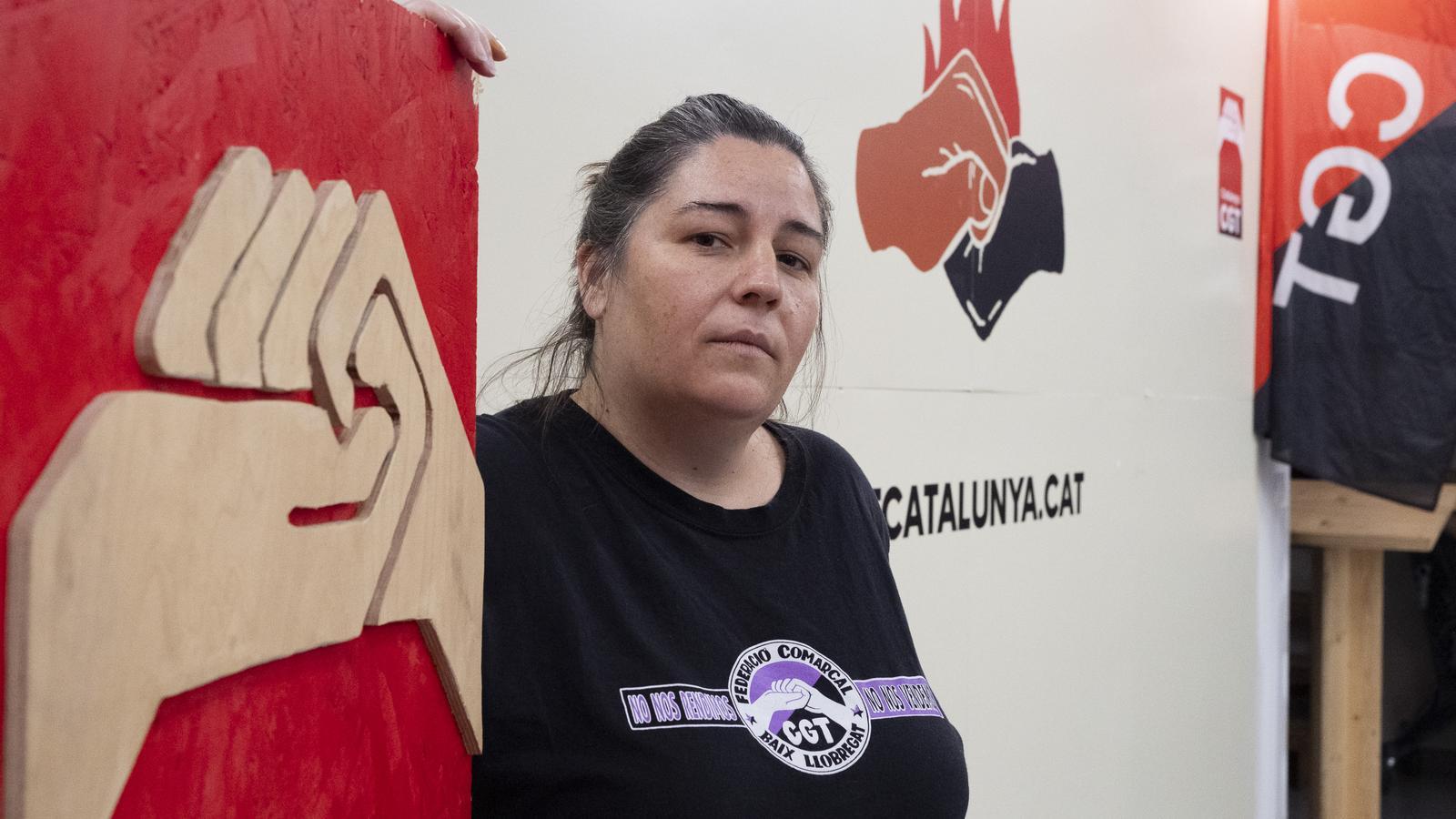
Montse Sánchez: "This strike is not an electoral campaign for the PSOE"
General secretary of the CGT in Catalonia

-
CAT -
CAST
BarcelonaMontse Sánchez (l'Hospitalet de Llobregat, 1981) combines her leadership of the General Confederation of Labor (CGT, the third largest union in terms of membership in Catalonia) with her job at Seat, from which she is not released from work duties. The union is one of the main promoters of the general strike called for next November 11 throughout the State, and it participates in initiatives such as the Strike House (Casa de la Vaga), located at the central faculty of the University of Barcelona. Currently, the CGT is in a moment of great expansion. According to them, the increase in members is mainly due to their commitment to conflict.
How are we reaching the strike on November 11?
— A year ago we announced a cycle of mobilizations and the current situation is precisely the result of this breeding ground. People are showing their discontent and are willing to take to the streets precisely to make demands for housing and labor rights. The expectations are good.
Is housing, however, a strictly labor-related factor?
— Yes, it is linked. Our commitment is to equate salary increases with the rise in inflation. This measure is essential to maintain the standard of living. Furthermore, we advocate that, in collective bargaining negotiations, salary supplements are agreed upon to help cope with the extreme situation regarding housing. To say that one thing is not linked to the other is confusing: the working class is the one that accesses housing from a more vulnerable position.
Were the so-called Maricarmen decrees ambitious enough to turn this situation around?
— Not only were they not enough, but they were also not specific enough. The decrees should have been worked on with much greater depth. For example, they continued to leave aside those who are already on the margins.

The general strike takes place on the eve of an electoral campaign.
— What we want to make clear is that this strike is not an electoral campaign for the PSOE or for any other political party. In fact, it is against the entire political class, since we understand that during all this time it has not been able to offer any social or labor solution in terms of housing. The strike is strictly for the working class, whether they are currently in a paid situation or not.
However, even though the strike is not seeking to campaign for anyone, housing is centering the electoral speeches. And it is the opposition that has criticized the call.
— In general terms, political parties always try to capitalize on and include all social movements in their agendas. We also experienced this same situation during the March 8th strikes, where more and more political parties were including demands typical of self-managed assemblies in their agendas. Will there be parties that want to capitalize on it? Obviously, it is very likely they will try. However, we trade union organizations must make it very clear that this strike cannot be a tool for the political class.
Can the fact that it is an offensive strike –which seeks to win rights– instead of a defensive one –which seeks to protect rights– affect its turnout?
— Our reading is that until now we were in a moment of social peace at the expense of the constant loss of rights of the working class. But we are still in time to end this feeling of defeat. We work so that workers are clear that one should not negotiate downwards, but upwards. The strike gives us the opportunity for the working class to regain strength.
It speaks of a constant loss of rights for the working class, but in recent years measures such as a large increase in the minimum wage and the limitation of temporary contracts have been carried out.
— But the reality is that it is proving very difficult for companies to actually allocate resources to improving the well-being of the working class. There are collective bargaining agreements that are negotiating salary increases below the CPI. Furthermore, the gag law still remains in force and layoffs are becoming cheaper and cheaper. If the question is whether the measures that have been promoted are satisfactory, the answer is similar to that of the Maricarmen decrees: they still leave much to be desired.
How is the strike organization going? It is a stoppage called by organizations with very diverse traditions.
— We have always had a lot in common with the Tenants' Union. In fact, we have even shared training spaces, and many people have dual membership. We feel quite comfortable working with any social movement that shares the ideology of the CGT. Regarding the relationship with the rest of the unions, I would not say that the relationships are complicated, since we want to achieve a very powerful general strike and we have to join forces, but it is true that we do not quite have the same rapport. We are glad to see that there is now talk of increasing conflict, but we have been heading in this direction for a long time. Thus, they are not complicated, but the truth is that they do not quite gel as they have in other stages.
You were saying that you have been committed to increasing conflict for some time. What are you asking for to reduce it?
— The conflict will continue. When a cycle of conflict begins, it is not only necessary to seek to achieve what is requested, but also to follow up on those requests. There are still many goals to be achieved, and our idea is to maintain the conflict at the highest level.
