Bar Agustín, the warmth of a home that has ended up being a refuge and resistance
Located on a corner, it makes food as always and serves a loyal community that goes there for breakfast or lunch
-
CAT -
CAST
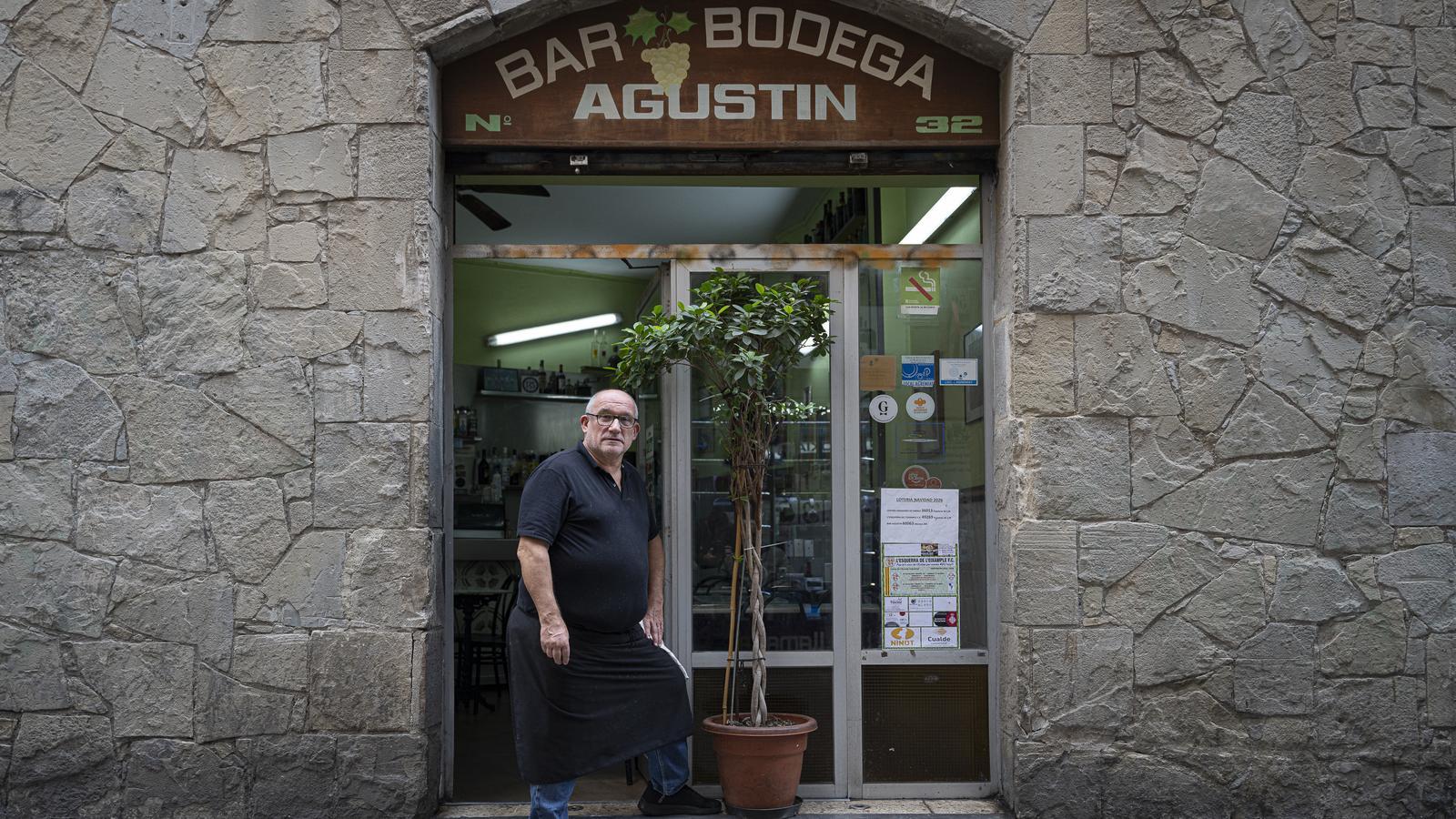
Today we are stopping at a corner of Carrer de Ferlandina and Carrer de Sant Vicenç in Barcelona. A corner of the world that reminds us of the city as it used to be. And that it will always be as long as places like Bar Agustín continue to pull up the shutters every day. It is a space for breakfast or lunch, to converse with the person next to you, to build neighborhood, to find out what happened to the woman who runs the tobacco shop, to discuss the news, to argue about soccer, to drink from a porró, and to mingle with people outside your own circle. It is opened every day by Carles Tarrasón Monte, the son of Agustí, who has worked there forever. What time does he open? "It depends on the line at the bakery to buy bread," he tells me. Things here are not rigid, but at approximately 7:30, Carles starts serving his community with a very subtle sense of humor and a kindness that can be seen from miles away. Carles has the ability to make everyone feel like a lifelong friend, even if you just arrived at his bar five minutes ago. He knows his regulars and knows what everyone likes. The bar is not very large, and its marble tables fill up very quickly at lunchtime for the homemade daily menu, which costs between 15 and 16 euros depending on the dessert and coffee.

When you arrive, he recites what's available to you. Gazpacho, empedrat, pork knuckle, meatballs, cod with samfaina, liver... If you take too long, he will decide for you. He serves wine in abundance with the porró, and if you have the yogurt with honey, he will explain to you that the honey is from his cousin, a beekeeper in the village of Los Calpes, a hamlet of La Pobla d’Arenós, in Castellón. We are surrounded by all sorts of objects that remind us that they are Espanyol fans here. “Look, I am a 'perico' (Espanyol fan), and my best friend's name is Piqué,” says Carles laughing. Above the bar, a long row of pacifiers testifies to the passage of time. One of them belongs to Carles' son, who is now 28 years old. The tradition was established that when a pacifier was given up, it could be deposited at Bar Agustín. So there is one from a whole bunch of people who entrusted them to Carles. “We always say we’ll meet at the bar!” a customer explains to me.
"You shouldn't call it 'Raval'"
Carles has only ever had one boss in his life: his father. He is 59 now, and has been working at the bar since he was 16. His father, Agustí, is now retired, but he is the one who makes the tripe. As we are discussing this, Agustí walks through the door. Born in 1938, he comes to have breakfast every morning at his favorite table at the bar, at 9:30 a.m. A ham sandwich and a pitelo, which he explains to me is what he calls a drink made of half cava, which comes from a split-sized bottle, and half red wine. A mixture that, according to Agustí, can't hurt you because it is “wine with wine,” and the most important thing is “not to drink it cold.” Cava at room temperature—I had never been told that before. I suppose the name comes from the Pitel·lo cava, which has been sold in small bottles. As soon as he has crossed the threshold, Agustí is already clearing things off the table. And moving with agility. His 88 years don't weigh him down. It must be the pitelo. Agustí's father was a port stevedore. And the place where we are right now is where he worked as an errand boy. It was the Bodega Carlos, where he delivered ice and spirits. And in 1963 he took it over. He was the one who established this approachable way of doing things with a lot of warmth. A legacy that his son has followed. Both of them regret, however, that the neighborhood has changed a lot, and that for a long time they were one among many, and that unfortunately there aren't many left in the neighborhood now. I share with them that the ARA newsroom is nearby, that we are also in the Raval. “You shouldn't call it Raval, you should call it Barri Xino,” Agustí tells me. He says that is what it is up to Hospital street. Where we are now would be more the “districte quinto.” “Raval is a modern invention,” adds his son. Agustí remembers the post-war period, when tobacco butts were sold and he would buy the “broccoli stalk to eat, we would peel it and eat the inside.”
“Not everyone is cut out to work with family,” explains Carles. For him, it hasn’t been a problem, and the family atmosphere has extended to the rest of the customers. He sees them enter through one of the two doors and you already see him opening a medium beer or serving a shot of herbal liqueur. Meanwhile, he doesn't lose the thread of the conversation. A true fish in water. He shows me a book by a professor from the Massana School, Enric Farrés, who presented it there. Bar Agustín has been the dining room of many people’s homes, and for the last few years, it has been a refuge. A safe space for everyone, with popular prices, the food that used to be the usual, and a family ready to welcome you with the warmth of a home.
