"Very quiet" night at the great French fire: 84,000 evacuated return home
The firefighters show themselves "optimistic" for more favorable weather conditions

-
CAT -
CAST
BarcelonaThe night has given firefighters in southwestern France a brief respite, who view the evolution of the most serious fire ever recorded in the country with "optimism". After a "very quiet night", meteorological conditions with 80% humidity suggest a "much more acceptable situation", assured Commander Matthieu Jomain, communications officer for the Departmental Fire Service. The prefecture of Gironde announced this morning that it has authorized the immediate return of residents to nine municipalities in the department, allowing 84,000 evacuated people —out of a total of 220,000— to return home.
However, authorities reiterate the need for caution. "42,000 hectares are not stopped just like that," insisted the commander, who explained that the extinction of residual hotspots will continue to extinguish the fire "as soon as possible". The perimeter of the fire remains 15 kilometers from Bordeaux, but its intensity is lower. Authorities have also given the green light for traffic to resume on the A-63 motorway, which had been closed until now.
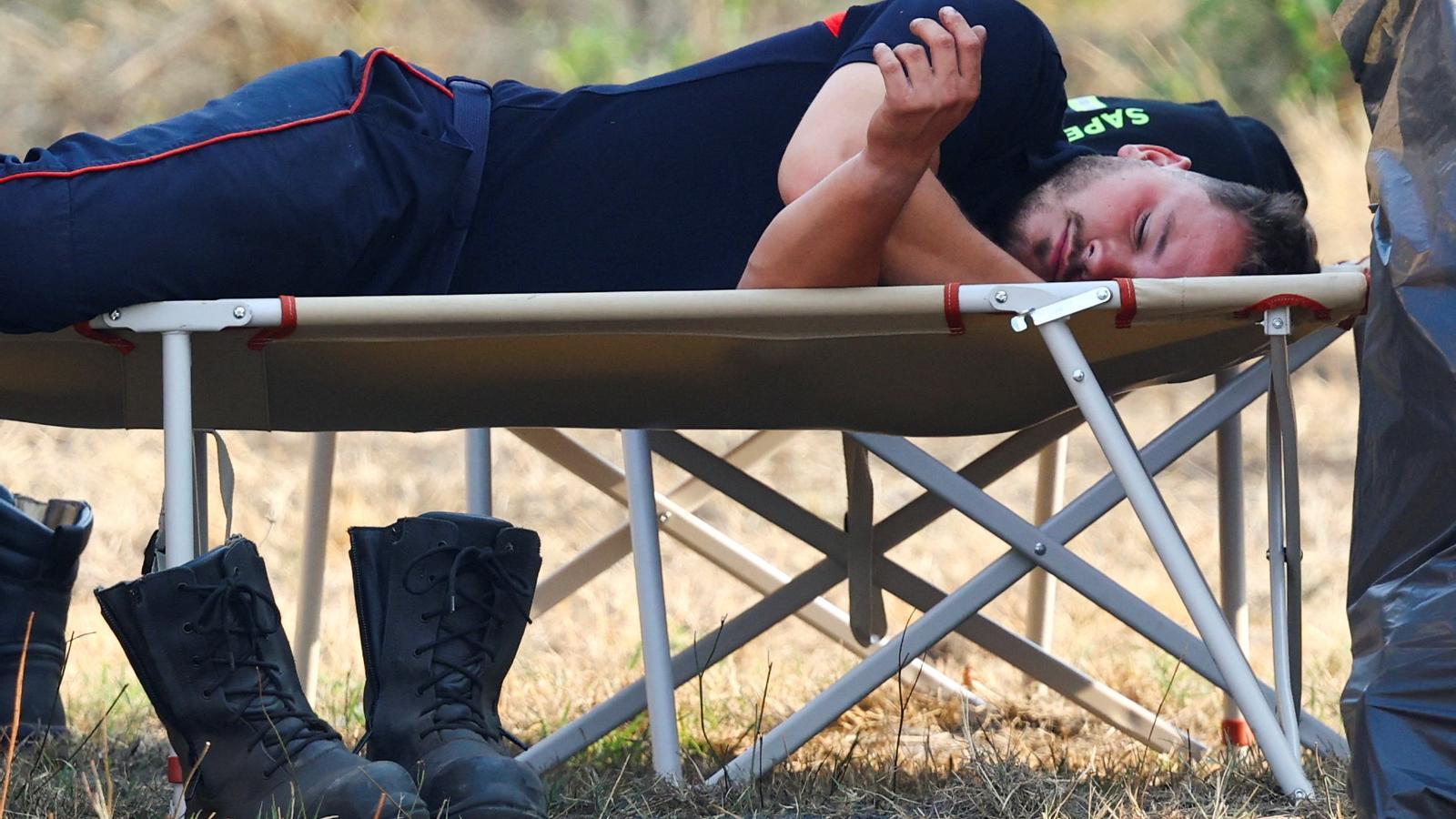
For nine days, emergency services have been fighting against time to extinguish the flames with a massive deployment: nearly 2,750 firefighters, 1,500 soldiers, 1,440 personnel from other security forces, and 18 aerial resources – including a military A400M aircraft adapted to drop retardant liquid – are working to combat the fire. And, on the ninth consecutive day, fatigue is beginning to show. "There are flare-ups that require a massive deployment of troops and aerial resources. Fatigue is present, as we have been fighting for eight days," Jomain said yesterday in statements to BFMTV.
The Gironde fire has highlighted the shortcomings of the French emergency service. Last Wednesday, the day the megafire in Gironde began, firefighters had already reported a lack of equipment and personnel due to the deaths of two firefighters in the region the day before, July 21st. Before the fire broke out near Bordeaux, the various services were already having to deal with an average of more than thirty fires daily. "The personnel involved work in continuous shifts, sometimes for very long periods," denounces the firefighters' union in a statement. At the same time, "the need for relief, support, and reinforcements continues to increase."

Faced with a deployment of this magnitude, the volunteer firefighters' union has called for mobilization of former firefighters, medical personnel, people with logistics or transport skills. Their proposal is to draw up a national census to deal with the "multiplication of fires of particularly worrying scale and intensity".
In parallel, sixteen departments of the country are on orange alert for extreme temperatures this Wednesday and it is expected that by Thursday there will be twenty-three. In some, the fire continues to burn. In the Landes region, bordering the Gironde, the fire is under control after having burned 3,600 hectares. The same is true in the Var department, on the east coast, where the fire that has devastated nearly 4,800 hectares was officially declared under control on Tuesday evening. In contrast, the flames continue to advance in Haute-Corse and the Hautes-Alpes. The first fire has burned 1,083 hectares, according to the latest assessment, published on Tuesday evening; and that in the Hautes-Alpes region has burned 510 hectares.
Another consequence of the fires is that air quality, especially in the Gironde region, has been compromised. The French Minister of Health, Stéphanie Rist, has warned that smoke can cause respiratory problems and has urged the vulnerable population or those with heart or lung diseases to stay home or go out with a mask. The ministry, she assures, has made more than 5 million FFP2 masks available to pharmacies so that users who need them only have to collect them. During the same press conference, the minister reported that 42 medico-social establishments have been evacuated so far, and a total of 4,272 people have been displaced, mainly the elderly or people with disabilities.

A questioned model
Why do fires burn with such intensity? Seeing images of forests engulfed by fire, the orderly arrangement of burnt trees, which are at an identical distance from each other, is striking. This is explained because the forest areas currently burning in Gironde and Landes are mainly formed by artificial forests. Most are planted in what are called "regular monospecific stands." As explained by Husbert Pérez, an ecologist at the French environmental consultancy Envolis, these are "areas with a homogeneous mosaic of vegetation"; that is, forests composed of a single species and with trees of the same age. This system, which is very economically efficient for timber exploitation, has a problem: when a fire starts, the fuel supply is almost continuous. The lack of diversity means there are no other, more humid trees to act as firebreaks, and the fire advances more quickly without encountering obstacles.
To this is added that the burnt forest areas are mainly maritime pine forests intended for timber production. This species is extremely flammable due to the high concentration of resin and the behavior of its pinecones, which, as Pérez warns, "retain embers inside and explode, favoring propagation." Furthermore, the pine needles that accumulate at the base create a vegetal layer that causes the fire to spread rapidly. While repeated heatwaves, droughts, and strong winds continue to be the main triggers for fires, a study published in the journal Nature in 2025 asserts that plantations in temperate climatic regions (like the Mediterranean) are twice as likely to burn as natural forests.
