Catalonia blockade: who will pay for the riots?
The arrest of two underage girls raises to five the number of those arrested for the riots in Barcelona and the justice system sends a third young man to provisional prison
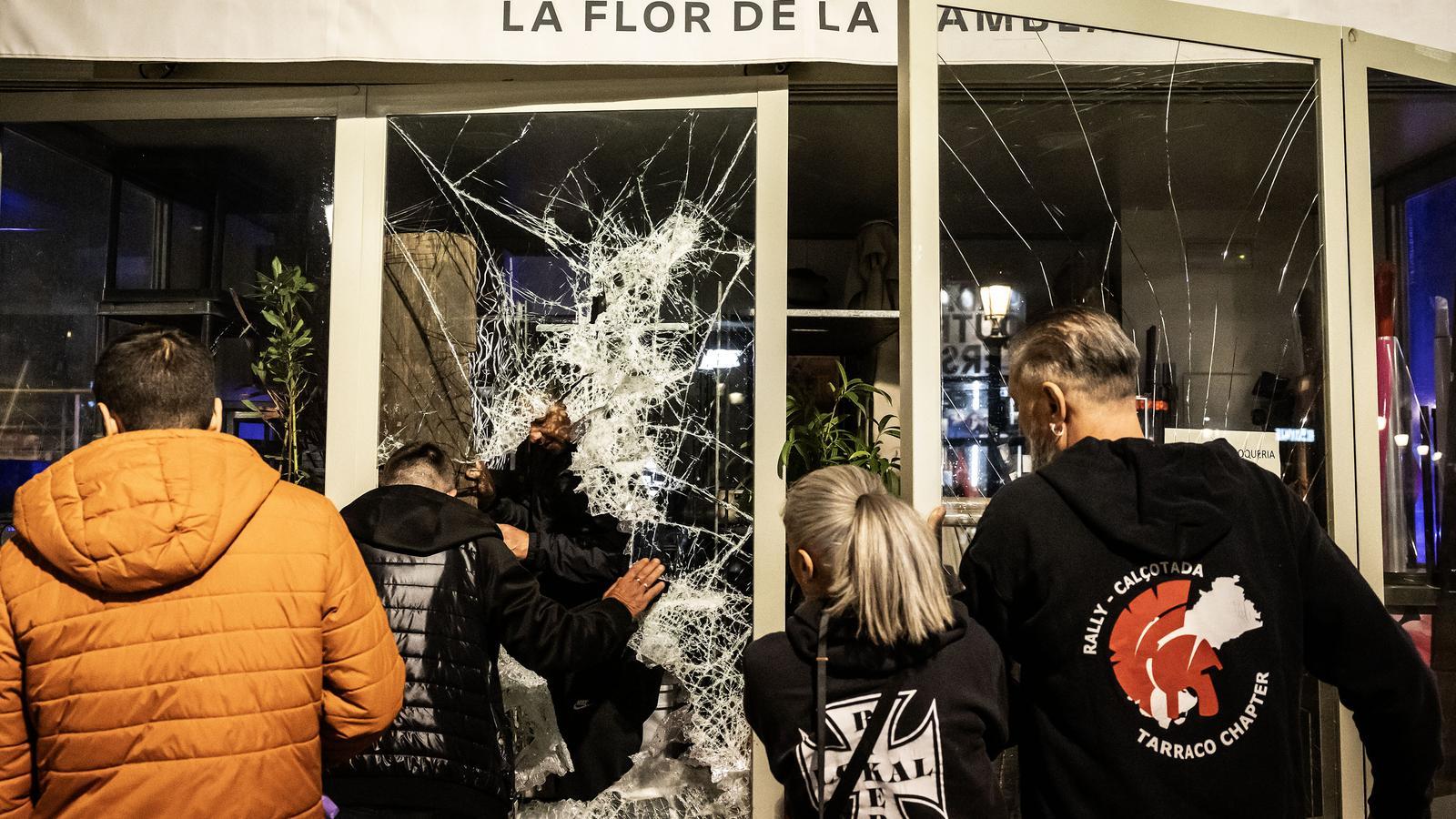

-
CAT -
CAST
BarcelonaThe police siege against the Blocus agitators continues. The Mossos d'Esquadra and the National Police have arrested two underage girls, aged 14 and 17, for promoting the looting on October 24 in Barcelona. They were arrested in the Maresme and Bages regions, and investigators believe they managed different groups created to facilitate coordination among participants in the riots. One of these WhatsApp groups was accessed via a QR code that was spread on TikTok.
In total, five alleged agitators have already been arrested in Catalonia, in addition to the arrestee from Valencia who proclaimed himself the leader of Blocus and incited the looting in Barcelona. In fact, this Monday it was also learned that the detainee in Cabrera d'Anoia, a 21-year-old man, has been sent to provisional prison with an open case for the crimes of public disorder and criminal organization. Right now, three accused are in prison, one minor is interned, and another minor is at liberty.
The Government has already announced that it will appear in court proceedings for the riots. Regarding the role of these young people and the possible criminal consequences they face, Eloi Font Manté, a lawyer specializing in digital law and partner at Grant Thornton, explains that creating a channel or a group is not in itself a crime: "For there to be criminal responsibility, it must be proven that they directly incited the commission of crimes and that they did so consciously." In the case of minors, sentences have more of an educational purpose.
However, Font adds that these administrators are not automatically responsible for what other members write, since criminal responsibility "is personal." However, it can end up having consequences if these messages are adopted. For example, by pinning them, forwarding them, or spreading them. On the other hand, can these online agitators also have civil liability? And the answer, according to Font, is yes: "Whoever is criminally responsible is also civilly responsible if there are damages."
The role of the platforms
This Monday, the president of the Generalitat, Salvador Illa, also focused on the platforms. Specifically, in statements to SER, he explained that he has given instructions to the legal services to study "all possible actions" to hold the platforms and their executives accountable for the Blocus groups.
Font points out that platforms may have responsibilities under the Digital Services Act, a European Union regulation. This regulation does not oblige them to monitor all content that is published, although if they have knowledge of illicit content – because someone has notified them, for example – and they do not act quickly, they can indeed be subject to sanctions. In parallel, regarding possible action against the executives, Font points out that the scope is "limited", as it would be necessary to prove that they knew about the facts or participated in them.
In fact, Telegram closed the channels shortly after receiving the notice from CITCO – which depends on the Ministry of the Interior –, an innovative path that the Mossos d'Esquadra explored and which until now had only been used with anti-terrorism content. Police sources remark that collaboration with platforms is often a complicated task, but that in the case of Blocus it has worked surprisingly well. They hope it will be a precedent to continue working in the same way.
Only two minors without precautionary measures
While investigations against the agitators proceed, the judicial case against the youths who carried out these looting incidents continues to cause repercussions. They have been particularly intense days in the juvenile section of the Barcelona High Court, with 79 minors having been brought before the judge in a staggered manner so as not to overwhelm the judicial system, which sources with knowledge of the matter point out has been at its limit. It was not until this Monday that the complete map of how they ended up was known: of the 79 minors, five have been interned and 72 are on supervised release. Of the latter, 32 youths are prohibited from attending demonstrations. Thus, there are only two minors detained without precautionary measures.
Apart from the respective penalties associated with public disorder, the minors could also assume civil liability for the damages caused. Cristina Llinás, a lawyer at Coca Advocats, an expert in criminal law and civil liability, explains that the exact amount will not be known until there is a sentence and a specific minor has been linked to a specific looting or act of vandalism. In all scenarios, Llinás notes that the parents will have to "respond civilly"; that is to say, they will have to pay for the economic damages their children have caused. This civil liability is joint and several between the minor and the parents. Furthermore, it is not a criminal sanction that can be replaced by community service. And if this amount is not paid, it can lead to the seizure of assets or accounts of those civilly responsible.
In the case of economic damages that a business may have suffered, the Insurance Compensation Consortium could potentially indemnify the shops, as the regulations include public disorder among extraordinary risks. However, the Consortium will assess whether this case applies. The affected parties must have a policy that meets specific requirements. Finally, even if the Consortium pays, it can always ask those judicially convicted to pay their part.
Defense of the deployment
All these judicial movements arrived two days after that a major police and commercial shielding prevented new disturbances in the center of Barcelona. The executive deputy chief of the Mossos, Ramón Chacón, has stated that Blocus's calls have been cut "at the root". In statements to RTVE, he also assured that the device that was launched on Saturday was "strongly sized" and has assessed that it was "proportional and above all effective". For his part, the Deputy Mayor for Security, Albert Batlle, has highlighted the work done by the police and has assured that this monitoring will continue "in the coming days".
