Renfe is working to limit to 40 km/h the restart of a train when the safety system fails
Completed the identifications of the 69 mortal victims of the Urda accident
-
CAT -
CAST
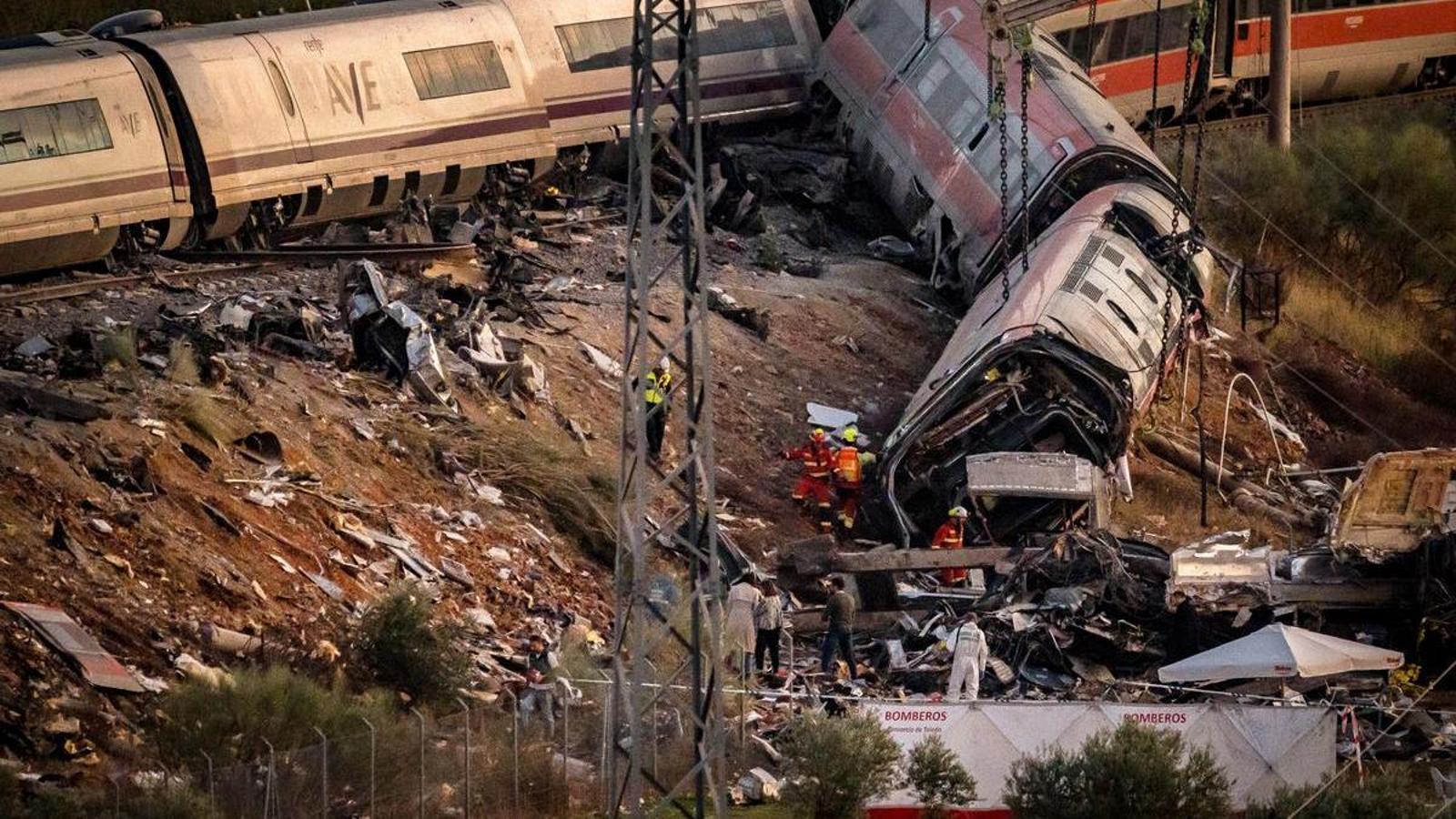
BarcelonaThat whenever the LZB safety system fails, trains should resume operation at 40 km/h. Without exception. This is the proposal Renfe is already working on, which is also being requested by the company Iryo and the train drivers' union following the tragic collision between an Iryo and an AVE last week in Toledo. The railway accident has left at least 69 fatalities and is the second deadliest in the history of the State. The possible measure appears in a Renfe document in which they are evaluating giving drivers the directive not to run at "normal speed" when the high-speed protection and safety systems stop working.
However, sources from the Spanish company point out that it is not yet a definitive decision nor an approved instruction. In fact, they also recall that Renfe is not the regulator or the operator of traffic. In this sense, the proposal also includes measures such as the driver always confirming with the control center that there is no other train within their block [a section of track where, for safety reasons, only one train can be operating at a time], as happened in the Urda accident. According to Renfe, they are already working jointly with Adif and the European Rail Traffic Management System.
Iryo also made a move this Monday in the same direction: it has requested by letter to the State Railway Safety Agency (AESF) –which reports to the Ministry of Transport– that the traffic protocols be reviewed when safety systems stop working and, among other things, it has also asked to limit train speeds to 40 km/h when there is an LZB failure. As El Economista has reported and ARA has been able to confirm, Iryo also proposes to limit and automatically monitor the speed of a train when the connection to the safety system is lost and to analyze the current capacity of the Automatic Signal Announcement and Braking system (ASFA), one of the signaling systems on the tracks that also has the option to stop a train if it is about to pass a red light.

Before this working document came to light on Saturday, the train drivers' union Semaf had sent a letter to the AESF requesting the protocols be modified "urgently". The text insisted that the regulations needed to be redone in the event of a disconnection of the LZB –the system that guided trains on the section where last week's tragedy occurred– or the ERTMS, which is the new standardized model in Europe used in railway circulation, and there could be more than one train in the same block. This Monday, the union again insisted to the AESF that it "should not delay in accepting the proposal". Meanwhile, Semaf is asking all train drivers to "exercise extreme caution in their daily operations to be 100% sure that everything strictly complies with the current regulations".
Adif defends itself against other "isolated" incidents
Five days after the railway accident, the investigation points to a chain of errors, according to which, after a failure of the LZB safety system, an order from the Adif control center authorized the Renfe AVE to resume travel at up to 200 km/h even though there was a stopped Iryo train on the tracks. Nevertheless, the investigation, which remains under judicial seal, is what will have to answer all the questions: why the Iryo train could not start again; why the order is given to the Renfe AVE to start at "normal speed" or why, between the start of the Renfe train's movement and the moment of the collision with the Iryo train (during about 15-17 minutes), no one warned the Renfe train driver that the Iryo was still stopped.
This Monday, the cranes working at the accident site in Urda removed all the carriages of the Iryo and AVE trains. In parallel, the identification work for the 69 fatalities of the accident has been completed. There are 40 men and 29 women, and there are no minors among them, according to the data collected by the Integrated Data Center and provided by the High Court of Justice of Castilla-La Mancha. 54 of the deceased held Spanish nationality, and the other 15 were foreigners (4 Americans, 2 Australians, 2 Japanese, 1 Argentine, 1 Canadian, 1 Czech, 1 French, 1 Mexican, 1 Portuguese, and 1 Tunisian).
Infrastructure manager Adif denied this Monday that it had refused to implement the safety recommendations formulated by the Railway Accident Investigation Commission (CIAF) following an incident that occurred in 2024, when an AVE train traveling with the ERTMS Level 1 railway safety system improperly passed a signal ordering it to stop at the Cuenca-Fernando Zóbel station. In this case, the initial error was made by the train driver, who confused the signal aspect, but the traffic manager committed a second error by authorizing the resumption of the journey.
The CIAF report highlighted that, in Cuenca, the authorization to resume movement had been based on a human verification –checking that the block was clear– and that this barrier was "susceptible to failure." For this reason, it recommended that technical measures be adopted. Specifically, deactivating ERTMS Level 1 in certain circumstances, installing provisional automatic protection systems on lines where ERTMS Level 2 is not yet functional, and ensuring that the security systems of the different sections of the same line are compatible with each other. All of this to prevent safety from depending exclusively on the decisions of the train driver or the traffic manager.
In the same statement, Adif asserts that it did not reject implementing these safety recommendations, but rather argued, in a widely justified technical document, which of the proposed measures in relation to this "isolated incident" could be accepted, studied, or were not appropriate, because they are already operational or because they could even have counterproductive effects.
