Serbian students challenge the power of Vucic at the polls
Two years of protests against corruption boost a citizen candidacy that polls place ahead of the populist right currently governing
-
CAT -
CAST
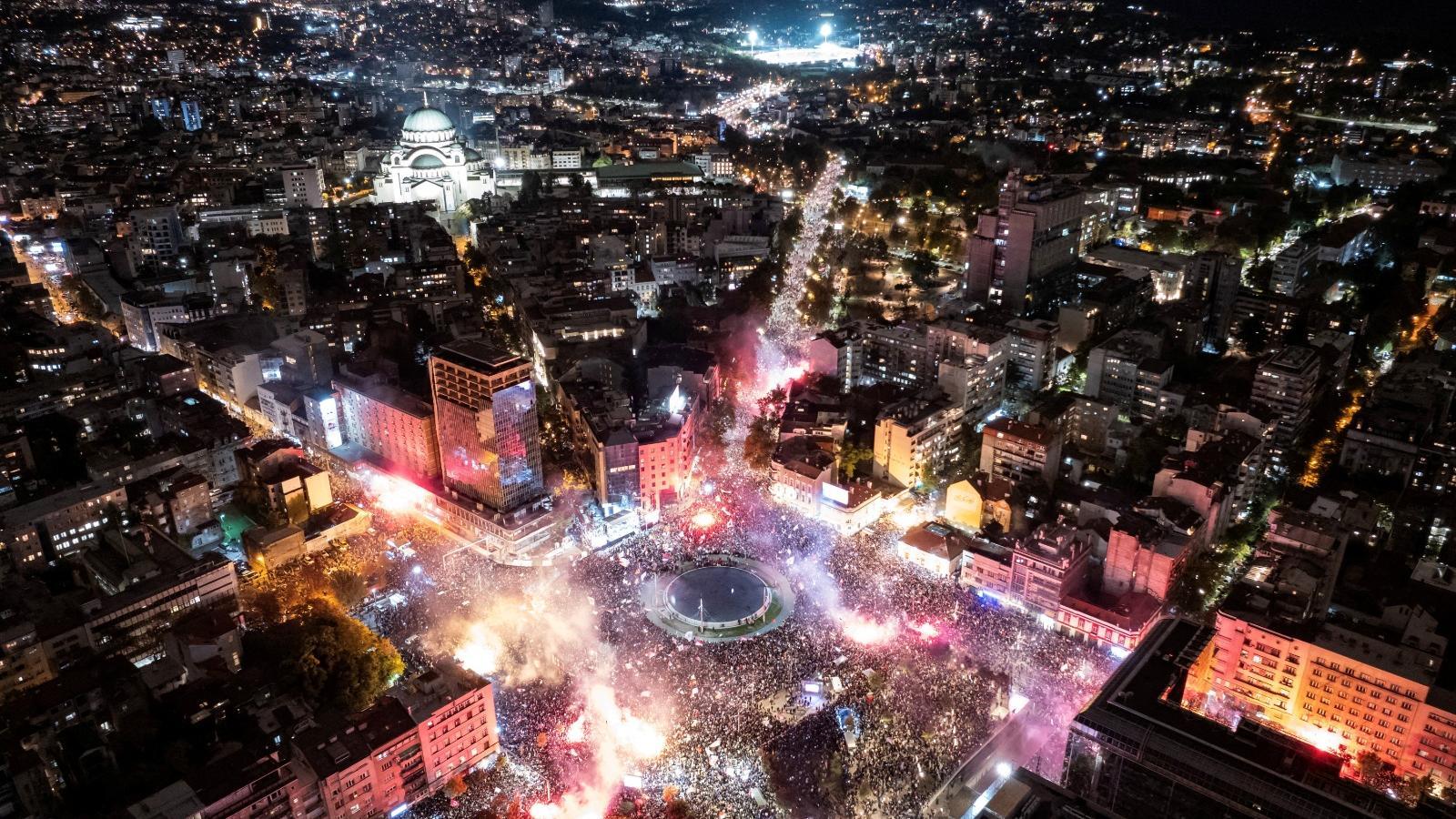
BelgradeHundreds of people have been filling the streets of Belgrade for days. In the capital of Serbia, songs of celebration can be heard and flags of victory wave everywhere. These are the celebrations of Serbian students on the occasion of this Sunday's parliamentary elections. More than six million citizens are called to the polls in an election marked by the key demands of a youth fed up with the corruption surrounding the country and its institutions.
The movement had been demanding for two years that responsibility be taken for the death of 16 people following the collapse of the Novi Sad station, the second city of Serbia. On November 1, 2024, a part of the building's concrete canopy suddenly collapsed, fell at the entrance, and crushed the travelers who were gathered there. The tragedy triggered a wave of protests against the government, led by the same students who have invaded the capital this weekend.
It is the second time in two years that Serbs must elect the 250 members of Parliament. Eighteen lists are running, although the political struggle is fundamentally centered on two: the candidacy endorsed by President Aleksandar Vucic and his Serbian Progressive Party (SNS), called Aleksandar Vucic-Serbia United, and the Student List-The Students Win, which emerged from the university movement. Between the two, there are several minority forces that could end up being decisive in forming a government. Vucic, a populist who has been in power for 14 years, as president or prime minister, aspires to the position of head of the executive.
After two years of protests and organization, the students are presenting themselves in the elections with a list of 250 candidates that includes professors, political scientists, artists, pharmacists, and other professionals from different parts of the country. There is no single leader, in accordance with the way the movement functions.
Furthermore, they do not present themselves as a traditional party, but as a citizens' platform, with a program focused on the fight against corruption, transparency, and the independence of institutions. Among the measures they propose are the creation of a special police unit that reports to the Public Prosecutor's Office to investigate corruption; a law on the origin of assets and a possible mass vetting or disqualification of civil servants and politicians; total transparency in public procurement; the review of major infrastructure projects; the depoliticization of the audiovisual regulatory body; public competitions to access public employment; free textbooks, and aid for startups and farmers.
Change of positions to remain in power
These are the fifth snap elections that Serbia has held in the last decade. They are considered the most important in the country since the 90s, as they could put an end to Aleksandar Vucic's hegemony. He was Deputy Prime Minister between 2012 and 2014 and Prime Minister between 2014 and 2017, the year in which he was elected President of the Republic, and he revalidated the position in 2022, which led him to establish a political model in which he has continued to concentrate the effective power of the executive and the ruling party. This Sunday, and with the goal of remaining in power, Vucic is running again for the position of Prime Minister and thus avoids the term limit established by the Serbian Constitution.
On this occasion, however, the Serbian leader seems aware that, for the moment, he has lost the battle of the narrative. He has based the campaign on strengthening the Serbian identity and has presented the SNS as a guarantee of stability, economic growth, and defense of national interests in a convulsed international context. During the campaign, he has presented the contest as a choice between stability and chaos.
For the moment, the polls place the students slightly ahead, with 44.4% of the votes, compared to the 42.7% attributed to Vucic's candidacy. Therefore, minority lists, such as Ivica Dacic's socialists, the center-left coalition Platform for a European Serbia, and the national minority parties, may become decisive actors.
