Netanyahu, the art of surviving every crisis
It has been the most voted in Tuesday's elections, although it has lost the parliamentary majority

-
CAT -
CAST
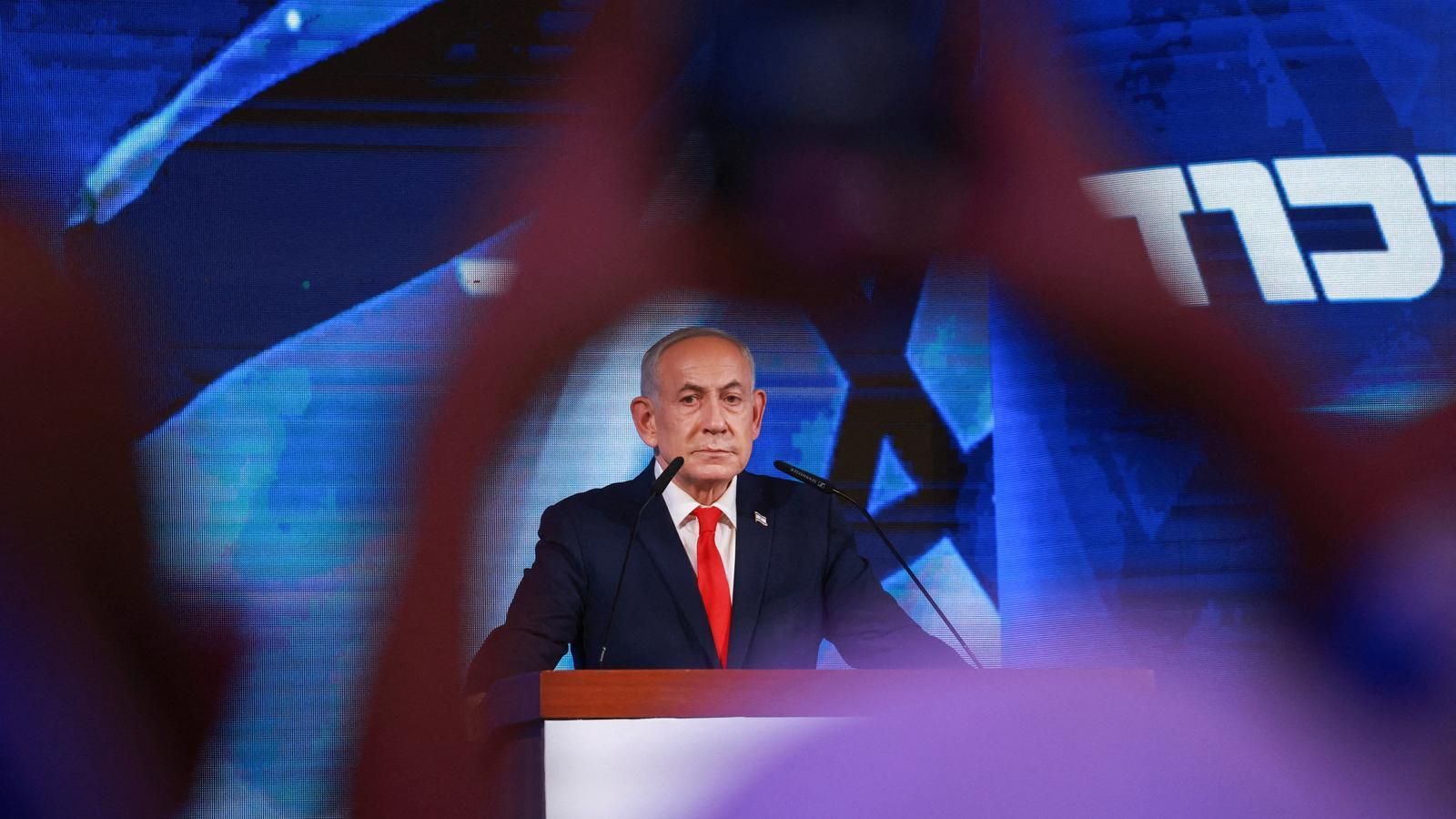
JerusalemThere are few political figures who have turned their survival into such a defining trait of their career as Benjamin Netanyahu. At 77, after decades of dominating the Israeli right, he remains at the center of Israel's politics despite diplomatic crises, massive protests against his policies, judicial investigations, and even the most serious security failure in the country's history, on October 7, 2023. Tuesday's elections have once again demonstrated his resilience: the Likud was the most voted force, even though its bloc has lost its parliamentary majority.
His way of understanding politics is marked by his family origins. Born in Tel Aviv in 1949, he grew up in a family linked to Revisionist Zionism. His father, Benzion Netanyahu, a historian who emigrated from Poland and was a specialist in the Inquisition, defended an expansive conception of the Jewish state and a distrustful view of relations with other peoples. His older brother, Yonatan, died during the military operation at the Entebbe airport, Uganda, to free the hostages of a hijacked plane. His death reinforced the Prime Minister's narrative in which sacrifice, external threat, and the need to protect Israel occupied a central place.
After serving in Sayeret Matkal, an elite unit of the Israeli army, Netanyahu, popularly known as Bibi, studied architecture and business administration at the Massachusetts Institute of Technology and began a diplomatic career in the United States. Between 1984 and 1988, he was Israel's ambassador to the United Nations, a period in which he honed his ability to communicate with international public opinion. With impeccable English and a rhetoric focused on the threats against Israel, he soon understood the importance of the relationship with Washington, which later became one of his main political assets.

The longest-serving prime minister
In 1993 he assumed the leadership of Likud and three years later he became, at 46 years old, the youngest prime minister in the history of Israel. He lost the 1999 elections, but returned to power in 2009 and remained there for twelve consecutive years, until 2021, a fact that made him the longest-serving prime minister in the country. After a brief period in the opposition, he returned to form a government in December 2022, until today.
His longevity is not explained solely by his communication skills. Netanyahu has known how to turn the fragmented nature of the Israeli parliamentary system, in which no party achieves an absolute majority on its own, into an opportunity to perpetuate himself in power. He has known how to negotiate with ultra-Orthodox parties and nationalist sectors, offering them concessions and institutional influence in exchange for parliamentary loyalty. He has also taken advantage of the divisions of an opposition incapable of articulating a common alternative.
His partners have found in him a guarantor of their interests: the ultra-Orthodox parties have pressured to preserve military service exemptions, while nationalist and religious sectors have gained influence over policy in the occupied Palestinian territories. In this balance, the leaders of the religious far-right, Itamar Ben-Gvir and Bezalel Smotrich, remain decisive. Although Netanyahu has distanced himself from Ben-Gvir during the campaign, their parties have won 7 and 6 seats, respectively, and are key to articulating a right-wing majority.

The prime minister's political strategy has also been based on a recurring message: Israel lives surrounded by threats and needs an experienced leader to protect itself. Iran and its nuclear program, which Netanyahu presents as an existential threat and which resonates beyond his electorate, have occupied a central place in this narrative for decades. The war on several fronts –from Gaza and Lebanon to Syria and Yemen– has also offered him the opportunity to recover this discourse.
As noted by Professor Yehudah Mirsky of Brandeis University in the United States, an expert on Israeli politics, in an interview published in 2025, Netanyahu is a master of political survival, capable of combining strategic prudence and tactical audacity and of adapting his bellicose discourse to the circumstances. According to Mirsky, confidence in his own abilities is one of the keys to his remaining in power.
Divisive figure
But his political continuity has been accompanied by growing polarization in Israel. Netanyahu has often presented the institutions that question him—the media, the judiciary, and the prosecution—as political adversaries. In this climate, the trial that he still has pending began in 2020, in which he is accused of bribery, fraud, and breach of trust. The prime minister has denied the charges and claims that it is a case of political persecution.
This tension with the institutions reached a peak in January 2023, when the judicial reform promoted by his government –which, among other measures, sought to give more weight to the executive in the appointment of judges– triggered months of protests. Those who opposed it saw it as an attempt to weaken the independence of the judiciary; his supporters argued that it was necessary to limit the excessive power of the courts. The initiative was largely halted, but his allies want to revive it.
That same year, the Hamas attack of October 7th, with 1,200 deaths and 251 hostages, called into question his main political argument: security. His political continuity seemed compromised at the time, however, the prime minister attributed the failure to the intelligence services and military commanders and rejected the creation of an independent state commission of inquiry, a refusal he maintains to this day.
With an arrest warrant from the International Criminal Court for alleged war crimes and crimes against humanity, which he rejects, Netanyahu has turned crises into instruments of survival. When he has lost support, he has rebuilt alliances; when he has been questioned, he has denounced a persecution, and when his security policy has been called into question, he has appealed to the external threat. The elections of October 27th place Israel once again before a fundamental dilemma: to imagine a future without Bibi or to let him maneuver once again to remain in power.
