Israel's settlers impose terror in the West Bank: "When they finish with one community they go to the next"
The army and the highest instances of the government protect them and guarantee them impunity
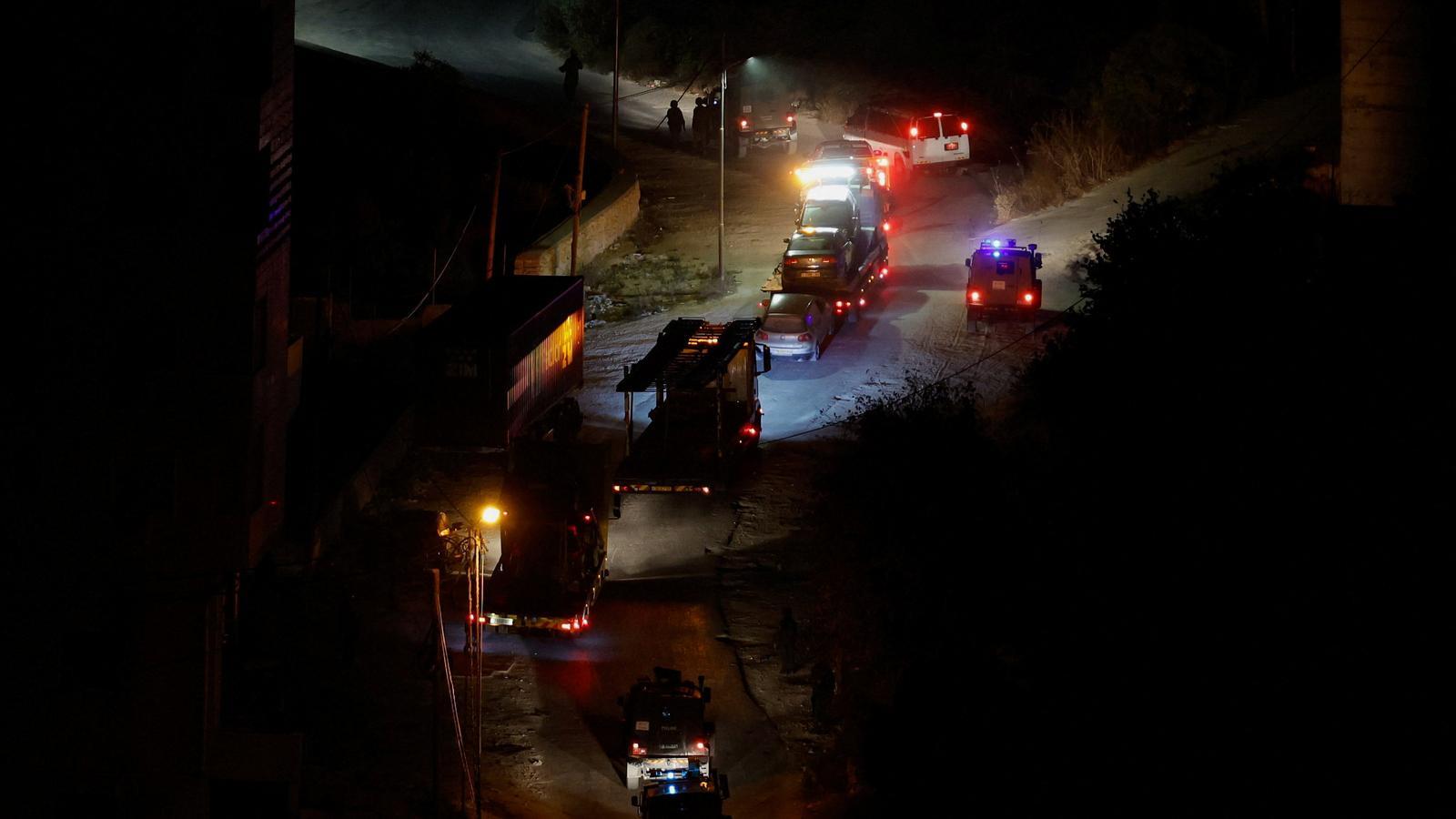

BarcelonaWhile Israel is awaiting the vote count of this Tuesday's elections, where Benjamin Netanyahu is gambling his political future, the Palestinian population of the West Bank lives under the siege of attacks by settlers and soldiers, in the shadow of the genocidal operation against the Gaza Strip. Waheed Abu Naeem only thinks about one thing: how to protect the primary and secondary school students from the attacks of the settlers who occupy eleven hills around his village, Al-Mughayyir, in the occupied West Bank. On April 23, a sniper murdered a 14-year-old student at the school gate, and since then, parents are afraid for their children to go to school.
“We were holding class when the students warned me that they had seen a group of settlers and soldiers behind the school. I made them all come inside, but two boys did not make it in time and they were shot. When I was able to pick him up, Aws was still alive: he died in the hospital shortly after,” recalls Abu Naeem to ARA, an English teacher at the school. That day he also lost his brother, Jihad, 36, who was a father at the school and ran there when his children called him to tell him they were being attacked. Witnesses identified the perpetrator of the shots: a well-known settler who had already participated in other attacks against the village before.
“Since the summer we have built fences around the school and we go to see the parents to try to convince them to let the students come to school. But it is not easy, because soldiers often throw tear gas near the center or harass the students when they return home at noon, from the military checkpoint,” he denounces.
The checkpoint is located on the only access road to the town, of about 3,000 inhabitants. According to the town hall, 75% of the village's land, dedicated to olive cultivation and livestock farming, has been occupied by settlers or the army, which decreed many of the fields belonging to Palestinian farmers as security zones to protect the colonies established illegally in recent years by the movement that, with the support of the Netanyahu government, is expanding the construction of Israeli settlements in Palestinian territory.
The teacher is convinced that the attacks by settlers and Israeli soldiers against the school are not gratuitous: “They want everyone to leave the village: if there is no education, there is no future, Israel wants to create a generation of ignorant Palestinians.” The center, where 500 boys study, is the only primary and secondary school in the village.
In addition, soldiers and settlers carry out “nightly attacks against houses, cars or farms: they destroy machinery and steal livestock,” explains Salah Khawaja, from the Colonization and Wall Resistance Commission (CWRC). They often close the only access road to the village to prevent people from entering or leaving to go to work. The olive harvest campaign –a key resource for the Palestinian economy, which helps sustain 300,000 families in the West Bank– has been another target of the attacks: “Soldiers and settlers enter the fields early in the morning, throw tear gas and force Palestinian families to lock themselves at home all day long”.
The settlers, protected by the government
The settlers feel protected by the highest levels of government, with members of the far-right who are part of the coalition with Netanyahu: the Minister of Finance and person responsible for civil affairs in the West Bank, Bezalel Smotrich, is one of their political representatives, along with the Minister of National Security, Itamar Ben-Gvir. According to the latest UN report from this September, there are currently 300,000 settlers in the West Bank, whom the state has been responsible for arming since 2023.
The settlers' strategy is based on the rapid expansion of so-called outposts, advanced posts usually formed by containers or prefabricated houses that are the first step to establishing a colony. This has led them to set a record of 130 agricultural holdings over the last four years, with the support of far-right Israeli ministers. In 2025 alone, they gradually seized about 30,000 hectares—almost the equivalent of the entire Gaza Strip—hill after hill, according to data collected by the Israeli NGOs Peace Now and Kerem Navot. “Settlers are illegally seizing more and more hills with the support of the government, while the army, for its part, closes large tracts of territory to Palestinians under the pretext of defending these illegal enclaves.” The human rights NGO B’Tselem adds in a recent report that “instead of protecting Palestinian farmers, soldiers expel them from their lands, protect the aggressors, or actively participate in the attacks.”
In 2026, about ninety Palestinians, including 20 children, have died at the hands of soldiers or settlers in the West Bank and about two thousand have been injured. The army has imposed more than 900 obstacles to mobility in the West Bank, a territory smaller than the province of Barcelona. The attacks are so widespread that there is no assessment yet of this year's olive harvest, but there is one from last year: in 2025, 178 settler attacks on olive groves were documented, affecting 88 Palestinian cities and villages. More than 6,000 trees and saplings were vandalized. In September, the Israeli authorities ordered the removal of vegetation from 339 hectares of Palestinian agricultural land in the center and north of the West Bank.
From north to south
While in the south the Israeli army has forced the displacement of more than 2,600 Palestinians from their homes in Hebron, in the southern West Bank, following an attack against a military checkpoint on Friday, in the north of the Palestinian territory things are not much different. From the north of the Jordan Valley, on the eastern border, Rashid Khoudari, from the Jordan Valley Solidarity Movement, explains to ARA what has happened to the Rasal Hamal community, where 37 families have been expelled by settler violence and the ten that still live there have been left isolated. “The army has closed the access gates to the community and they do not allow anyone to enter or leave. The settlers are deployed on all the roads and not even feed for the livestock can be brought in: the farmers have to try to go out at night with donkeys to be able to sell milk and cheese,” he recounts.
This community lives from livestock farming (goats and sheep) and the cultivation of bananas and olives, and in the settlers' attacks they have already lost more than 200 trees. “They arrive with two trucks protected by military vehicles and bring excavators to destroy the trees or the sheds,” he warns. Khoudari sees a pattern: “Everything responds to a plan, when they finish with one community they go to the next.” In the area, Israel has planned an expansion of the West Bank wall and there are several plans to cut the Palestinian territory into three isolated zones to facilitate the movement of the army and security controls. 'In the last 30 years we had not seen this level of violence,' the activist laments.

