The Palestinian parties of Israel can add up to evict Netanyahu, but the opposition does not want them
The two formations add up to 19 deputies that could give a comfortable majority to Eisenkot

-
CAT -
CAST
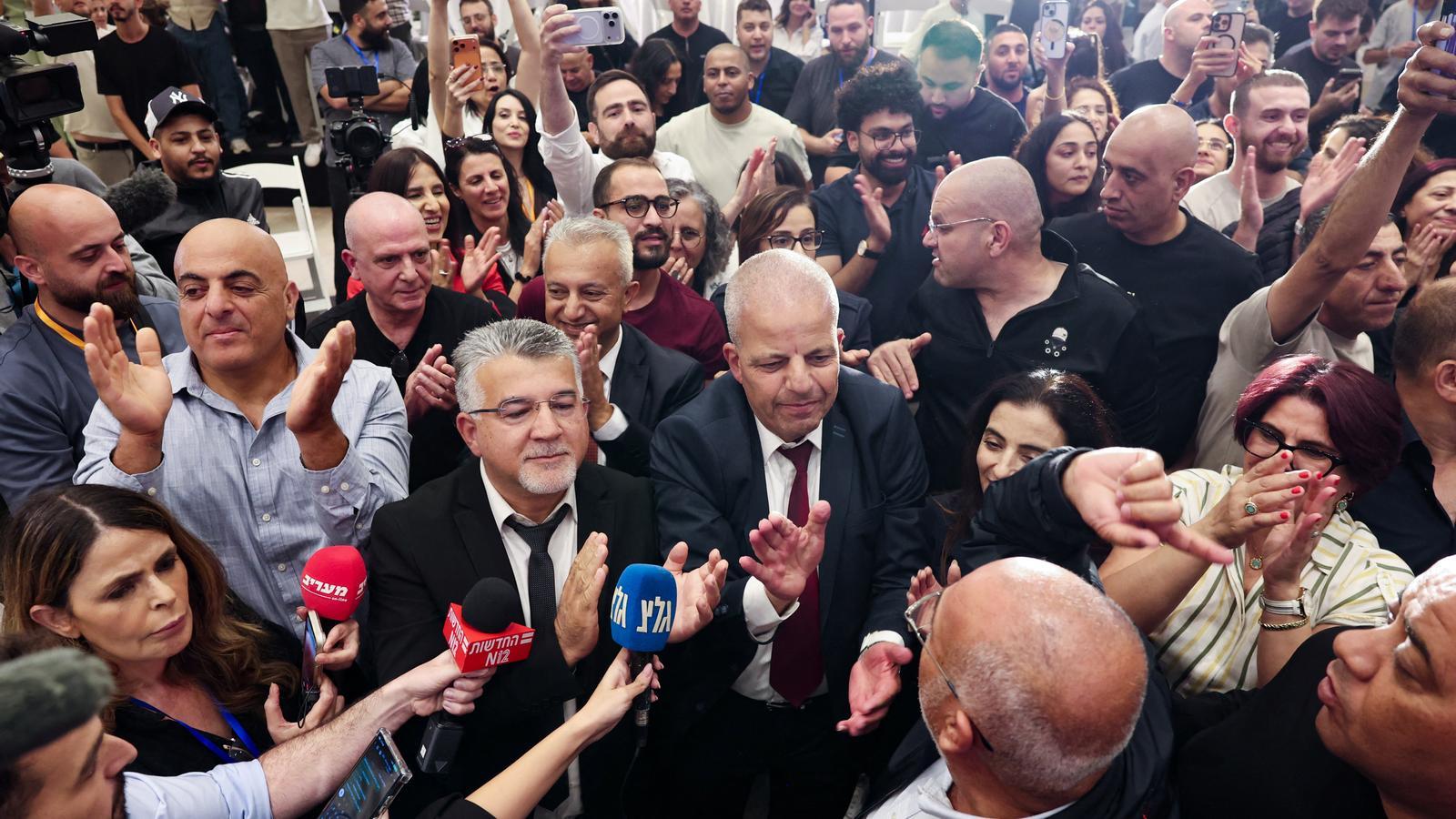
BarcelonaWaiting for the slow count of Tuesday's elections in Israel to finish, it is already clear that one of the keys has been the record turnout of the Arab minority, who represent 20% of Israel's population. This community had always been traditionally abstentionist because it did not feel represented in a state that treats them as second-class citizens. Unlike the Palestinians living in Gaza and the West Bank (whom Israel has never wanted to consider citizens so as not to lose its Jewish demographic majority), Palestinians with Israeli citizenship have the right to vote. And this time they have exercised it massively: 70% went to the polls, an unprecedented percentage.
This unprecedented data makes the two parties that represent them decisive in the Knesset, the Israeli parliament. Only with their deputies would the opposition coalition have a majority to remove Benjamin Netanyahu from power. But things in Israel do not work that way: the opposition bloc refuses to cooperate with the Arab parties, thus plunging the country into a political deadlock.
"The election result is very clear: Netanyahu has lost the parliamentary majority. And in a normal country that means the opposition forms an alternative government, but Israel is not a normal country. And both camps, Netanyahu's and the anti-Netanyahu one, are racist towards the Palestinians, and both openly say they do not want to sit with the Arabs, as if that were normal," denounces Sami Abu Shehade to the ARA, from the Balad party, one of the three that form the progressive and secular Joint List, which with 85% of the vote counted had obtained 12 deputies.
Behind the rise in electoral participation is the rejection by the Palestinian population with Israeli citizenship –or as the Jews call them, the Israeli Arabs– of the policies of Netanyahu's government that have hit them hard. First, because they have seen from their homes the genocide in Gaza and how the terrorism of the settlers in the West Bank has been unleashed. And also because in Israel they have been treated as an internal enemy, inciting violence against their communities, persecuting their expressions of solidarity with the Palestinians of Gaza and the West Bank, cutting the budgets of the municipalities where they are in the majority, or with arbitrary demolitions of their homes. Furthermore, for some years now, organized crime has taken over many neighborhoods in Israeli cities with a Palestinian majority.
The other party of the Palestinians in Israel is Ra'am (United Arab List), of a conservative nature and Islamist ideology, which would have obtained seven seats. The formation, which had already participated in the coalition government that briefly removed Netanyahu from power in 2021, is not as explicit as the Joint List in denouncing the occupation of Gaza and the West Bank.
"The lesser of two evils"
The Arab-Israeli political analyst Tabet Abu Ras notes to this newspaper that the minority is trying to defend a democratic framework: "We Arabs in Israel want to collaborate with liberal Zionist parties to get rid of Netanyahu; Israeli society is very sick and if it wants to live in democracy, it must count on us. But unfortunately, everything points to the fact that the opposition bloc prefers an agreement with Netanyahu's Likud". Abu Ras believes that a way to unblock the situation would be to form an ad hoc government that would allow changing the speaker of the parliament and establishing a state commission of inquiry into the security failures of the Palestinian attacks of October 7, 2023, and subsequently calling for new elections in which Netanyahu, investigated by this commission, could not be a candidate. "We have no illusions about Eisenkot, but we will take the lesser of two evils", he summarizes.
Daniel Levy, president of the US Middle East Project, notes the priorities of the opposition coalition. "It seems that the Zionist opposition, which said things like Netanyahu had to leave because Israel was in existential danger, mostly chooses to reject an alliance with Palestinian Arab parties and, therefore, de facto, maintain Netanyahu in power". He believes the opposition bloc "will remain faithful to its ethnonationalist Zionist ideology and will reject the Palestinian parties".
Israeli analyst Gil Hoffman reaches the same conclusion, in a conversation with ARA: "The most feasible scenario is a grand coalition between Netanyahu and Eisenkot, because, after all, both have lost the elections". He asserts, however, that "the problem is not racism, but that with the presence of Arab parties in the government, one would have to share confidential security information with those who support your enemies".

