Mexico closes falsely the clash with Spain over the colonial past
Sheinbaum, who needs allies to stand up to Trump, lowers the confrontation with the royal house despite not having achieved a formal apology or a real reparation
-
CAT -
CAST
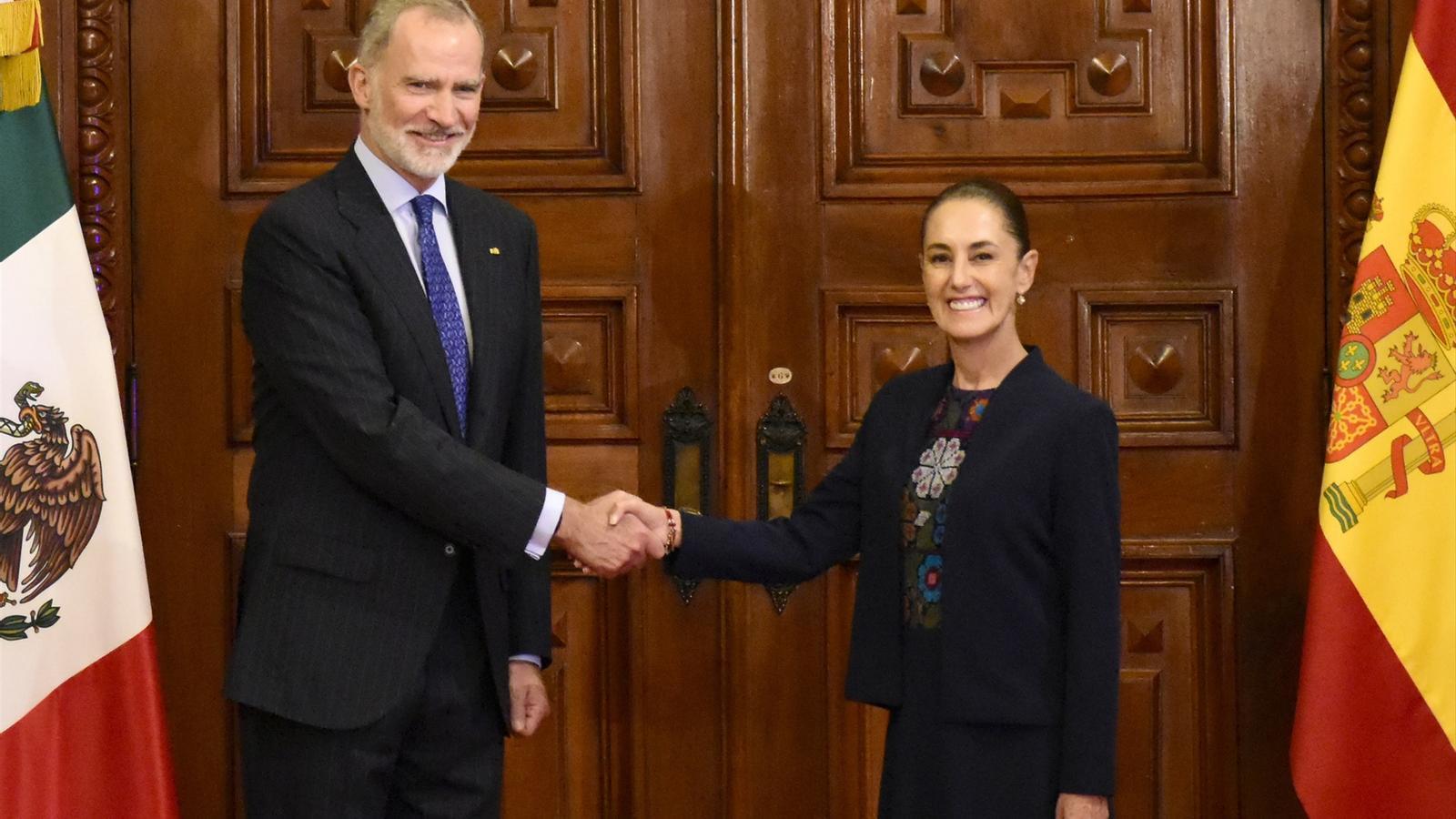
BarcelonaA year ago, the image that illustrates this piece would have been impossible. It is from June 25, when half the world was watching the football World Cup, which was being held, in part, in Mexico. The country's president, Claudia Sheinbaum, and Felipe VI appear in it, and it was taken during the Spanish monarch's visit to the Latin American country's National Palace, in a meeting that was "very cordial," according to the Mexican leader. It marked the culmination of a rapprochement process between the Spanish crown and Mexico, and left behind years of tensions over the Spanish colonial past following some advances that remain far from the demands that motivated the clash.
During this last year, Spain has acknowledged "a lot of abuse" in the colonization of America, tempering the historical position it has held for centuries regarding the colonial era. The first to unsettle the seams of the official discourse was the Foreign Minister, José Manuel Albares, last October. At the inauguration of an exhibition in Madrid titled The woman in indigenous Mexico, held in collaboration with the Mexican administration, the Foreign Minister spoke of "chiaroscuros" in history and acknowledged "pain and injustice" towards the original peoples. In March, Felipe VI, during a visit to the same exhibition, admitted "a lot of abuse" despite the "desire for protection" that, as he stated, the Catholic Monarchs had.
Two days later, the Mexican president invited the Spanish monarch to attend the football World Cup in Mexico. Until then, relations with the royal house were tense. For example, Sheinbaum did not invite Felipe VI to her inauguration in protest of the attitude of the monarch and the institution regarding the colonial past. In the background of all this is the request for formal apologies that former Mexican president López Obrador made to the Spanish crown in 2019. Felipe VI did not respond to the letter in which Mexico made the request, and relations remained strained for years, although at no point have they been broken.
The apologies have not arrived. Nor has a joint ceremony been held "at the highest level," as the letter requested, for the recognition of grievances. In fact, the King's words were half-hearted, in a six-minute video posted on social media in which Felipe VI toured the exhibition in Madrid and spoke with the organizers. Even less has a shared narrative of the common history of the two territories been agreed upon and written, just as the missive also requested. "Reparation should involve creating public memory policies. Institutions and spaces for permanent research and debate should be created to address spoliation, slavery, and the reparation of these events," adds Jordi Guixé, historian and director of the European Observatory on Memories at the UB. Nothing of all this has been done.
Sheinbaum's balancing acts
However, Mexico has lowered its insistence on repairing the past. "At this moment, it is more important for the country to maintain and diversify its international alliances. Sheinbaum does not want tensions with other countries, because she already has enough with the United States and the continent's shift to the right", portrays Palmira Tapia, a political scientist at the Center for Research and Teaching in Economics (CIDE) in Mexico. Trump maintains a confrontation with the Mexican left-wing government that involves the imposition of tariffs, the outsourcing of borders, and accusations against Sheinbaum's executive for not doing enough to combat drug trafficking. These are pressures similar to those he inflicts on other Latin American states, where his words have ended in direct interventions, such as in Venezuela, or indirect ones, for example with pressure in electoral contexts, as has happened in Brazil or Argentina.
In the case of Mexico, analysts usually point out that it is less likely that the pressures will escalate to a military intervention. Destabilizing a country with so many kilometers of direct border with the US would be especially risky. But in the current context, Sheinbaum needs to strengthen her alliances, and with Pedro Sánchez, the union is relatively simple. The Mexican leader and the Spaniard have emerged as two of the main references of the global left, and the Mexican president was one of the main guests at the progressive summit of April held in Barcelona.

With the marginalization on the continent of the political project represented by Sheinbaum, the issue of apologies –or, at the very least, of a recognition of past events– has been losing voice in the countries' institutions. Far off are the accusations of genocide by Gustavo Petro, former Colombian president, or Nicolás Maduro, the Venezuelan president deposed by the United States. The new right-wing and far-right governments in most cases not only do not put this demand on the table, but some even praise the Spanish conquest. Javier Milei, in Argentina, has restored the Day of the Race as the official name of the October 12th holiday in the country, and considers it a "nonsense" that Spain should have to ask for forgiveness, because Columbus's arrival in America marked "the beginning of civilization on the continent," he claims.
Beyond the international context, Sheinbaum, heir to López Obrador, represents a more moderate sector on some issues compared to her predecessor, despite both being part of the same political space, points out Tapia. Differences that, when it comes to governing, materialize in a more technical and less confrontational style. "We saw the request for apologies with López Obrador and we will not see it again," concludes the Mexican political scientist.
