Sánchez and his allies point to "the enemy": millionaires, speculators, technologists and Donald Trump
Progressive leaders propose reforming the UN to renew the commitment to multilateralism
-
CAT -
CAST
BarcelonaDonald Trump is a millionaire, a real estate magnate, has direct interests in technology companies and... is Donald Trump. The President of the United States embodies in himself all the characteristics of the "enemy" that this weekend has been pointed out by the left gathered in Barcelona, with Pedro Sánchez as host, who has established himself as the reference of the international progressive movement. "When we socialists govern, states do not bow to elites, we put them in their place," he exclaimed to close the weekend summits before the 6,500 people who filled pavilion 8 of Fira de Barcelona. The commitment of the Spanish leader, but also of the heads of state and government who have met, is to "resist" the push of the far-right, but also to "build" together a new multilateral world. "We will twist the arm of those who believe themselves untouchable. Of the millionaires who exploit people and play with greed; of the speculators who play with people's savings and homes, and of the technologists who line their pockets at the expense of the health of democracies and the mental health of our youth," Sánchez ratified, intoning from the stage the "No to war" that the entire auditorium followed.
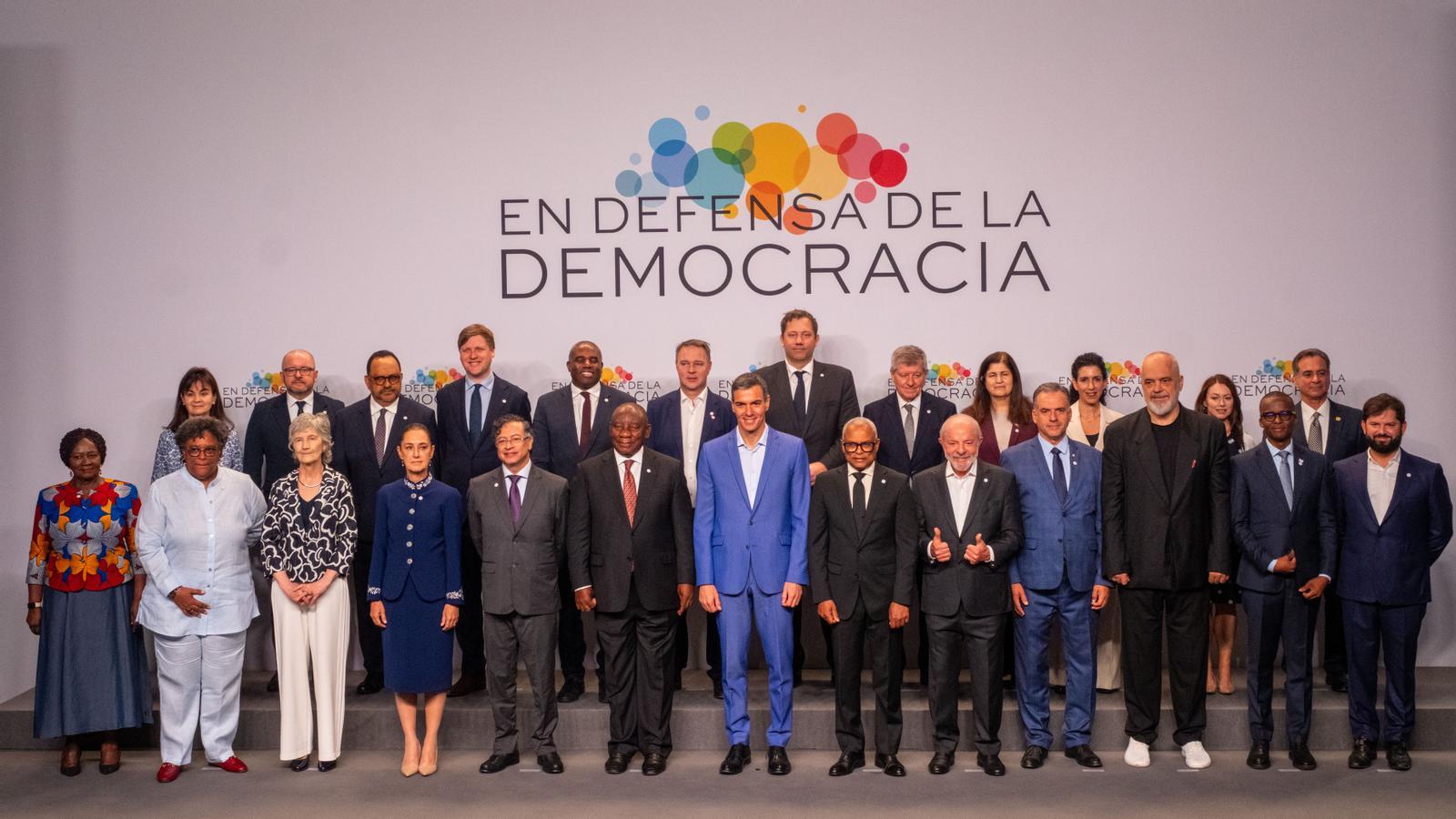
The Spanish president had set himself the goal of making Barcelona the anti-Trump city par excellence and since Friday, with the Spain-Brazil bilateral, until this Saturday, he has been the main protagonist. "Thank you, President Sanchez", the guests at the three forums, which have brought together socialist and progressive parties, governments, and activists from all over the world, have expressed one by one. The highlight of the weekend had been set for Saturday morning. More than twenty governments have passed through the IV Meeting in Defense of Democracy, which has been held alongside the Global Progressive Mobilisation, the socialist summit. The Brazilian president, Luiz Inácio Lula da Silva, has been the star guest, along with the Mexican president, Claudia Sheinbaum –who has invited Sánchez to Mexico, evidencing the improvement of relations between the two states–; and the Colombian, Gustavo Petro. The presidents of Uruguay, South Africa, Lithuania, Ireland, Albania, Barbados, and Cape Verde complete the heads of state or government. Vice-presidents and ministers from Germany, the United Kingdom, Ghana, Austria, and Botswana, and ambassadors from almost twenty countries have also participated.
"Democracy cannot be taken for granted", Sánchez warned. Beside him, the former president of Chile Gabriel Boric added that "democracy is not the natural state of things". And if it is in danger, they say, it is because someone is putting it there. Donald Trump and Benjamin Netanyahu – some, like Sánchez, include Vladimir Putin – will have taken note. The solution, still very undetermined, involves "reforming the United Nations", starting with the fact that, for the first time in history, they are headed by a woman.
Trump could not contain himself and, once again, has offered Sánchez what he needs: an enemy who takes him into account. "Has anyone seen how badly Spain is doing? Its financial figures, besides contributing almost nothing to NATO or its military defense, are absolutely horrible. It's sad to see!" the President of the United States wrote on his Truth social network.
"Attacks on the multilateral system; attempts to challenge the rules of international law; dangerous normalization of the use of force; inequality and disinformation." These are the main "dangers" facing the democratic system, Sánchez pointed out. The conspiracy is to move from shared diagnosis to action, and this is where the plan to reform the UN comes in. The Spanish government will support a Latin American woman to be the next Secretary-General. "It is a matter of justice and also of credibility." Two of the candidates meet the condition of being women and Latin American: former Chilean President Michelle Bachelet – who does not have the support of the country's new president – and former Vice-President of Costa Rica Rebeca Grynspan. The two men they compete with are former Senegalese President Macky Sall and Argentine diplomat Rafael Mariano Grossi.
In a fiery speech to close the meeting, Lula da Silva stressed that the states gathered in Barcelona do not intend to "create a new international," but simply to talk about "multilateralism" because it is a topic that, he assures, "cannot be discussed at the United Nations." "Why? Because today the UN does not represent what it was created for. The five permanent members of the Security Council [the United States, Russia, France, the United Kingdom, and China] have gone from guaranteeing the world's security after World War II to becoming warlords." Ramaphosa has called for Africa to also have a seat on the Security Council.
Strengthen multilateralism
From Saturday's meeting, several commitments emerge, such as the reinforcement and reconfiguration of multilateralism, threatened by the imperialism of Russia and the United States; digital governance, to globally regulate technology companies, and the democratic agenda, based on offering responses to citizens in the form of social justice, cohesion, equal opportunities, youth participation, gender equality, and inclusion. "The real risk is that democracy is hollowed out from within while it is attacked from without," Sánchez warned. "We believe in an order based on rules, on cooperation, and on legitimate institutions, but we also know that the multilateral system must be urgently renewed to reflect the reality of the 21st-century world," added the Spanish president.
The presence of the Mexican president has been one of the relevant news items of the event, which demonstrates the thawing of relations with Spain. She and Sánchez met bilaterally once the summit concluded. The "permanent struggle for peace" in a world "wounded by war and inequality" has a concrete proposal from the Mexican president: that the United Nations support a new fund for world reforestation from 10% of the money now allocated to armaments.
In general, political leaders have preferred to distance themselves from the anti-Trump label, some more vehemently, like the Minister of Justice of the Dominican Republic, Antoliano Peralta –he stressed that if he thought it was an anti-Trump summit, "he would not have come"– and others, like Petro, simply denying that it is a "contrary" summit and defending the proactive component of the meeting. "Both the aggression against Iran and the extension of the war in the Middle East are among the worst steps any government has taken, beyond the genocide in Gaza," he denounced in reference to the United States and Israel. Lula was even clearer: "We do not like emperors who believe they are the kings of the world." The Brazilian president insisted that "individually" states "have no way out" and that "no country, however large, can impose its rules on others."
Attendees and absentees
After passing through New York (on two occasions, under the auspices of the UN), Santiago de Chile, and now Barcelona, the next summit In defense of democracy already has its new destination: it will be Mexico. Representatives from Spain, Brazil, Mexico, Colombia, Uruguay, Albania, Cabo Verde, Guatemala, and Norway have repeated from the summit last September in New York, in addition to a UN representative – António Costa, the President of the European Council, had also been announced, although he was not finally in the family photo. The new countries that have joined this group in defense of democracy are Germany – with Vice-Chancellor Lars Klingbeil –, the United Kingdom – with Deputy Prime Minister David Lammy –, Lithuania – with Prime Minister Inga Ruginienė –, Ireland – with President Catherine Connolly –, South Africa, Austria, Barbados, Botswana, Ghana, Australia, Slovakia, Namibia, and the Dominican Republic. Despite former President Boric being present, the new government of José Antonio Kast has left the group, and Bolivia, Honduras, Senegal, and Saint Vincent and the Grenadines have also not been present.
Venezuela is not present, and if María Corina Machado, the Nobel Peace Prize laureate, ever ends up governing the country, it is clear she will not be there either. She has embraced the PP, on Friday with Alberto Núñez Feijóo and on Saturday with Isabel Díaz Ayuso, and has refused to meet with Sánchez. "What has happened in these last few hours in Barcelona is the demonstration of why this meeting [with Sánchez] is not convenient," she said this Saturday. "I believe that the facts have evidenced what I had previously expressed".
