The praise from United States President Donald Trump for the AfD has had consequences. German Chancellor Friedrich Merz has decided to postpone the call he had scheduled for this Wednesday with Trump after the United States president congratulated the ultra-right party on their victory in Saxony-Anhalt. The New York tycoon applauded the "enormous" triumph of the far-right party and attributed it to Germany's immigration rules and regulations, which he described as "horrible". Although the reason that led Merz to cancel the call has not been officially detailed, his team specified that it was not a "scheduling issue" and that there is no new date set for it. The purpose of the call was the 25th anniversary of the September 11 attacks.
Merz accuses the AfD of wanting to carry out an "ethnic cleansing" in Germany
The leader of the far-right party has requested the immediate deportation of "more than a million refugees"
09/09/2026 - 20:20 h

-
CAT -
CAST
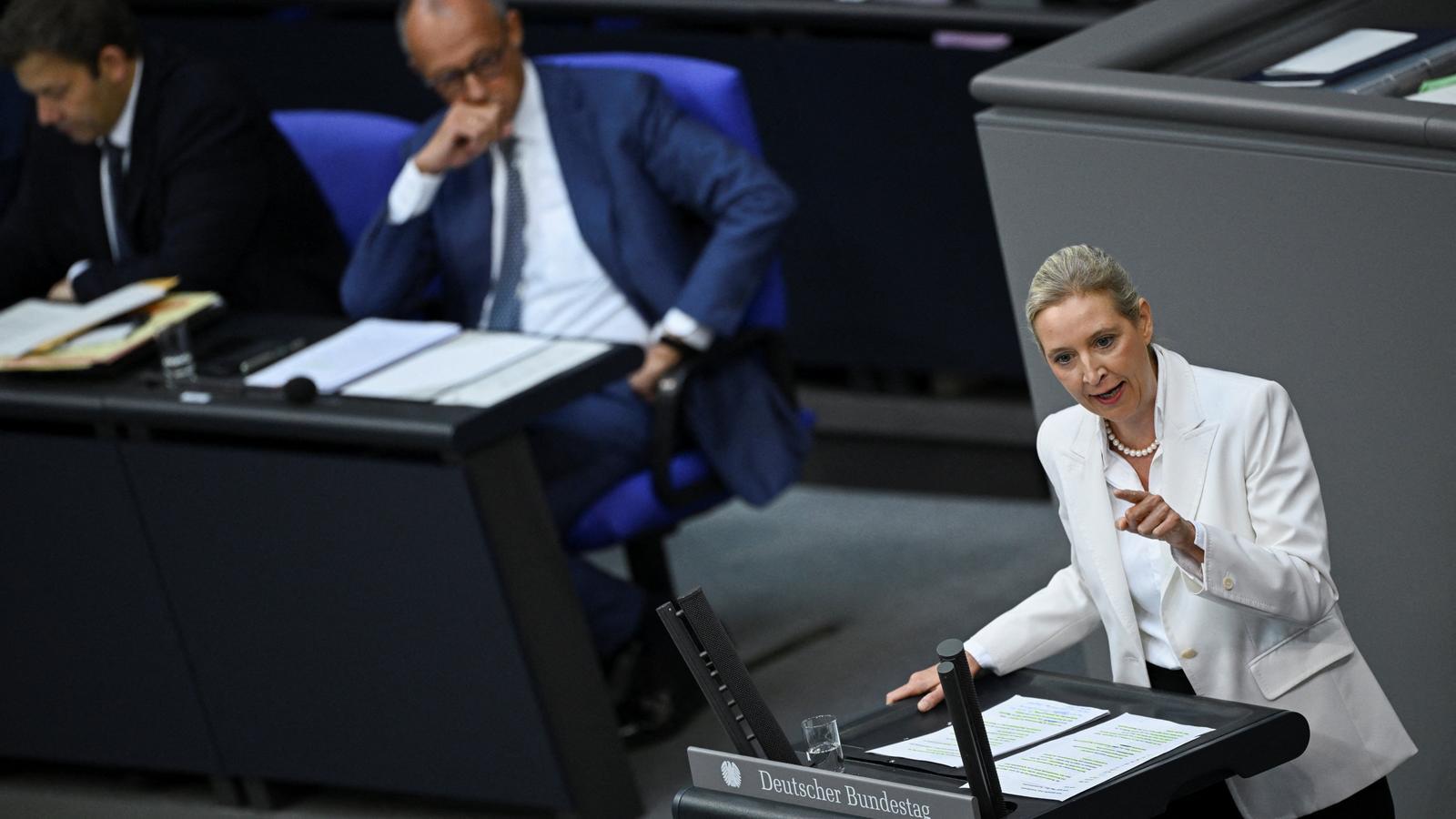
BarcelonaGerman Chancellor Friedrich Merz has raised his tone against the far-right party Alternative for Germany (AfD) with accusations of wanting to implement migration policies that amount to "ethnic cleansing" in Germany. Merz addressed the ultra-right party in this way during a debate in the Bundestag, the German parliament, regarding the 2027 budget, three days after the AfD's victory in the Saxony-Anhalt elections. The German chamber thus became the stage for the first clash between Merz and the far-right party leader, Alice Weidel, following the overwhelming triumph of the ultra-right in the small state in the east of the country and the collapse of the CDU, Merz's party.
With a German chancellor weakened after the defeat in Saxony-Anhalt and the CDU in the midst of a debate on how to deal with the AfD, Merz has made migration policies his main dart against the AfD. "If what is advocated here, the so-called remigration, becomes a reality, it would be nothing other than a synonym for ethnic cleansing based on origin and skin color," stated the German chancellor, who also accused the AfD leaders of wanting to "destabilize the country" and of "showing contempt for democratic institutions and state representatives".
Merz's words came in response to Weidel, leader of the main opposition party, who had called for the immediate deportation of "more than a million refugees". Emboldened by the overwhelming victory in Saxony-Anhalt, she defended that deportation policies are legal and considered that "attributing ethnic cleansing to the AfD as a political goal is a desperate attempt" to maintain a cordon sanitaire through a "manufactured demonization".
Against the ultra-right's postulates, Merz had warned that forcing migrants to leave would create a shortage of skilled professionals that would be counterproductive. "Not a single nursing home will function. There will not be a single operational hospital in Germany and no restaurant will be able to remain in operation. This would be the result of your policy of remigration", warned the chancellor.
The ultra leader also boasted about the results in Saxony-Anhalt and predicted the end of the coalition between conservatives and social democrats. "The voters have said it clearly," insisted Weidel, to whom Merz replied that more than half of the voters in the small eastern German state did not vote for the AfD – a party that the German intelligence services label as extremist– and that the formation did not achieve its goal of reaching an absolute majority.
Clash over Russia
Along with migration, Russia has been the other main point of friction between the CDU leader and the AfD leader. Weidel has called for returning to buying Russian gas and has criticized support for Ukraine, in addition to attacking Merz for having "allowed, without acting, the Nord Stream pipelines to be blown up". The German chancellor has focused part of his offensive against the AfD on the party's ties to the Kremlin.
"That is where the deepest division between us lies. We will continue to defend our freedom in the future", the German chancellor pointed out, after Weidel had accused him of warmongering. Merz presented the drone attack at Leipzig airport as a revealing fact of the ultra party's proximity to Russia, because they "laughed" at an "attack that was planned in Russia for months and that had Germany as its deliberate target". The German chancellor also reproached Weidel for not having a single word for Ukraine, and the AfD leader replied with criticisms of the support for Kyiv.
Alert to intelligence services
The future of the government in Saxony-Anhalt is still up in the air. The AfD fell three seats short of an absolute majority and has already expressed its intention to open talks to try to reach power. Although the scenario is still uncertain, the possible arrival of the ultra-right in government has put the German intelligence services on alert. The alarm has been raised, above all, because of the consequences for national security.
In terms of internal security, the main responsibility lies with the states (Länder) and, if the AfD reaches the government of Saxony-Anhalt, it would have direct access to the Office for the Protection of the Constitution, the same body that in 2023 classified the party as "clearly far-right" and which is in charge of monitoring it. There is also concern about the use that a party close to Russia could make of this information, with fear of possible leaks to the Kremlin.
Merz cancels call with Trump over praise for AfD
