At least 33 dead and 50 missing in the Russian attack on Monday against a school in Ukraine
The center, located in the region of Zaporizhzhia, functions as a distribution point for humanitarian aid
-
CAT -
CAST
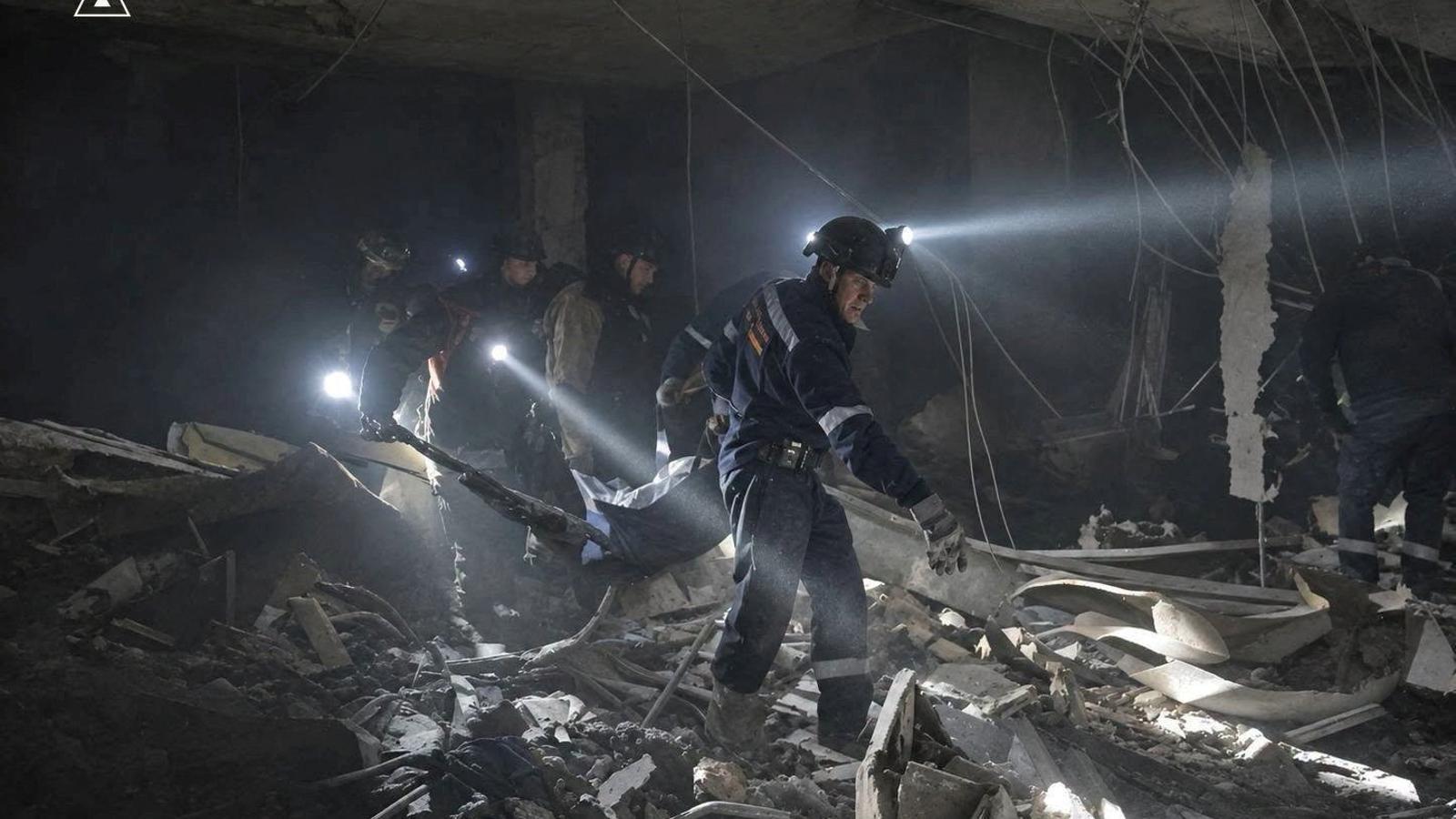
BarcelonaAt least 33 people died on Monday and 50 are missing in a Russian attack on the town of Komyshuvakha, near the front line, in the Ukrainian region of Zaporizhzhia. The aerial bombardment struck a school, where civilians were receiving humanitarian aid, according to Ukrainian President Volodymyr Zelensky. Russian forces dropped eight aerial bombs, in a "double tap" strategy, which seeks to strike rescue teams arriving at the scene after an initial attack to save victims. Specifically, a Russian plane dropped remote-controlled FAB-3000 bombs, with an explosive charge of up to 1.5 tons, which are designed to destroy bunkers and underground targets. Ukrainian authorities warn that it is impossible for an attack of this nature to be accidental.
In addition to the school, Moscow also attacked the building where the people who were at the first bombed site had taken refuge, as denounced by Zelensky in a message on X: "After the first aerial bomb attack, there was a second attack with nine more bombs, aimed specifically at the shelter where people were taking cover".
This is a technique that Moscow has used on repeated occasions: a few minutes after launching the first attack, it fires another either at the same place, when emergency personnel are assisting the wounded, or at a nearby area where the civilians present in the zone have headed. In this case, emergency services have said that two members of a rescue team and four police officers are among the fatalities.
Zelensky remarked that the attacked area was known to be a place for distributing humanitarian aid. "The Russians could not have not known that every week the neighbors who have stayed in Komyshuvakha receive humanitarian aid at this very spot," he wrote.
In the same post, the Ukrainian leader asserted that the attack shatters hopes for "progress toward peace" generated after the humanitarian operation in Oleshky. In this town, located near Kherson in an area occupied by Russia, Moscow and Kyiv have agreed on a local truce that came into effect last week, with the aim of evacuating the population and delivering humanitarian aid to civilians who have decided not to leave their homes despite the pressure of the war. "With these crimes, Russia sends a totally opposite signal," he said, and once again called for "a firm and harsh response" from the international community against Russia.
Awaiting negotiations
The bombing comes after Ukraine attacked Russian oil facilities again on Friday, despite Moscow's warning that a bombing against oil infrastructure could affect the meeting to address how to advance towards a peace agreement, which does not yet have a date, but which could take place during these first days of November. Movements for this meeting to take place have been happening in recent weeks. At the end of October, Finland and Norway positioned themselves as possible mediators in a conversation with Vladimir Putin, who viewed it favorably.
Attacks against oil infrastructure such as last Friday's have become a common strategy of the Ukrainian army to make the war felt in the Russian rear as well. US President Donald Trump has pressured Zelensky to stop it, with the argument that it is driving up the price of gasoline worldwide. And also with this argument, a few weeks ago, the United States announced that it would buy 300,000 tons of Russian diesel. The American leader thus sought to lower fuel prices, which are skyrocketing in the US and are one of the reasons his popularity is in free fall.

