A Russian soldier dies every two minutes on the Ukraine front: X-ray of the human cost of Putin's war
The leaked statistics show a sacrifice without precedents in the history of modern Russia and 720,000 corpses are already accumulating

-
CAT -
CAST
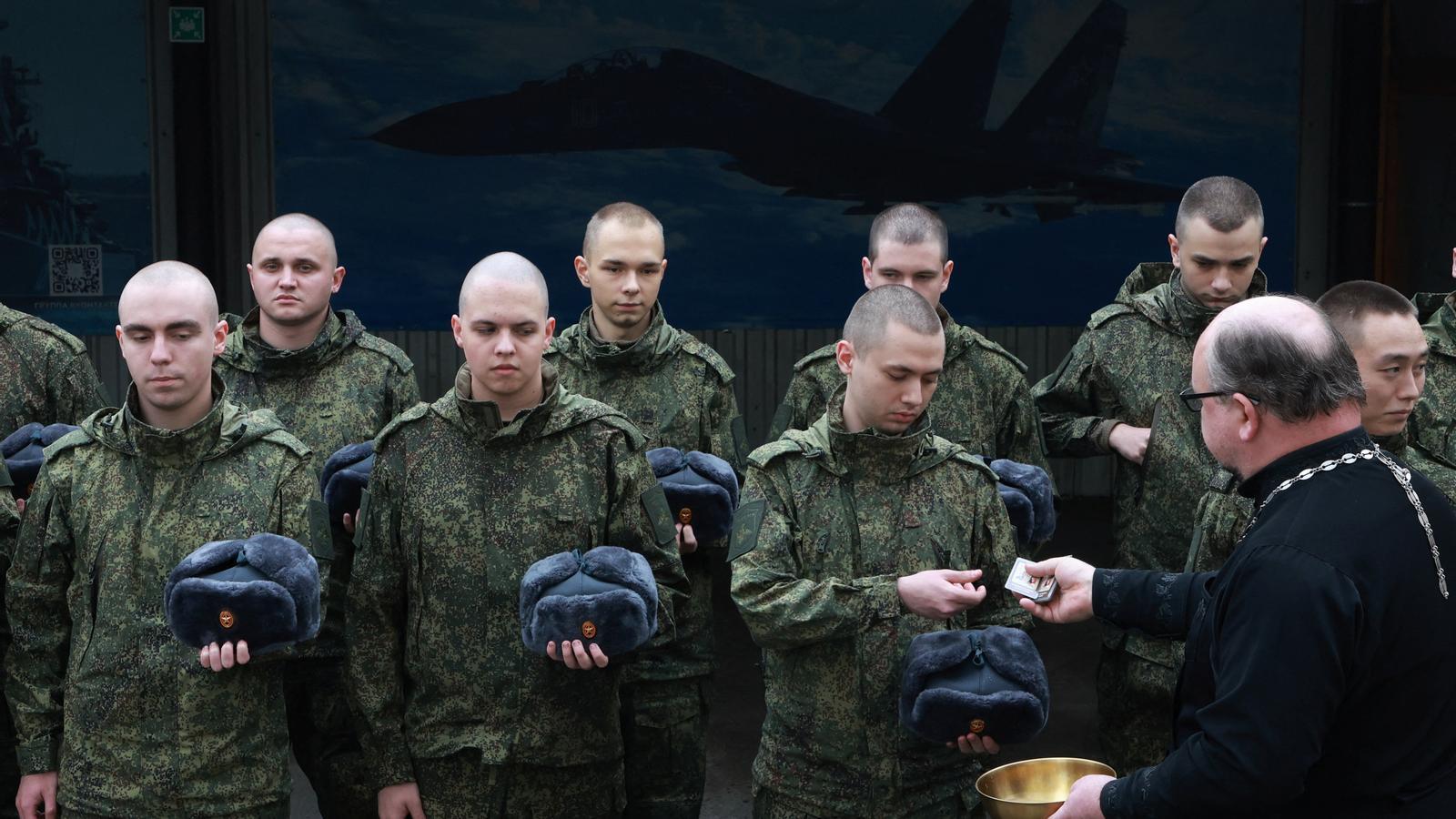
MoscowÍgor Samulénkov, 41, signed a contract with the Russian army on November 3 in Rostov-on-Don. That same day, while he was being transported to the Zaporizhzhia front, a drone blew up the vehicle in which he was traveling. He was accompanied by Oleg Shorin, who had enlisted the day before, and Denis Polukhin, who enlisted on the 1st. All three died. Their names will continue to pad the list of more than 720,000 Russian soldiers killed in the war in Ukraine, according to calculations by the independent media outlets Meduza and Mediazona. These are figures that the Kremlin has struggled to hide for years, but which, thanks to a leak by a group of Belarusian and Ukrainian hacktivists, allow us to quantify the human cost of the conflict for Russian society.
Analysis of the Russian government's official statistics has allowed journalists to confirm nearly 490,000 deaths linked to the hostilities. Adding the figures for the missing, the projection to date exceeds 700,000 Russian military personnel killed. This means that, on average, a soldier dies every two minutes and twenty seconds. And if we take into account that approximately 2.4 million Russian citizens have gone to fight since February 2022, it can be concluded that one in three has not returned alive.
The scale of the losses for Russia is not comparable to any of the wars in which the country has been involved since World War II. In Afghanistan, the conflict that contributed to the collapse of the Soviet Union and represented a generational trauma, 15,000 boys died over nine years, fewer than those who die in Ukraine every month. In the two Chechen wars, the committees of mothers of fallen soldiers speak of 25,000 deaths, thirty times fewer than in the current confrontation. In fact, 700,000 is a number only comparable to those executed during the climax of Stalin's Great Terror between 1937 and 1938.
A large part of these men, nearly 270,000, according to the most conservative estimates, have been killed in Donetsk, the region that has become Vladimir Putin's obsession and that his troops have not been able to conquer in almost five years. Among the bloodiest battles in this territory, that of Pokrovsk stands out, the cruellest of all, a city of 60,000 inhabitants for which the Russian army had to sacrifice more than 50,000 troops, a toll that doubles if the surrounding towns are included.
The offensive on this Ukrainian fortress caused the deadliest months for the Russian ranks. In May 2025, about 730 Kremlin soldiers were dying every day on the battlefield, most of them while trying to occupy this municipality that is almost in ruins. The week of December 15 was the worst of the entire war for the Russian army, with 6,900 deaths, almost a thousand per day. In those days, Aleksandr Vasilyev, of the 589th Motorized Rifle Regiment, deployed in Pokrovsk, recorded a video, terrified, after being sent on an assault mission. He described a "hell" of mines, drones, and mortars in which most of his comrades had been blown to pieces and he had been able to survive "by sheer luck." "They have sent us to the slaughterhouse, damn it. They have annihilated almost all of us," he complained.
The leaked data also confirm what human rights activists had long been denouncing: Putin has ensured that the cost of the war was borne by the poorest regions furthest from the big cities of European Russia. Moscow is the area that has contributed the fewest Russian military casualties to the invasion: 0.3% of men of working age, while Saint Petersburg has contributed 0.5%. It is also significant that two of the territories with the least war impact on the male population are Ingushetia (0.4%) and Chechnya (0.7%), both in the North Caucasus, an area where the Kremlin wants to avoid any kind of turbulence.
In contrast, the six oblasts from where the most dead soldiers come are located in the far east and, of these, three are among the ten with the lowest incomes. In the Jewish Autonomous Oblast, bordering China, almost 6% of men between 18 and 65 years old have died in Ukraine, a country 6,500 kilometers from their homes. This proportion is 5% in Zabaykalsky Krai and 4% in Tuva.

One of the societies most punished by the conflict is the Buryat, in northern Mongolia, where more than 3% of working-age men, almost 13,000, have ended up losing their lives. A paradigmatic example is three members of the same family from Kijinga, a city in this region, who died fighting: Oleg Iundunov, 39, was the first, in October 2022; in January 2024, his uncle Bair, 64, and in June 2025, his father, Aleksandr, who was 62 and had also been assigned to the Pokrovsk sector.
War is not just for the young
Deaths of men approaching retirement age have become increasingly common as the war has progressed and financial incentives to enlist have grown. If in 2022 fatal casualties among those over 50 accounted for 5% of the total, by 2026 they already constitute 20%. Vilia has been desperately searching for her father since the summer. Nafir Shamshutdinov, 53, signed a contract with the Russian Ministry of Defense on July 14. Two days later, he was already sent on a combat mission, and on July 22 he went missing in the Druzhkivka sector, in Donetsk. “I just want to have the documentation [of his death] in my hands and be able to continue living in peace,” she says.
In total, 82,000 Russian soldiers over 50 years old have died in Ukraine, a very high figure in a confrontation of this kind. Economic promises, however, have not only seduced heads of families eager for easy money, but also post-adolescents without future prospects. Artiom Shebaev was 18 years old when he enlisted in the armed forces and was quickly transferred to an assault unit without even training. Shortly after, he disappeared. Now Liudmila, his mother, who has also had her husband as a prisoner in Ukraine for more than a year, addresses Putin, tired of getting no answers: “Vladimir Vladimirovich, could you perhaps get involved in the search for my son and the return of my husband home? Or will you wait until my heart stops beating? You will bury us all together in the same grave.” It is estimated that some 7,000 young Russians aged 18 and 19 have died at the front since 2022.
Demographers warn that the war is already having disastrous consequences for Russian society, amidst the authorities' battle to increase the birth rate. The invasion is the main cause of mortality among men under 65, and while male life expectancy has not stopped retreating until it once again stands at the 65 years it recorded in the wake of the pandemic, female life expectancy has continued to increase to reach 79. This has caused the largest gap between the life expectancy of both sexes since records have been kept. A trend that could still widen if the conflict does not stop and continues to claim the lives of hundreds of thousands of Russian soldiers.
