The EU and the United Kingdom certify the start of the thaw with the first post-Brexit agreements
London and Brussels agree to facilitate agri-food trade and a mobility program for young people, but postpone the pact on university fees
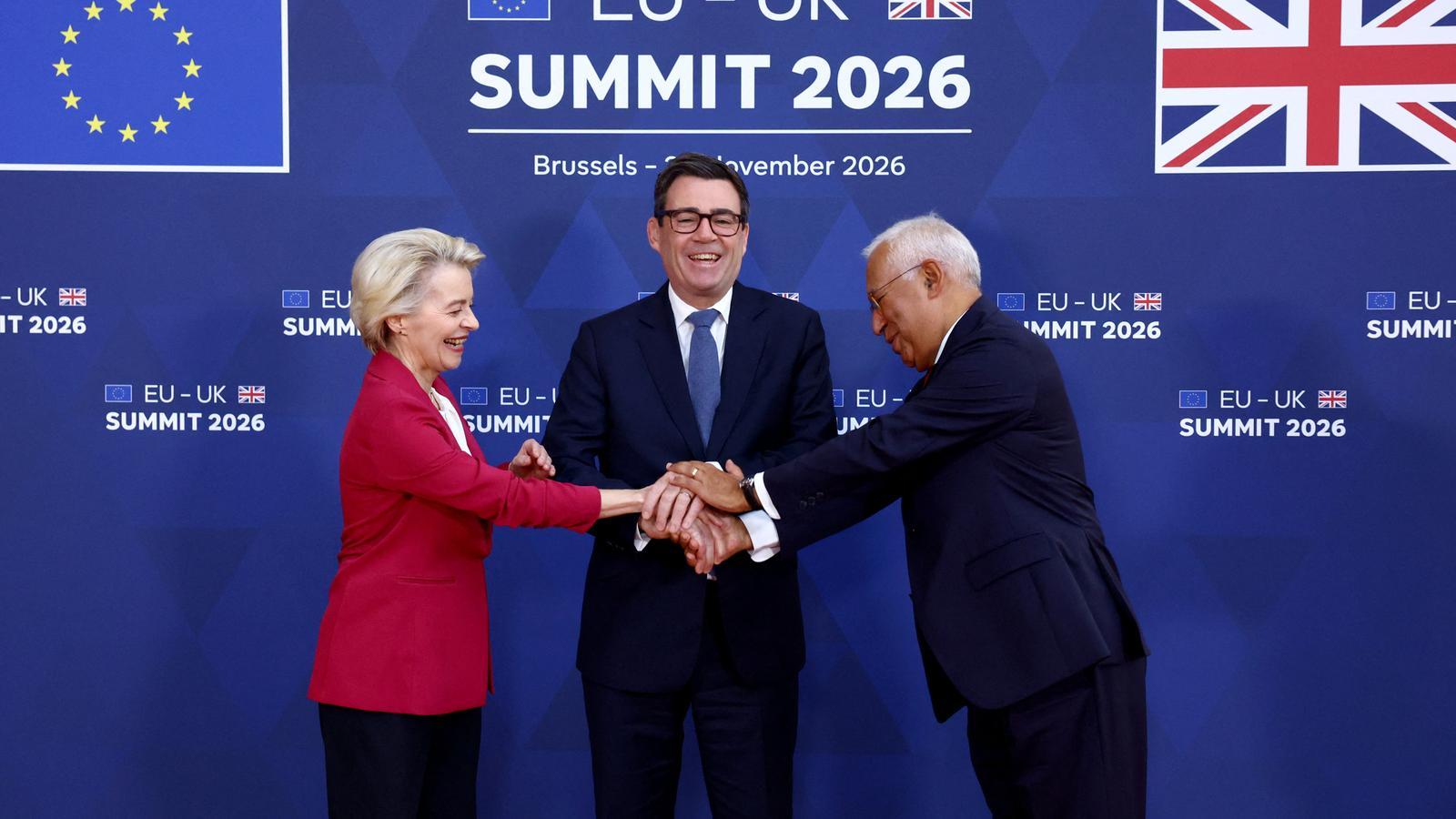

BrusselsBrussels and London have sealed their rapprochement with a triple agreement: they have agreed on the creation of a common sanitary and phytosanitary area to facilitate agri-food trade, the linking of emissions trading systems and a youth mobility program. They have left pending, however, one of the most delicate loose ends of the post-Brexit rapprochement, university tuition fees, and have given themselves six months to finish resolving it.
A decade after the United Kingdom voted in favor of leaving the European Union, the premier Andy Burnham; the President of the European Commission, Ursula von der Leyen, and the President of the European Council, António Costa, wanted to stage, with a handshake, that the wounds of Brexit are beginning to heal. “You measure distances in miles and we, in kilometers; and we may drive on opposite sides of the road. But the most important thing is that we move in the same direction, and that is what counts,” stated Costa.
The rapprochement, the leaders made clear, is still partial and is driven by pragmatism and the convulsive geopolitical context. “In a more dangerous world, together we are stronger,” asserted the British Prime Minister at the entrance to the summit. “In an increasingly confronted world, reliable and like-minded partners have both the responsibility and the duty to work together,” agreed the President of the European Council.
From the speeches they have delivered, the desire to turn the page and look ahead can be inferred, to provide “more opportunities” for future generations, who are the most benefited by the announced pacts. “I believe the British public can now look towards a better future and face the next decade with more hope,” stated Burnham.
But progress is slow (the effects of the pacts will not start to be seen until 2028), and reservations persist. The EU wants to avoid making concessions without London assuming equivalent obligations. And the British government, in turn, aspires to recover economic muscle by opening up to the continent, but without becoming subordinate to community rules.
This tension has surfaced in the negotiations over the university fees that EU students will have to pay in the United Kingdom. The EU argues that they should have the same conditions as British students—that is, access to the so-called home fees—, by virtue of the principle of equal treatment. London, on the other hand, has offered to lower their fees, but is resisting fully equalizing them.
Brussels has gone all out on this issue and has tried to condition the adoption of the agreements on emissions, healthcare, and youth mobility on a pact regarding university fees. After the refusal from Downing Street, a six-month period has been agreed upon to negotiate them, which should allow the four agreements to come into force as a single package. “What we are announcing today is probably the limit of what we can achieve in the current Parliament,” warned Burnham in reference to the electoral commitments assumed.
Fewer controls and coordination on immigration
The most significant agreement and the one that will have the most immediate impact is the sanitary and phytosanitary pact, which will allow for the elimination of mobility controls for “the vast majority of animals, products of animal origin, plants, and plant products” between the continent and the island, starting from March 1, 2028, which is when it will enter into force. London estimates that it could result in a benefit of up to 5.1 billion pounds annually to its economy.
Regarding the carbon market, the EU and the United Kingdom have concluded negotiations to link their respective emissions trading systems (ETS), which will also apply starting from 2028. This will exempt British and EU products, such as steel, from each other's carbon border levies.
The third agreement is that of youth mobility, which will allow 100,000 young people from the EU and 100,000 from the United Kingdom to reside for up to three years in the other territory. According to the document, the beneficiaries will be able to work, study, participate in volunteer programs, or simply travel. It is expected to be implemented by 2028 at the latest so that the first participants can travel by 2030 at the latest.
The document also mentions irregular immigration, especially in the English Channel. In this regard, both sides have committed to increasing cooperation and jointly addressing issues such as the fight against migrant smuggling networks, the strengthening of border management, and the exchange of information. These are commitments that must be specified over the coming months.
As expected, the question of to what extent the United Kingdom will have to align with community rules to benefit from European industrial initiatives also remains pending. Burnham is demanding that British companies be able to sign up for the so-called Made in Europe (Made in Europe), the plan with which Brussels wants to favor industrial production within the bloc and protect strategic sectors from foreign competition, especially the automotive one. The EU has shown itself willing to study it, but sets as a condition that London aligns itself with the European trade defense measures against imports of Chinese electric vehicles.