Lorca was not found... but in searching for him, more than a hundred victims appeared, many of them women
Among the victims there are many young women and a child of only twelve years
-
CAT -
CAST
Barcelona"Lorca is a universal symbol and is alive in the memory of all of us, his work can be found in any library, but of the rest of thousands of murders in Granada there is hardly any information and they must be rescued from oblivion. There is a memory that could not leave the houses for fear of the Civil Guard, the police and the neighbors themselves," points out the archaeologist Francisco Carrión, who has led many of the excavations, including that of the Barranc de Víznar, in Granada.

If you want to investigate the graph in more detail, open the high-resolution version in another tab.In the search for the poet's remains, research teams have been locating a series of mass graves for which there was no trace. "Lorca is the symbol of the disappeared and it would be very good to find him to talk about repression on an international scale; on the other hand, however, he is the paradigm of the disappeared who is not found. There are many people in the same situation," highlights historian Queralt Solé.
More cruel towards women
So, Lorca has not been found in the Barranc de Víznar, but many other victims have been found, leaving physical evidence of the diversity and cruelty of Francoist repression: among those murdered and clandestinely buried are trade unionists, teachers, intellectuals, merchants... and a significantly high number of women. "Of the 194 people exhumed in Víznar, forty are women, a rather high figure. The violence exerted against women was greater than against men, with evidence of blows, contusions, and much more brutal executions. We have found twelve women who belonged to the Needle Union and a boy only twelve years old who had two shots to the skull," details Carrión.
Although initially the collective imagination associated the graves almost exclusively with men, the discovery of graves, some composed solely of women, demonstrates a clear intention of gender repression. "Recent findings confirm that the violence exerted against women was not only motivated by ideological reasons, but also included an added punishment for being women, often with extremely brutal patterns of violence. This differentiated punishment is today one of the most active fields of research in the area of historical memory," says Solé
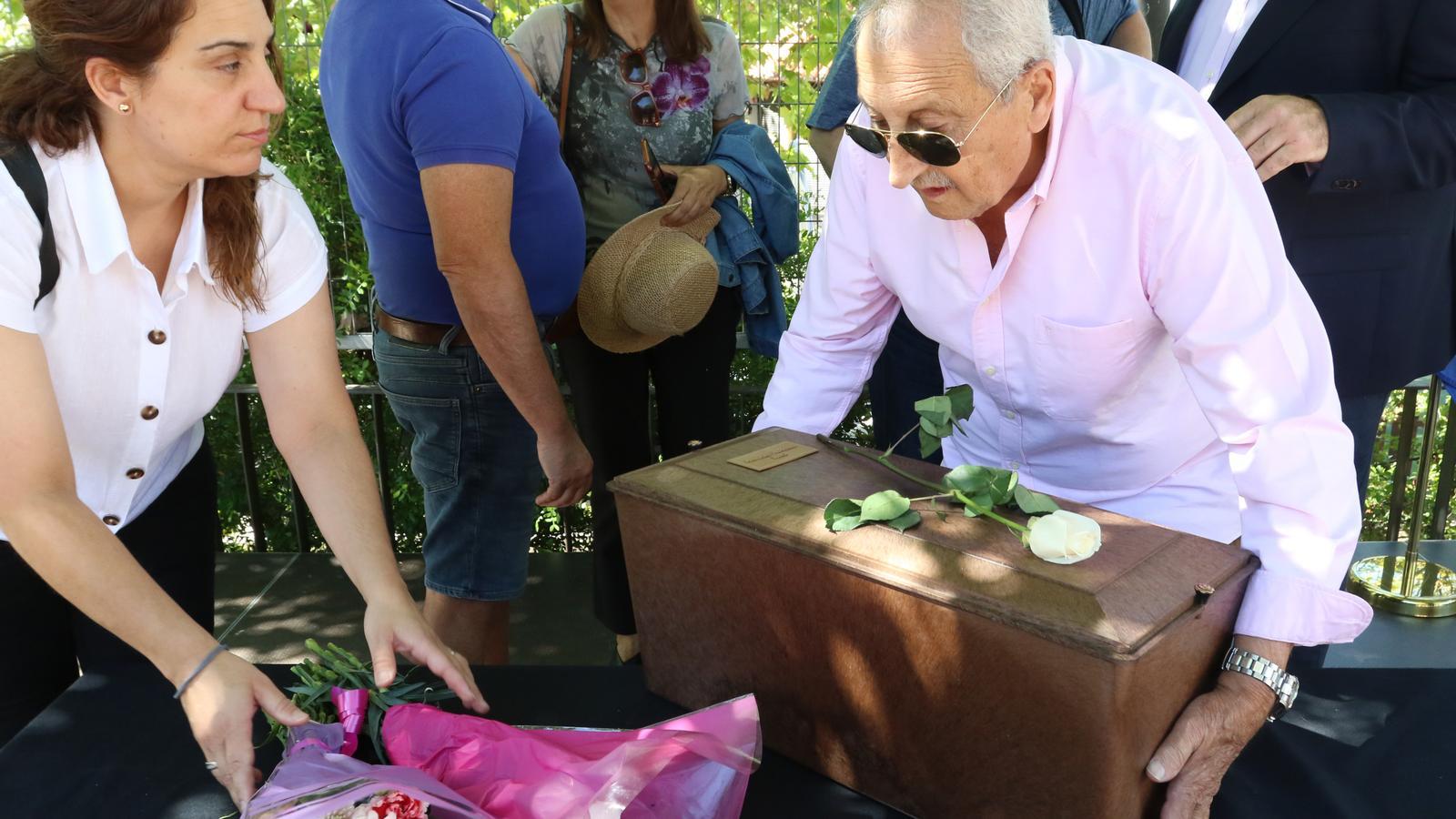
In the Barranc de Víznar, seventeen people have been identified so far, and the remains have been returned to eleven families. In one of these deliveries, carried out on September 19, moments of great emotion were experienced with direct descendants who were already very old. "Despite suffering from advanced Alzheimer's, at the moment of receiving the remains of their loved ones, they regained total and absolute lucidity: seeing this reaction to a wound that has been open for so long is an extraordinary testament," highlights Carrión. Another relative, Mario Martín Canal, who received the remains of his sister Eloísa, after taking the urn, placing it on his lap, and kissing it, said: "As long as I live, I want to have her with me."
Not to be separated from the remains
In the same mass grave in Víznar, the remains of Carmen Rodríguez Parra have been identified, affectionately known as "Madre Carmela," a mythical figure of Granadan anarchism. Carmen was also a pioneering woman: in the May 1936 elections, she became one of the first women to serve as an electoral supervisor in Granada. After the coup d'état, she was arrested and transferred to the Convent of San Gregorio. Her murder was extremely cruel. From her time in prison, only a small purse remained, which her daughter Nieves kept with a note: "My mother's purse returned from prison when they killed her."
According to recent data from the State Secretariat for Democratic Memory and RTVE, 5,848 graves have already been counted throughout the state, 1,478 have been exhumed, and 2,341 remain to be exhumed. However, hundreds of graves will never be found. 31% of Spanish towns have a clandestine grave, and there isn't a single village that doesn't have one within fifty kilometers: they are found in cemeteries, but also on roads, in wells, in mines, or in caves.
"The passage of time and decades of imposed silence have caused the irremediable loss of direct testimonies and many primary documentary sources. However, the 21st century has also brought scientific advances that have allowed many victims to be identified," highlights Solé. This progress, however, faces an obstacle also due to a long silence: if no relatives are found from whom to obtain DNA samples to compare the remains, the identification effort becomes impossible. "All in all, the impact of a mass grave is incomparable to that of any monument or document: the presence of human remains is the most direct and incontestable proof of the cruelty and repression of the Civil War," says Solé.
