Who rules at the bottom of the sea, where 99% of the information we consume circulates
There are hundreds of transoceanic cables, which a few multinationals install, while states push to exploit the minerals that lie in the depths of the oceans

-
CAT -
CAST
BarcelonaNearly a thousand people climbed the world's highest mountain, Everest, last year. Humans know the limits and secrets of our environment, of what we see, very well, and even the most inaccessible point has become a tourist attraction. But on planet Earth there are still many things we don't see, practically unreachable places. Everest is two kilometers shorter than the deepest point in the oceans, the Challenger Deep, in the Pacific, an immense well that is almost 11,000 meters deep. There are still many secrets to discover.
More than 70% of the Earth is underwater. The seas have served humanity as a source of living resources, through fishing, but in recent decades they have also become an immense energy generator: a significant part of gas and oil production now comes from marine areas, and there are wind turbines installed on the water. Furthermore, in recent years, the debate about the extraction of minerals from the seabed or even the possibilities for science to find genetic resources that help cure diseases has opened up. Added to all this are the growing infrastructures that cross the oceans. There are hundreds of electrical and telecommunication cables running from the United States to Europe. Also pipelines to transport gas, oil or hydrogen from one part of the world to another, or from extraction platforms to terminals. The North Sea is full of them. So is the Gulf of Mexico, the entire coast near the states of Texas and Louisiana. The battle for global power is also played out under the sea.
A telecommunications network
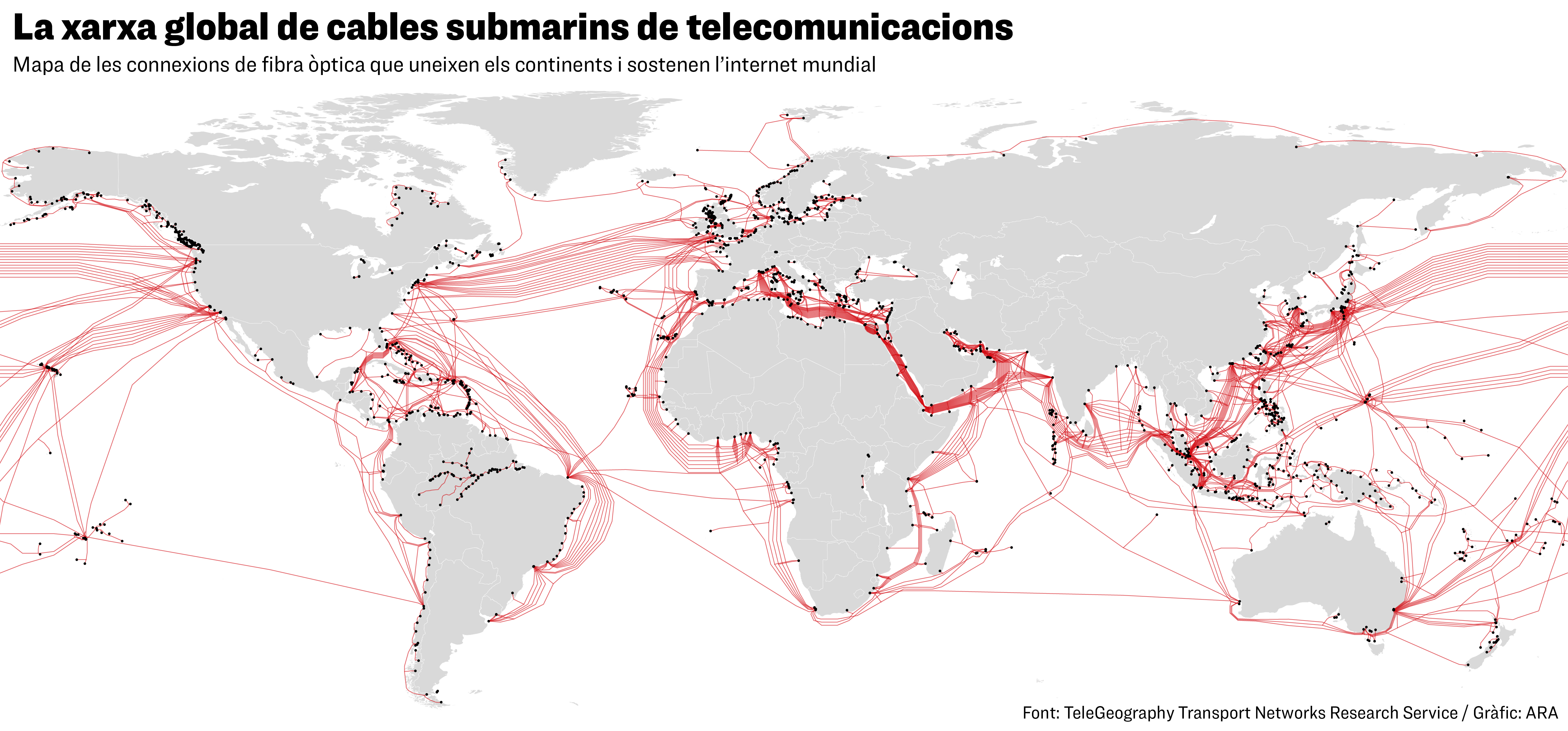
More than 95% – some even speak of 99% – of internet traffic goes through submarine cables. The flow of data does not go mostly by satellite, but rather at some point passes through the 694 cables that cross the planet underwater – counting those projected and under construction. And what passes through these tubes are not just absurd viral videos. "Also images of a CT scan taken in Barcelona that go to the United States or bank transactions. It cannot be trivialized. Irrelevant information is transmitted, but also sensitive and valuable," explains the UB professor, Miquel Canals. In January 2025, after the sabotage of submarine cables in the Baltic, the Secretary General of NATO, Mark Rutte, warned that the more than 1.3 million kilometers of existing submarine cables – now 1.5 – guaranteed daily financial transactions worth 10 trillion dollars. Nothing to do with the 16 hours it took for the first transatlantic message to arrive through these cables, in August 1858: a 98-word telegram from Queen Victoria of England to American President James Buchanan.

- If you want to investigate the chart in more detail, open the high-resolution version in another tab.
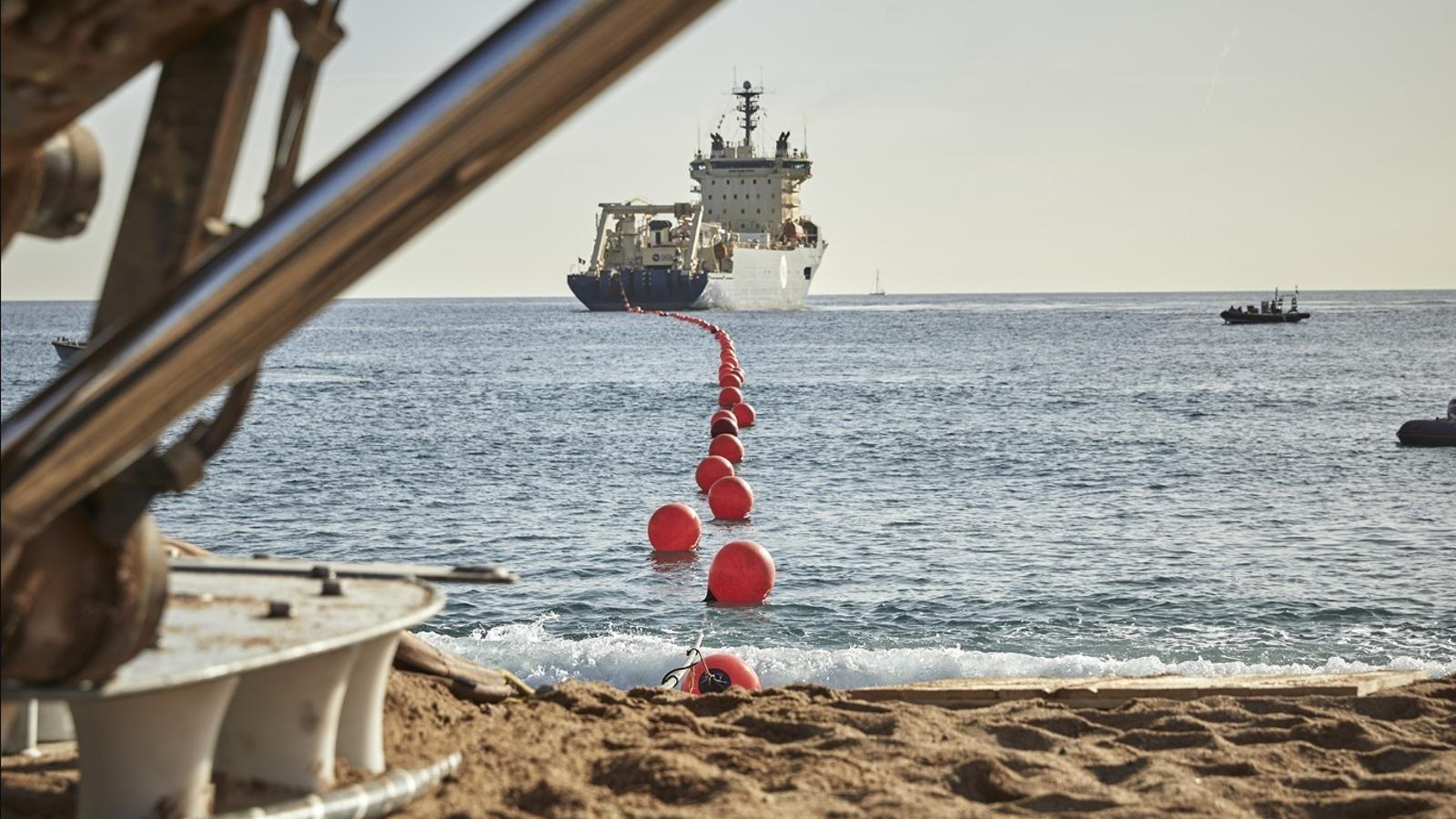
"In the Suez Canal, the Red Sea, the Strait of Malacca, there are many. In places where many ships pass, many cables pass underneath. The Baltic is also a hot spot," explains technology and telecommunications expert Albert Cuesta, who has been able to see from the inside one of the ships that installs these miles-long cables that cross the Atlantic. They are small cables, a few centimeters in diameter, which are unspooled from large spools and fall to the seabed, thousands of meters deep. They remain on the seabed and are covered with the material of the ocean itself. Every 100 kilometers, an optical repeater is placed, powered through the same cable, while near the coast the cables are protected to prevent ships from damaging them with anchors.
These cable installations are in the hands of a few companies. Cuesta highlights four: the French Alcatel Submarine Networks, the American Subcom, the Japanese NEC, and the Chinese Huawei Marine Networks. "They are strategic companies, Alcatel is nationalized by the French government, and no Chinese company can do anything without the Beijing government," points out the expert, who notes a "double monopoly" in this sector. The data traveling on these fiber optic cables are in the hands of the big tech giants – Meta, Google, Microsoft, and Amazon – who are the ones financing the deployment, often associated in projects.
big tech –Meta, Google, Microsoft, and Amazon–, who are the ones financing the deployment, often associated in projects.
According to a CNBC estimate, investment between 2025 and 2027 in this field will be 13 billion dollars, double that of the previous three-year period. Amazon is promoting Fastnet, a connection between Maryland and Ireland with a capacity of 320 terabits per second, equivalent to streaming 12.5 million high-definition movies simultaneously. Meta announced Project Waterworth, a 50,000-kilometer cable to connect five continents. "AI is increasing our need for subsea infrastructure," admitted Alex Aime, a senior executive at the company.
A cable crossing the transatlantic highway between the United States and Europe can cost between 250 and 350 million. These are cables, according to Cuesta, with a lifespan of about 25 years, not because they get "damaged," but for "a capacity issue." When cables stop working, they are not replaced or usually removed, but new, much "more capable" ones are installed.
This race to deploy the longest and most powerful cables is taking place under the watchful eye of the governments of the major world powers, fearful of espionage and sabotage. In 2016, the PLCN project was presented to connect Los Angeles and Hong Kong. But Meta and Google had to change it because the Joe Biden administration did not look favorably upon an infrastructure of this magnitude passing through Chinese territory: there was fear of espionage or that the Beijing government would collect data. This led to the route being modified, to Taiwan and the Philippines instead of Hong Kong.

Miners in the water
If the installation of electrical wiring, oil pipelines or gas pipelines is practically unquestioned, where there is debate is in relation to marine mining. Especially, outside the exclusive economic zones (EEZ) of each country: states are sovereign over the exploration, exploitation and management of natural resources within the 200 nautical mile strips from their coastline. But what happens in the middle of the ocean? It is full of very valuable materials, such as cobalt, nickel, manganese or copper. Professor Canals distinguishes between metalliferous deposits, when fluids from volcanic areas or oceanic ridges come into contact with water and generate large mines, and polymetallic nodules, small rocks that are on the seabed and have taken millions of years to form by the precipitation of metals in the water.
The Clarion-Clipperton Zone, a large area of more than five million square kilometers in the Pacific Ocean, between Hawaii and Mexico, is the largest reserve of metals on the planet: there are trillions of polymetallic nodules resting at a depth of 5,000 meters. More than on all the land. But, at the same time, it is a great refuge for many natural species. "One thing is to identify the resources, another is exploitation. Is the extraction technology developed? I would say no. Habitats in very deep areas have a very slow metabolism. Anything that damages them may be very difficult to reverse or even irreversible," points out Canals. The rich biodiversity in this geographical area may be in danger if there is massive extraction of materials: some ecosystems may disappear and giant clouds of toxic mud and sediments may be generated that will remain suspended in the water.
The International Seabed Authority (ISA), a UN body, is responsible for managing it. It has granted about twenty exploration contracts – not exploitation – while countries like China, Russia, Norway, the United States, or Japan are pressing and investing to position themselves well in this race for basic mineral resources for the global economy. Canals considers that, for the moment, the market is what is slowing down an unbridled race: it is not yet profitable. It happened with the Solwara project, in Papua New Guinea: the country partnered with a Canadian company to build the first underwater mine, but it failed. Nevertheless, the pressure on the ISA is growing. The island of Nauru, in the middle of Clarion-Clipperton, has initiated litigation with the help of a Canadian company to get the green light to exploit the seabed.
In any case, drawing on a map which areas can be explored and which cannot, is ineffective. "It is very easy to protect a marine area on a map, but you have to implement surveillance. Furthermore, even if you have a grid painted on the map, if minerals are extracted from the side, the protected part will end up receiving the impact," the professor reiterates.