The centenary cake of Olot that only three people know the recipe by heart, and don't have it written down anywhere
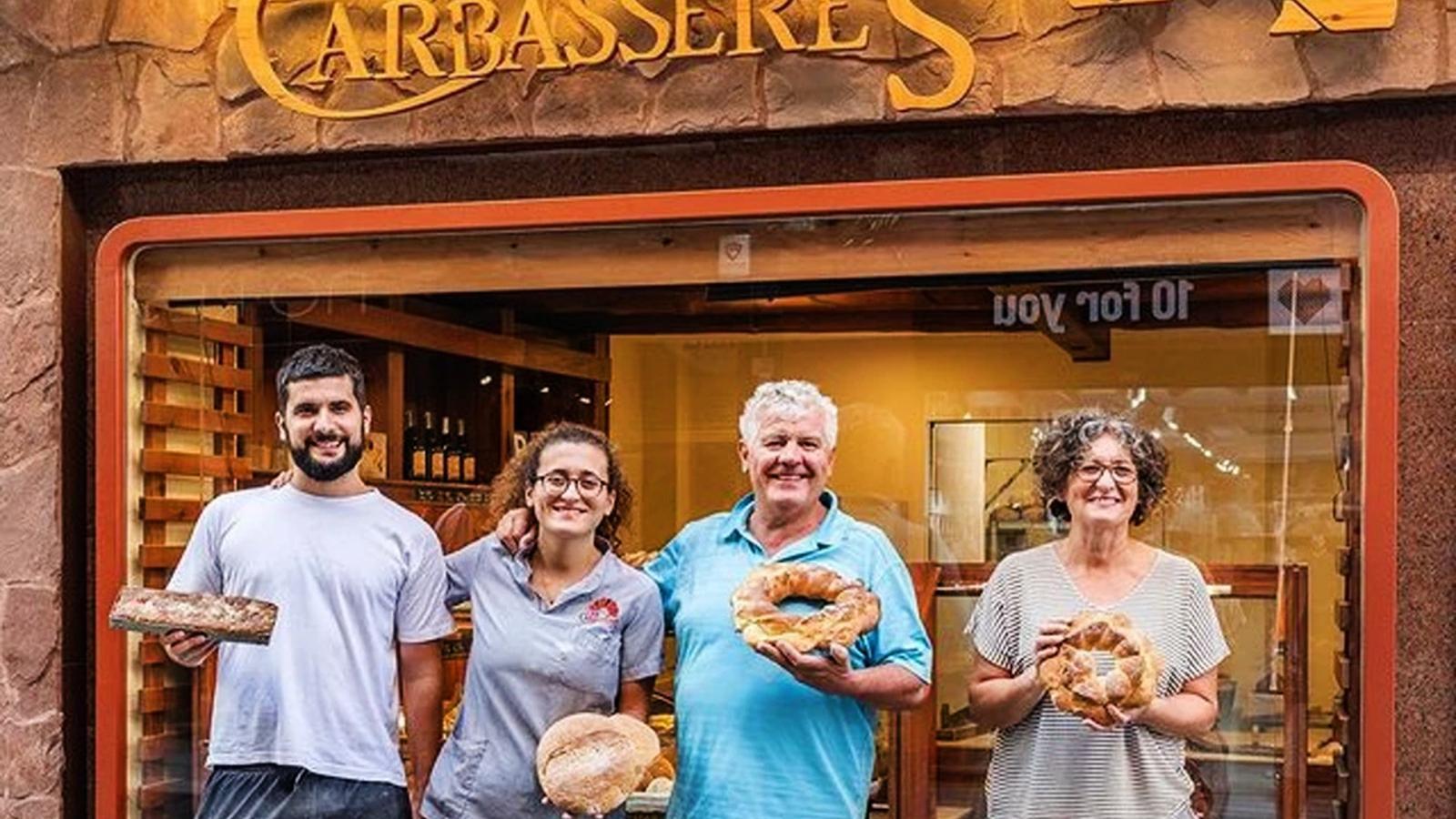
The pastry shop Can Carbasseres, from 1884, has passed the baton to the children, Alba and Nil Vilanova, who are in the workshop

-
CAT -
CAST
OlotIt is Monday, market day in Olot, and Sant Rafel street is a hive of people entering and leaving the Can Carbasseres pastry shop. It has a large display window, showing a sample of what can be bought inside. On the sign, with the name, there is a date: 1884. I go inside, and I find a whole family working there. The father, Jordi Vilanova, is retired, and talks with the customers who are queuing to buy; the mother, Judith Ribera, serves behind the counter, and the children, Alba and Nil Vilanova, are in the workshop. "I am the first woman in the family in five generations to work in the workshop," says Alba. She is the first to braid the tortells of Can Carbasseres, which are known throughout Catalonia, and which can be eaten for both sweet and savory dishes.

Next to the tortell, there are other flagship creations. The coca de llardons is also one. They make them all year round, every day. In many towns they are associated with Carnival and Sant Joan, but at Can Carbasseres they are an everyday item. In the workshop, below the shop, the wooden drawers have the dough resting, and little by little they will introduce it into the wood-fired oven, which "runs on wood; no gas at all," Jordi, known as Toti, and his sons tell me, assuring that there are no ovens like theirs left in Catalonia. "People want to control the exact temperature at all times; we work differently," they state. First, they put the wood inside and light the fire; then they move everything to one side, embers included, and then in the middle is where they introduce, with the help of a shovel, the doughs, which they will have previously left to rest in the trough-shaped drawers. When the oven is very hot, they start putting in the doughs that need more heat; the tortells and the coques are last.
A recipe made from memory, never written down
Can Carbasseres has always been in the family, and the recipe for the braided tortell is known only to them. “We don't have it written down anywhere, nor will we. And not even our mother could explain it, because only those of us in the workshop know it,” say Alba and Nil, who add that they don't think it's dangerous not to have it written down. “We can tell you what the ingredients are, which are flour, sourdough, egg, Paris yeast, sugar, aniseed,” and that's it. The braiding is a game of hands, because you have to stretch the dough, roll it, close it. “Perhaps we have some video posted on social media showing how the braiding is done,” comments Nil. The fact is that they make many every day; on market days, even more: “Perhaps seventy or eighty on Mondays, because the whole region comes to Olot.” The rest of the days are quieter.
Next to the two famous coques (there are three different sizes of tortells), there are also round breads. “Dad started making them about twenty-five years ago. At first, we only made them with wheat, but now also with buckwheat flour, spelt, cornmeal.” They are soft breads, which are eaten in a jiffy. There are some with chocolate. “We made them because we wanted to offer a snack, to create an alternative to pastries, and that’s how the breads with chocolate came about,” comments Alba.
Back to the tortells, and I ask the family about their origin. “It’s a preparation that comes from the baker's world, not the pastry chef's,” says the father: they have always made it with a round shape and a hole in the middle. As it dates from the end of the 19th century, Jordi Vilanova believes it is of Jewish origin. For Rams, the palm was blessed with the tortell hanging from the arm. In any case, it is a sugar-balanced sweet, which in Olot and the region is eaten for breakfast, snacks, or even as bread to accompany meals or to eat with cured meats or cheeses. “Once there was a competition in Olot to explain ways of eating tortell, and eighty different ways came out: with jam, chocolate, with pâté, and more”.
With all the questions asked about the production, I am focusing on the succession. Alba and Nil are the fifth generation. Alba started at twenty-seven: she had finished her degree in journalism and two master's degrees, one in communication management and the other in cultural management. "And if I were to start again, I would choose to study journalism and the two master's degrees again; it's just that when I finished studying, I decided I wanted to work in the family workshop," explains Alba. Her father listens, and says that she was the one who wanted to do it and that she expressed it to the family. No woman before, none of the four generations ahead of her, had entered the workshop, on the ground floor of the listed building on Sant Rafel street in Olot, to work there. She has been the first, and she assures that she likes the job. She combines it between the workshop and the counter. Downstairs, she works with her brother Nil, who started at 17; she, ten years later, when she had finished all her studies. "I don't know if any woman in the family had considered it before, but I have been very clear about it," concludes Alba Vilanova.
