The four wine producers that everyone will talk about, and that excite the oenologist Sara Pérez
The Vinseum, the wine museum of Vilafranca del Penedès, hosts a guided tasting by Sara Pérez in which she presents four women who make personal wines, outside of conventionalisms

-
CAT -
CAST
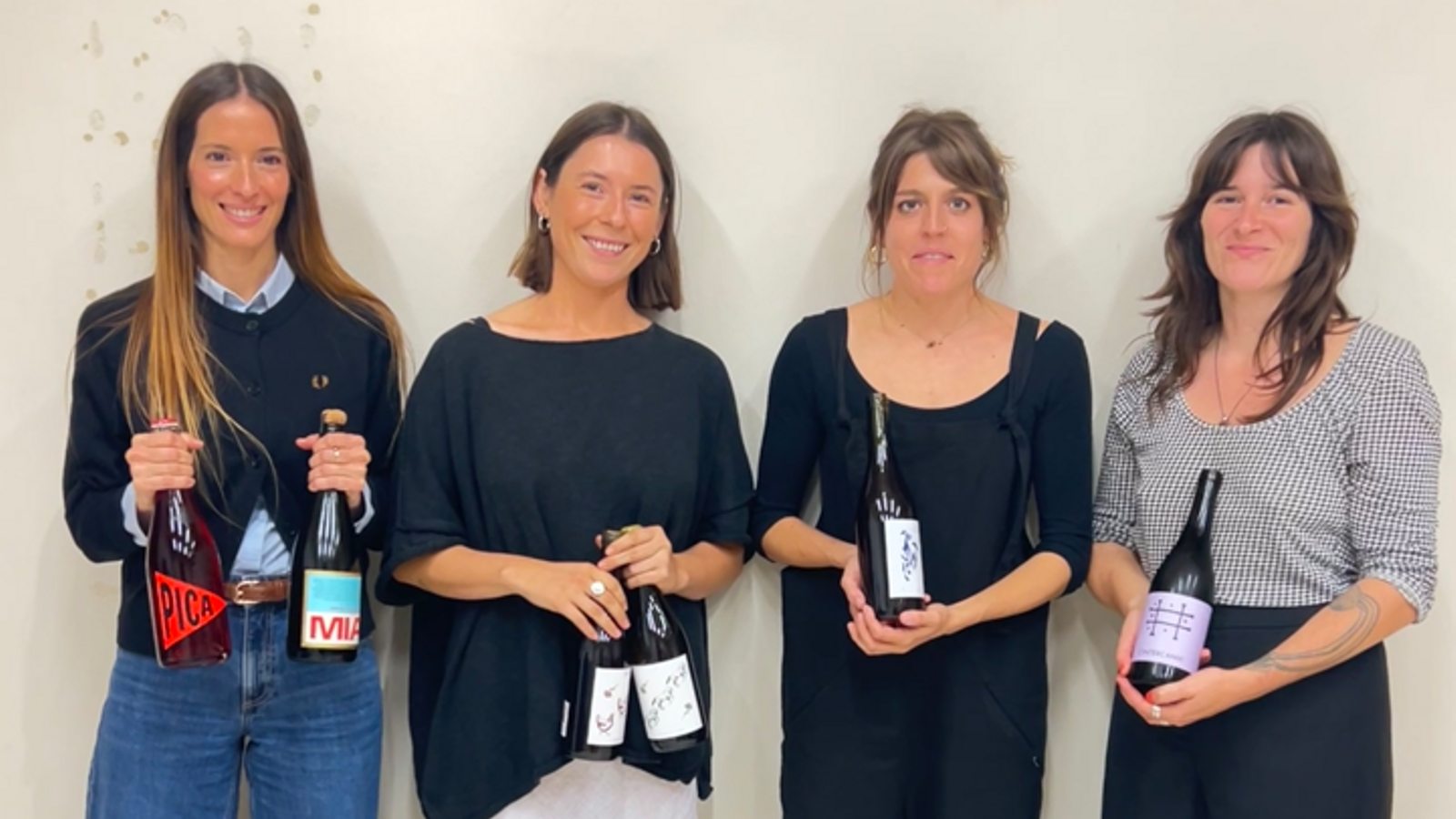
Vilafranca del PenedèsIt is Tuesday evening, and the Vinseum, the wine museum of Vilafranca del Penedès, has organized a star tasting, that is to say, they have invited an oenologist, Sara Pérez (Venus la Universal; Mas Martinet), who in turn has chosen four female winemakers who will be talked about a lot in the coming years, as she herself asserts. Sara is one of the great women of wine, representing both passion and good sense at the same time. She radiates enthusiasm when she speaks, and at the same time argues and debates the topics raised with rigor."When I arrived in Priorat with my family, I was seventeen. I did not start making wines until I was twenty-eight." The data is important because "I inherited what my parents had done there, I did what was established, and I think they made the revolution, yes, but we all settled into our chairs right away." "Right now the country, Catalonia, is experiencing a great revolutionary wave, and what I can do at my age is to spread it," she says. How does she do it? She has chosen the wines that she likes, and those of Isa Serra (Horta Colomer, in Priorat), Anna Martín (Hattrick, Terra Alta), Marta Nieto (Vins l'Intercanvi, Penedès) and Júlia Faura (Vins Ric, Berguedà) excite her.

Sara Pérez explains that the four winemakers have many points in common: they work and express themselves with freedom and are demonstrating a new perspective on wine, which is transformative. "It does not escape me that all four are women, and that they have knocked on the doors of four men, the winery owners, so that they would let them make wines; perhaps there is a servitude, a teaching, a paternalism, that we should avoid because the four women are four super-powerful monsters, who demonstrate having enormous courage with their wines". Sara also explains what the four winemakers are like with another characteristic that unites them: "The unique perspective and sensitivity that they show in their wine, and this even though the winery and the vineyards are often not the same, because they are nomads or have been, which is a fact of current life".
We start by tasting Isa Serra's ancestral. "When I drank Isa's ancestral, my head exploded; I said to myself: "Is she really making bubbles in the Priorat?"". The ancestral is sold with the Horta Colomer label, it is outside the DOQ Priorat, "there is no need for us to get into the subject of appellation of origin regulations now," and Sara explains that in the 90s the revolution in the Priorat was made by people who came from outside, and Isa says that she is from outside, but she has settled there and started a family." Isa's perspective is what made Sara rethink everything; so much so, that the Horta Colomer ancestral is one of Sara's great recommendations, who also shares her opinion on natural wines: "It is the first movement born from below; it has no guru at the top recommending them, and that is why I think it is a social revolution, which breaks the hegemony that existed until now; and we must respect, listen to and understand it."
A spicy red wine, a unique look
We are back with the ancestral and the Pica wine (red, made with spicy peppers; this year with Jalapa chilis) by Isa Serra. "It is a wine that comes from the Priorat, with llicorella soil, which is land of fire, a metamorphic soil, which was created three or four hundred million years ago". It is a land of fire, where the vine grows between heaven and earth. "Both the ancestral and the Pica I make at the Vall Llach winery, which works from excellence, and I have made them from my intuition and with the freedom that being outside the designation of origin gives me", explains Isa Serra, who adds that she has interpreted the Priorat with bubbles and spiciness, which she makes with the peppers, chili peppers, and Jalapa chilis that she plants in her garden, in the middle of Porrera, the so-called Horta Colomer. The ancestral is called Mia, as a tribute to one of the first people who welcomed her when she arrived there: the cook at the La Cooperativa restaurant in Porrera. "I wanted to make bubbles because Mia is celebration, but also elegance and excellence, and that is how I thank her for having welcomed me, for having made me feel less like a foreigner". The ancestral Mia is made with white grenache.

At this point, Sara Pérez reflects aloud on a project she would like to promote: "Just as there are artistic residencies, the idea of winemaking residencies occurs to me, which means that the person we host at our winery can also make their own wine, their own interpretation using our grapes." This is the idea with which she gives meaning to the word nomad-guest, also called stagiaires. And it all came to Sara's mind two summers ago when she had her first stagiaire during the harvest. "I started with the harvests in 1997, so one of my first stagiaires, whom I saw again two years ago, was a man who was much taller than me and very well-educated." Sara then thought about this idea for stagiaires to become residents who make their own wine. "They do the harvest with me, I give them food, lodging, and I give them grapes so they have the possibility to make their wine." What would Sara gain from this idea? "Learning, because for many years we have thought that teaching students on internships was unidirectional, and it is not like that, because every question they ask me makes me rethink concepts that I had forgotten or shelved, and it is also the way to feel eternally young; eternity is working with young people." If these residents could make three hundred bottles and sell them on their own, the circle would be perfect.
Second producer. It is Anna Martín, who has traveled all over the world and lives in Terra Alta making natural wines, under the name Hattrick. "My father is an oenologist, he never pressured me to follow in his footsteps, so I studied veterinary medicine". There was a time when she spent days working consecutively with him, and it was then that she became interested in the world of wine. One of the natural wines that Anna has produced has passed through a Jerez barrel to pay homage to her father, of Cordovan origin, and the final sensation is a wine with great uniqueness. Lovers of Jerez wines will be transported there, to the south, but without having left Terra Alta.
We continue with the third producer, Marta Nieto (Vins L’Intercanvi), who begins by saying she makes "a humble little wine, made with a lot of love." Sara interrupts her immediately: "It's not a little wine, it's a great wine, a very good wine." Marta continues explaining that in all the professions she has had (such as a filmmaker) she has felt like an intruder, but now making wines she feels comfortable. "With the vineyard, with nature, I have found the authenticity of life, even though I come from a family that has no wine-growing properties." Marta started pruning friends' vineyards in various denominations of origin, and now she has taken root in the Penedès, where there is monoculture of vines, an aging farming population, and complicated terrain. "I have ended up in vineyards where a tractor cannot pass, and I have come to have the feeling that I am accompanying the end of the life of the vine." So, in this paradigm shift, which means that "we don't know how many years this landscape will last," Marta has made a wine thanks to the exchange with the farmer David Baixas, a master of biodynamics: he gives her the grapes; she goes to fairs to sell the wines. Her wine is made with Xarel·lo, in a vineyard surrounded by forests, and the result is a fresh wine with minimal intervention. "It is a wine that I make for love because making wines does not solve my economic life."
We continue with the last of the star tasting, Júlia Faura, from Vins Ric. "I am from Lluçanès, but I live in Berguedà, and I make wine to value the people who work the grapes in the Sota el Cingle project, in Berguedà," says Júlia. They use recovered native varieties, and she also did a work exchange: "I helped them with the harvest, and they let me make this wine, which has been a way of discovering who I am."
The end of the tasting arrives. Sara Pérez takes the floor again with a final rhetorical question: "Haven't they seemed like wonderful women and wines to you?". They are the future, which can already be drunk. And the star tasting ends with a toast with the wines and the ancestral of the four winemaking women.
