Eugènia Bieto: "We must depend less on subsidies. It is not known if they will be collected or when"
President of the Catalan Coordinator of Foundations
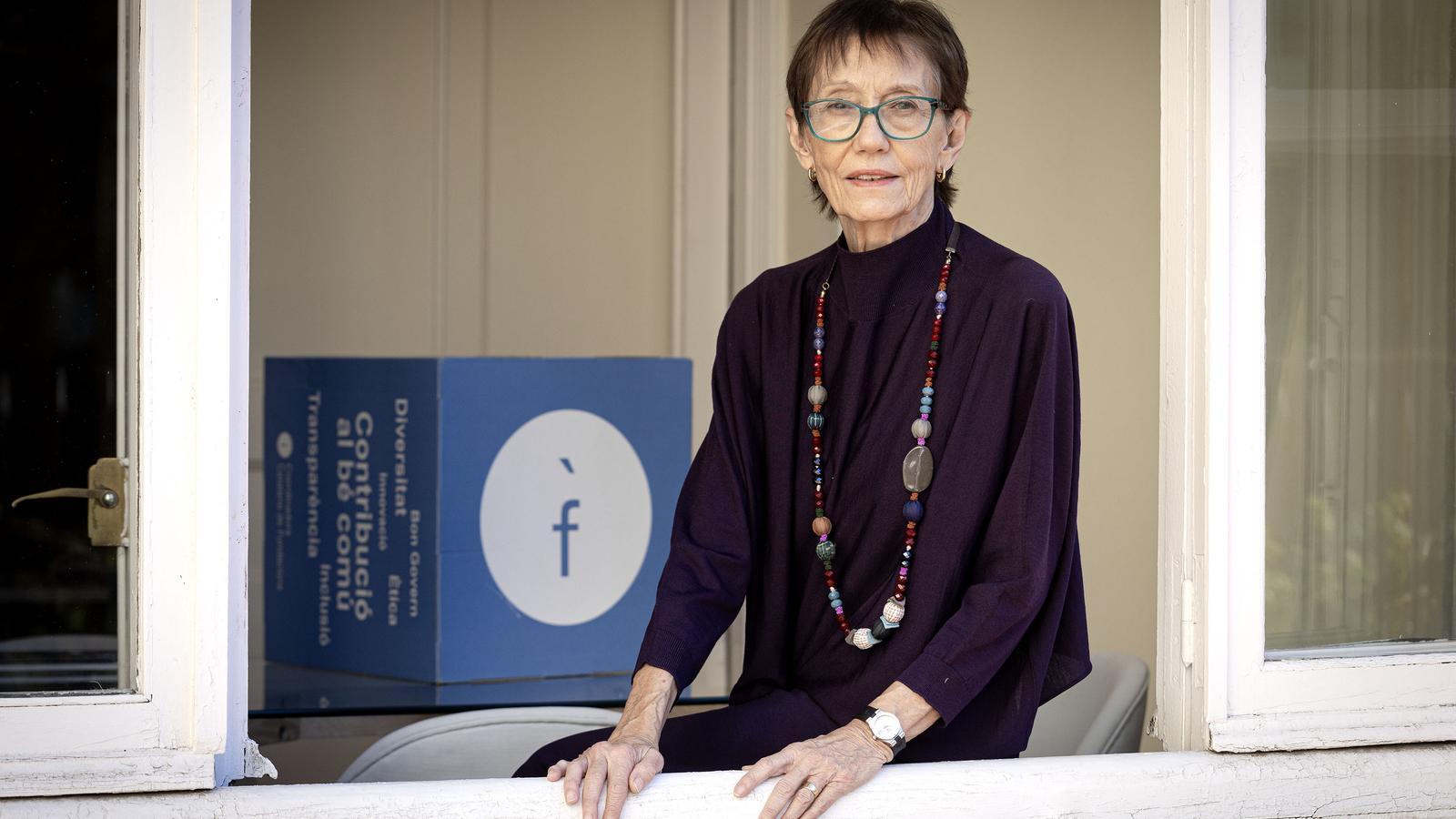

BarcelonaEugènia Bieto (Barcelona, 1950) is an honorary professor at Esade Business & Law School. She was the director general of Esade (2010-2018) and is currently the president of the Catalan Foundation Coordinator.
How many foundations are there in Catalonia?
— In Catalonia there are 2,100 active foundations, which report to the protectorate of the Generalitat. Of these, the coordinator groups 815, which gives us an important capacity for representation.
What do foundations contribute to the Catalan economy?
— There is all the social action they carry out. But it is true that foundations are also an economic sector. We study it because all the data is available, since foundations must submit their accounts every year to the protectorate.
Are these real data?
— These are real data. And it is an important economic sector, because it employs more than 110,000 people, which represents 2.8% of employment in Catalonia. Furthermore, they count on the selfless, free collaboration of 40,000 volunteers. And, above all, very relevant, 15,000 trustees. In the end, the board of trustees is the body that guarantees that things are done well. In economic figures, total income is nearly 7 billion euros, of which 68% are sales and services. This 68% is real economic activity.

And the rest of the income?
— Apart from the 70% that comes from sales and services, there is around 25% from public subsidies. At this moment, the goal is to depend less on subsidies. Because it is unknown if or when subsidies will be collected. And only the rest are donations, a percentage that is low, although it has been growing in recent years. And it has been growing for different reasons.
Which ones?
— Firstly, because the act of asking has become professionalized. We increasingly find foundations that have, at the moment they ask for donations, a person who has been trained in this.
Are they creating a structure to request donations?
— There is a structure, I think it is professional. But in small foundations, what does the coordinator do? Provide training so that all foundations adopt this culture. Total income is important and the percentage of gross value added of the Catalan economy from the foundational sector is 4.2 billion euros, which represents 1.7% of the Catalan gross value added, with 2022 data. We are talking about a country of foundations, 2,100 foundations, half of which have fewer than twelve employees. We are talking about a small sector. But these twelve also grow a little: that is, the number of foundations does not change much, but employment is indeed growing.
Wouldn't it be logical to have some kind of merger of foundations to gain volume?
— It is one of the challenges. I would not call them mergers, but alliances. I come from the business world, I come from Esade and I have been a strategy person. And it is true that we must look at all the tools and strategies of the private sector to see what can be implemented in the non-profit sector. But things cannot be transferred in the same way, because foundations have a characteristic. They are usually very rooted in the territory and have that capacity to capture its needs, to be in proximity. We organize meetings between foundations from the same sector or from different sectors so that they learn to collaborate. For example, now they are with the implementation of artificial intelligence. It makes all the sense in the world for them to make some kind of alliance. In many aspects, in terms of technology, in terms of impact measurement, we do send this message.
Is the patronage law key to increasing donations?
— Radically yes. The patronage law favors it. The latest law that was approved in 2024 represented a substantial improvement. It is also important now to have a Catalan law for it, because this is a layer on top of the state one.
Will the law currently being processed in Parliament go ahead?
— For the moment, the first step is moving forward. I believe so. It has enough support.
And will it be a good tool?
— It will be a good tool, without a doubt, because I believe it adds 15% [in tax deduction for donations] more on top of what already existed. And also, above all, this Catalan law rewards regularity, that is to say, commitment. If you commit to making a multi-year donation for four years, then you get a higher tax deduction.
Improvements in governance for foundations are also necessary. They have gained a certain bad reputation, as something obscure that is used for tax avoidance, to hide things. And, furthermore, there have been scandals that do not help. Should some type of reform be carried out?
— We are going to address this question from two perspectives. First, that of bad reputation. I agree that when any malpractice comes out, it weighs heavily and does them a lot of harm. Secondly, we also conduct a study on this trust. When you ask about a whole series of institutions what level of trust between 0 and 5 they deserve, foundations appear fifth, behind SMEs, associations, NGOs, and the police. They are also asked with what words they associate the word foundation. Then, 40% associate it with positive things, such as altruism, help, efficiency, etc. But 26% associate it with corruption, lack of transparency, tax avoidance, and shady schemes.
Then, to improve this, is it necessary to improve the governance of the foundations or is it necessary to improve the protectorate?
— The protectorate is doing an extraordinary job. However, when the issue of opacity exists in the collective imagination, the governing body, which is the board of trustees, is obliged to ensure that the things the foundation does are what they should do and, furthermore, that they are done well. And transparency. The foundation should advertise everywhere, because foundations are required to submit a real report with their income and how they have spent it. We published the practical guide on the responsibility of trustees and the importance of implementing compliance. I believe this would be one part and another part would also be to give visibility to the work that foundations do.
Is it a sector that still needs to be professionalized both from the point of view of the workers and from the point of view of the governance of the employers?
— Yes, but in the last ten years I have noticed that there has been a growing professionalization in all areas. There is still a lot to be done in the field of governance, in terms of rotation and renewal of boards of trustees, for example.
Do foundations compensate for the shortcomings of the administration?
— It is often said that foundations reach where the public administration does not. I would say that there are three pillars in the functioning of a country, which are the public administration, companies, and foundations. When all three collaborate, it works very well. But it is true that foundations can go further than the public administration. They are more efficient than the administration.
