The fishermen who come because Europe has left them without fish
The Senegalese who work on Catalan boats are climate refugees who have emigrated to Europe because of industrial fishing, which has altered their subsistence economy

-
CAT -
CAST
Cambrils and Vilanova i la GeltrúThey are called Mourtalla Diop, Mamadou Diop, Cheikh Wele and Thierno Sene; they were born in Senegal and speak Wolof as their first language. None of the four knew each other before meeting at the ports of Vilanova i la Geltrú and Cambrils, where they work. All four share a similar story of overcoming adversity: they come from fishing families in Senegal, a country they had to leave because one day what they knew how to do, fishing, had become a profession with no future. They left the so-called Global South of the African coast to look for a new job, a new life, and they have found it in the Catalan ports. “I like fishing because it’s what I’ve always done,” explains Mamadou one afternoon at the port of Vilanova i la Geltrú. Mamadou shares the same surname as Mourtalla, but they comment that they are not related. “We met working at the port of Vilanova,” they say, adding that the surname Diop is common in Senegal.

The populations of the coast and the eastern part of Senegal, Gambia, Mali, and Burkina Faso depend on fishing and fish consumption. “It is their food security,” explains Marina Monsonís, author of the award-winning book Mare mar (Ara Llibres), where she explains how these communities function: men practice artisanal fishing and women are dedicated to smoking, drying, and selling fish in local markets. Family economies are based on this chain, with these two well-defined roles. But one day all this changed: Europe's fish farm industry, which requires large quantities of feed – made from fish – grew so much that “European boats, including Spanish ones,” went to fish on the African coasts, says Monsonís. The Barcelona Street Vendors Union has explained that the fishing carried out by Spanish vessels, and those from other European countries, on the African coasts has been “industrial fishing with a capital I, which uses bombs and destroys everything,” recalls Monsonís. As artisanal fishermen in Senegal run out of fish, "their entire community, cultural, and economic life, their cuisine and nutrition, their way of life, and their relationship with the environment” is altered. That is why, Marina Monsonís continues to explain, Senegalese migrants become “ecological refugees,” because they have felt forced to “abandon their land and their sea because the natural resources that allowed them to live have been destroyed”.
A country without artisanal fishermen
If Spanish boats and others have been able to go there to fish with industrial methods, it is because there have been “international trade agreements, which have the approval of the corrupt government of Senegal, which has allowed the activity of multinational companies established in the country to end the basic and necessary resources for the local population”, says Monsonís, who recalls that Europe has also gone to Senegal to dump electronic and electrical waste. “Since 2015, 125 tons of electronic and electrical waste have been dismantled in Senegal”, says Monsonís.

This is the scenario that the fishermen from Senegal in our ports have experienced. Their relatives have stayed in their country of origin and they keep in touch whenever they can. It is a scenario that has been explained and denounced. The report Feeding the monster: How European aquaculture and animal feed industries are stealing food from West African communities, by Greenpeace Africa and the Changing Markets Foundation, has explained that "the fishmeal and fish oil industry is diverting a valuable food source to make feed. Every year, more than a million tons of fresh fish that could feed millions of people in West Africa are used to feed animals in industrial aquaculture, mainly in Europe and Asia". For this reason, the question Monsonís asks is whether the fish farm industry should be stopped, because if it were stopped, then the feed industry would also stop, and then "we would benefit the coastal communities of Africa". The expert points out that Greenpeace's study "also tells us that this harms coastal African communities such as those in Gambia and along the coast of Senegal, and inland communities such as Mali, Burkina Faso and the eastern part of Senegal". They are affected because fish is their food security, which has effects in all areas, social, economic, and also physical health.
A new opportunity in Cambrils
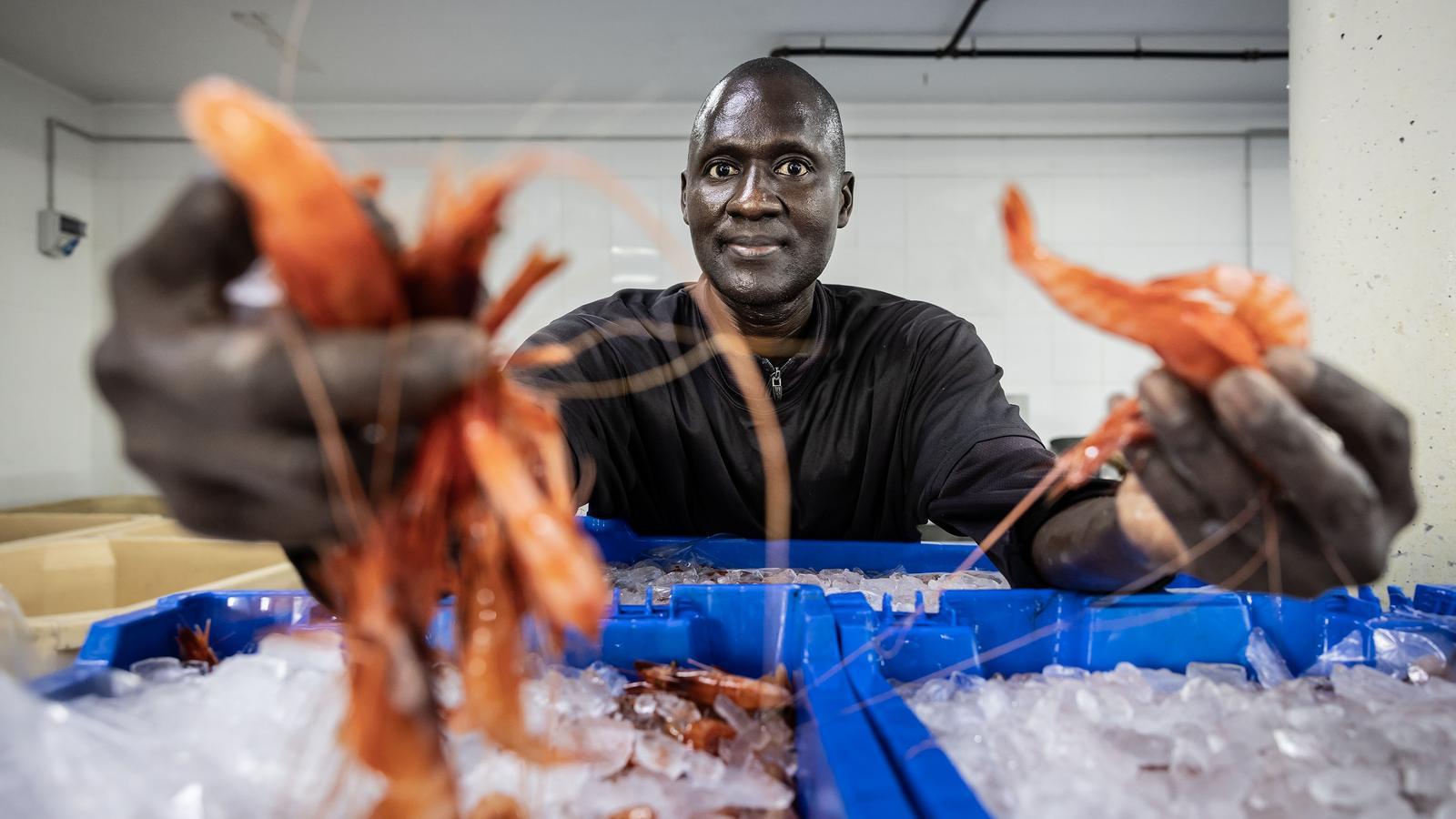
In the port of Cambrils, Thierno Serne says he is 18 years old. He has been working there since September and remembers how he helped his father to get the fish boxes and clean the boat. "I've been doing it since I was little," he comments, adding that at home his mother sold them at the market and they also ate them. Now he lives in Tarragona, a city he says he likes very much, and where he studied cooking. He shares a flat with other colleagues, and writes whatsapps to his mother to tell her he is well. "I like the work at the port of Cambrils; it's very fast because the fish has to leave the port immediately once it has passed through the fish market," he explains. He works a few hours in the morning, when the bluefish boats arrive, and then in the afternoon, with the boats that arrive with red prawns and white fish. He puts ice in the boxes and prepares them for the buyers to take away. He speaks Spanish, understands Catalan, and says that the journey from Senegal to Tenerife in a makeshift boat was not easy at all; but he doesn't want to remember it and on the day of the interview he says he will cook rice with fish.
Meanwhile, in the port of Vilanova i la Geltrú, Cheikh Wele says, in Spanish, that everyone knows him by the name of Sergio. "I've gotten used to it, but my name is Cheikh," he says from on board the boat Montclar, which is the largest in the port of Vilanova. Today they have fished red prawns, but not as many as a few months ago, and that discourages him. "I want my boss to catch a lot of red prawns, because then he is happy," he says. He has been living in Vilanova for fifteen years, where he has managed to change his life; not his profession, because he does what he knows how to do: fish. In Vilanova he lives with his wife, with whom he has had three children, who go to L'Arjau school. "Did you know that in Senegal we also fished prawns, which are not as red as yours? We used to take these prawns to sell in Huelva, and that's how I entered Spain." From Huelva he went to Almeria, and then to Catalonia, and now his children speak Catalan and he is learning it: "Look, I know how to say 'a little', 'whenever you want'."
Finally, Mamadou Diop, who works on the boat named La Geltrú, says he arrived sixteen years ago. "And it was by chance, because I was accompanying other colleagues, from Senegal, who had come to Vilanova to sell clothes as street vendors". Since he was a fisherman in his country, he thought about asking for a job there. Today he has a partner and three children, and in August they are going to visit family. "It wasn't easy to get to Spain; I did it via Tenerife by dinghy in 2006, and from there, to Madrid, to the town of Don Benito. While I was there, some friends from Reus called me, and they told me that there was a lot of work in the ports here, and I came", and he says it seriously because Mamadou has a stern demeanor, clad in his boots and green waterproof suit.
A few meters further on from Mamadou, who is on the boat La Geltrú, is Mourtalla Diop, who works for the Vilanova Fishermen's Guild. He says he has been living in Vilanova for eleven years and that he speaks Catalan, and also Italian, in addition to Wolof, of course. Both are friends now. Mourtalla talks as fast as he works at the fish market, because he knows that as soon as the fish has been auctioned at the market, every minute counts: he is very fast at placing ice on top of the fish boxes, at wrapping them with plastic film, so that buyers can take the boxes away. It was his life in Senegal, the one he would have liked to continue having if it hadn't been for the day the fish ran out. And, without fish, in Senegal, there is no life. That's why he has looked for it in our ports.
