Svetlana Aleksiévitx: "In Chernobyl, an apple, a glass of water, a bath in the river could kill you"
Journalist, Nobel Prize in Literature

-
CAT -
CAST
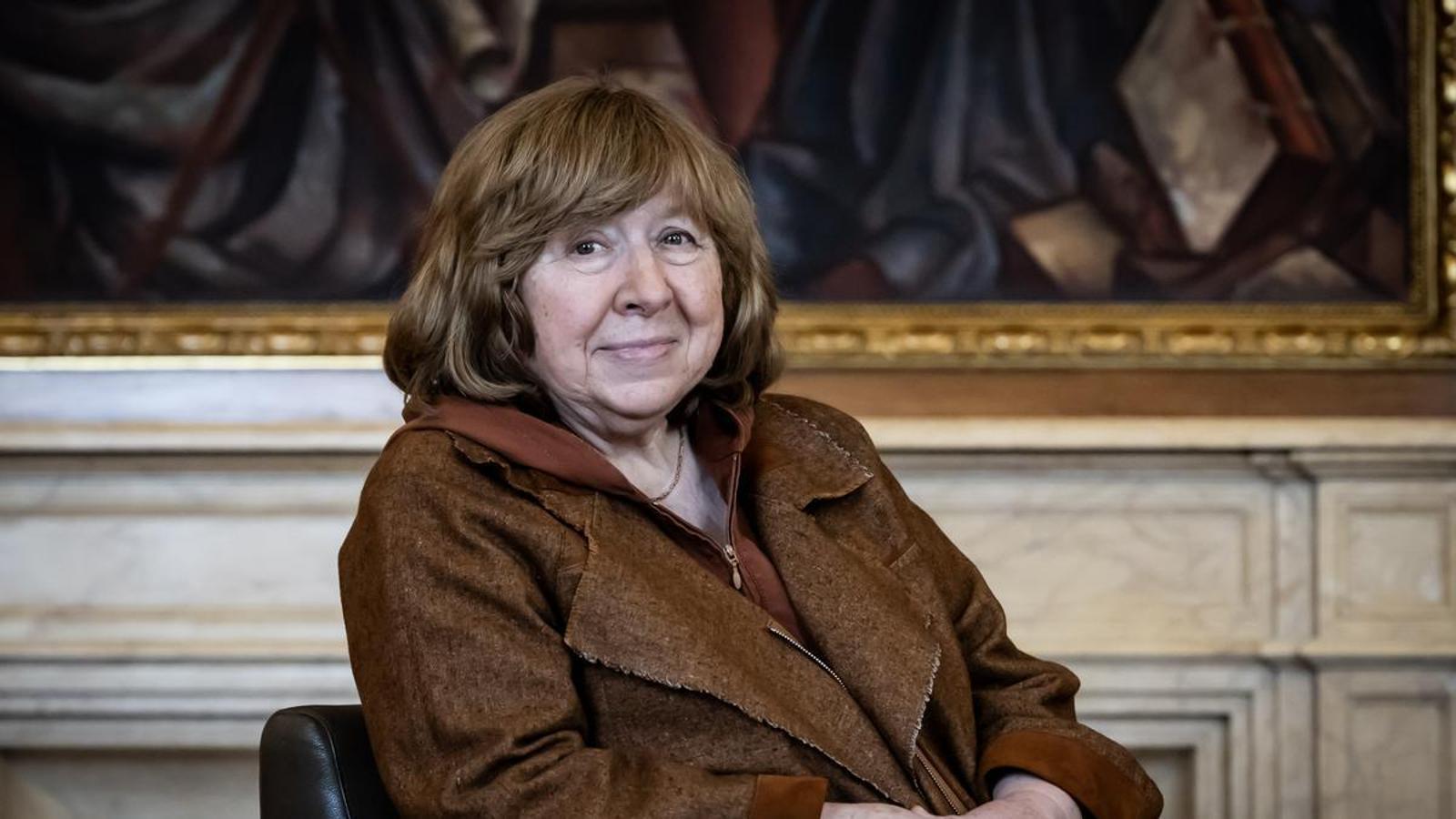
BarcelonaWhen opened, Svetlana Alexievich's books cry out with the force of hundreds of voices. They are the testimonies that this journalist, Nobel laureate in 2015, packages and makes resound polyphonically to explain what chronicles and reports usually dilute in a sea of data, figures, and body counts. Talking with this atypical reporter of feelings is a peculiar experience: she bypasses the inevitable barrier that is established when the intervention of an interpreter is necessary, thanks to a deep gaze, the kind that communicates entire paragraphs. Alexievich visited Barcelona within the framework of the Ortega y Gasset awards presented by the newspaper El País.
Journalistic orthodoxy holds that our profession is based on facts, facts, facts. But you, as a reporter, have pursued something as elusive as feelings. Why?
— It seemed to me that facts were not the most important part of our lives. Nor are they the most reliable part. Sometimes they are invented, changed, distorted. Feelings, on the other hand, are harder to hide and invent. However, since they are also forgotten, I wanted to capture them through the living word of people. To catch them in order to fix them.
When an office worker's salary was 100 rubles a month, he invested 500 rubles in buying a recorder. What was the idea he had then?
— At that time I already knew what I wanted to do. And it was what I ended up doing later: books. There is no one who speaks like journalists write, so when reporters transcribe what another person says, fundamental things get lost. My desire was to capture the word on the fly, just as it comes from the person, because when you write a text, many nuances end up being blurred. On the other hand, if you record it, it lasts forever.
In your experience, are men and women different as witnesses?
— I prefer listening to women, they are more honest with their stories. They are more open, they always tell the truth and their feelings are authentic. They are concerned with feelings, with details. Men, on the other hand, are more action-oriented: they are interested in facts, results, things that happen and how they happened. They seem a bit colder to me.
As the daughter of a soldier who went to war, at what point did you begin to question the official narrative of your country's history?
— I must say that my father was a soldier only during the war, not a career soldier. He studied at the journalism school in Minsk and, from the second year, he was called up and went to fight. After returning, he became a rural teacher, as his father had been before him. And, in fact, they were known as teachers. But it is true that he had great faith in the communist idea. He considered that the idea was very good and that if it had been distorted it was Stalin's fault. But, even so, when he was buried he asked for his Communist Party card to be placed in the coffin with him.
You, on the contrary, have been critical of the communist regime.
— Our relationship wasn't easy: we had different convictions and argued often, but love finally won. I understood that our convictions had nothing to do with the essence of our father-daughter relationship, which was love. When I wrote The Zinc Boys, about the war in Afghanistan – the name is because the boys arrived in zinc coffins –, I told my father: your students are killing there. They are not planting gardens, nor doing good: they are killing. And my father cried. This was the moment our ideas definitively diverged.
He said he wants to return to Belarus when the other exiles do. Do you see it as possible in the medium term?
— I don't think it will be possible. It won't be soon.
What is the first thing you will do when you can return?
— The same thing I always do: write. And also talk more with my people, with those who live in my country, instead of talking with the exiles, because the people who have left the country I notice feel insecure and lost. They are scattered and don't see each other too much.
Is a person considered brave?
— (Laughs shyly) I don't know. Since I had been to the war in Afghanistan, everyone told me I was very brave. But I remember going to the house of a very well-known Russian philosopher, once I was back, and he received me with a German Shepherd. Well: even though it was docile, I was terrified! The poor beast could already wag its tail, trying to convince me it was harmless, but I was afraid of it. And its owner joked: “Take the dog away from the brave Alexievich, from the war in Afghanistan!”
What is the moment when you have suffered most for your integrity?
— In the Afghanistan war, of course. But I suppose it was also dangerous to be in Chernobyl, because there, unlike in a war, you could also be killed by an apple, a glass of water, or a bath in the river, especially in the first months and years after the catastrophe. Radiation was everywhere.

“Nobody taught us to be free, they only taught us to die for freedom”. It is a phrase of yours. How is freedom conquered?
— You can only be free if you have grown up in a free country, and we had lived in a country of lies, a violent country. In the 90s, when we tried to make the revolution, it seemed that we had already conquered freedoms and that we wanted to go down the path of democracy. But in reality it was not like that, because the people who had made the revolution were not free people: some did not want to pay taxes, others wanted to shoot communists... They did not know what freedom was.
You tried to join a peaceful revolution to oust the dictator. You did not succeed. Do you think peaceful change is possible?
— Now I don't believe it anymore, but back then we had no experience. We were very candid, very naive. At that moment it seemed to us that yes, that we could conquer freedoms through peaceful means. If we can ever free ourselves from the dictator –I don't know how, perhaps if someone helps us–, then maybe yes, we could talk about a peaceful revolution. But while he is in power, it is impossible.
What are the rest of Europeans missing about dictator Aleksandr Lukashenko?
— (He smiles) We ourselves don't fully understand him. He's someone who was born and raised in a small rural village. He only had his mother, he had no known father. And life for children in the countryside was very difficult. I understand he's very angry with everyone, for having been a boy deprived of many things and full of deficiencies.
And does this still define him as an adult?
— I suppose it was not expected that there would be an attempt at revolution and it left him in a state of shock, so I think that has put him in a permanent revenge mode against the people who attempted that revolution. There are certain similarities with the biographies of Stalin and Putin, such as mistreatment or omissions by paternal figures and difficult childhoods. They are aggressive people, bad people. These people, when they grow up, do not develop the organ of love and have no empathy.
The image of Putin, indeed, is one of extreme coldness.
— When the submarine Kursk was at the bottom of the sea with hundreds of young soldiers and officers on board, the whole nation was worried, suffering from what was happening. A journalist finally asked Putin if there was any news about the submarine; he thought for a moment and said as if it were nothing: it has sunk. This blunt answer left the entire community in shock.
Would you interview Lukashenko, if he allowed it?
— And so. As if it were out of curiosity.
And what would be the first question I would ask him?
— I would ask her what she knows about love.
Belarus is Europe's last dictatorship, but in many democratic countries freedom of expression is eroding. What would you say to your colleagues in countries like the United States, where we are observing this rollback?
— Now that Putin has become what he has become, Lukashenko boasts of not being the only dictator in Europe. In any case, I would tell my colleagues to do their job honestly. That they have the courage to resist. That they do not take steps back in the face of the darkness that is pressing to impose itself. We should try to resist.
I will end with another quote of his. “In 5 years, everything can change in Russia, but in 200 years, nothing changes.” Putin and Lukashenko have been in power for decades. What will happen the day after Putin and Lukashenko?
— Russia will change very little the day after Putin, because it has created a totalitarian mechanism that is embedded in the country and includes the great Russian landowners. In fact, today we see that some of the younger Russian officials than him already criticize him because they consider him not strong and severe enough. These young people who succeed him will act with even more firmness. On the other hand, Belarus would indeed be a different country, because Lukashenko has not managed to create this mechanism: all his power revolves around his figure, around his person. He has power as long as he lives and governs, but when he does not, he will lose all strength.
