"We are the true social engine of the town": the Barça fan clubs that give life to Catalan towns
In towns of less than a thousand inhabitants, Barça supporters' clubs unite people of different generations and create spaces for communal life

-
CAT -
CAST
BarcelonaIn Sant Bartomeu del Grau, they have the Vic plain at their feet. “We are a borderland,” they say half-jokingly, as the town is within Lluçanès but administratively attached to Osona. One spring weekend, residents arrive at the municipal building where the assembly hall is located. People of all ages. Some children are playing football outside, and inside, tables are being prepared for a fellowship meal where local cured meats are not lacking. The Barça supporters' club is organizing an event, and it seems half the town will be there.
Two years ago, a group of people from Sant Bartomeu del Grau decided to start a Barça supporters' club. It is not yet official, and they are progressing through the labyrinth of bureaucracy to obtain an NIF, a preliminary step before being recognized by the club. When Barça plays important matches, almost a hundred people gather to watch. On the day of the annual fellowship meal, there are over 200 people. “For a population of less than a thousand inhabitants, that’s quite good, isn’t it?” says Joan Salvans, the president of the club. “Having the club has given life to the town. In villages, bars are closing, spaces for being together are lost... We were part of the Sant Bartomeu Football Club and played every Thursday. The team disappeared twelve years ago due to a lack of people, but we extended Thursdays as best we could. And that’s how we thought about creating the club,” he adds.
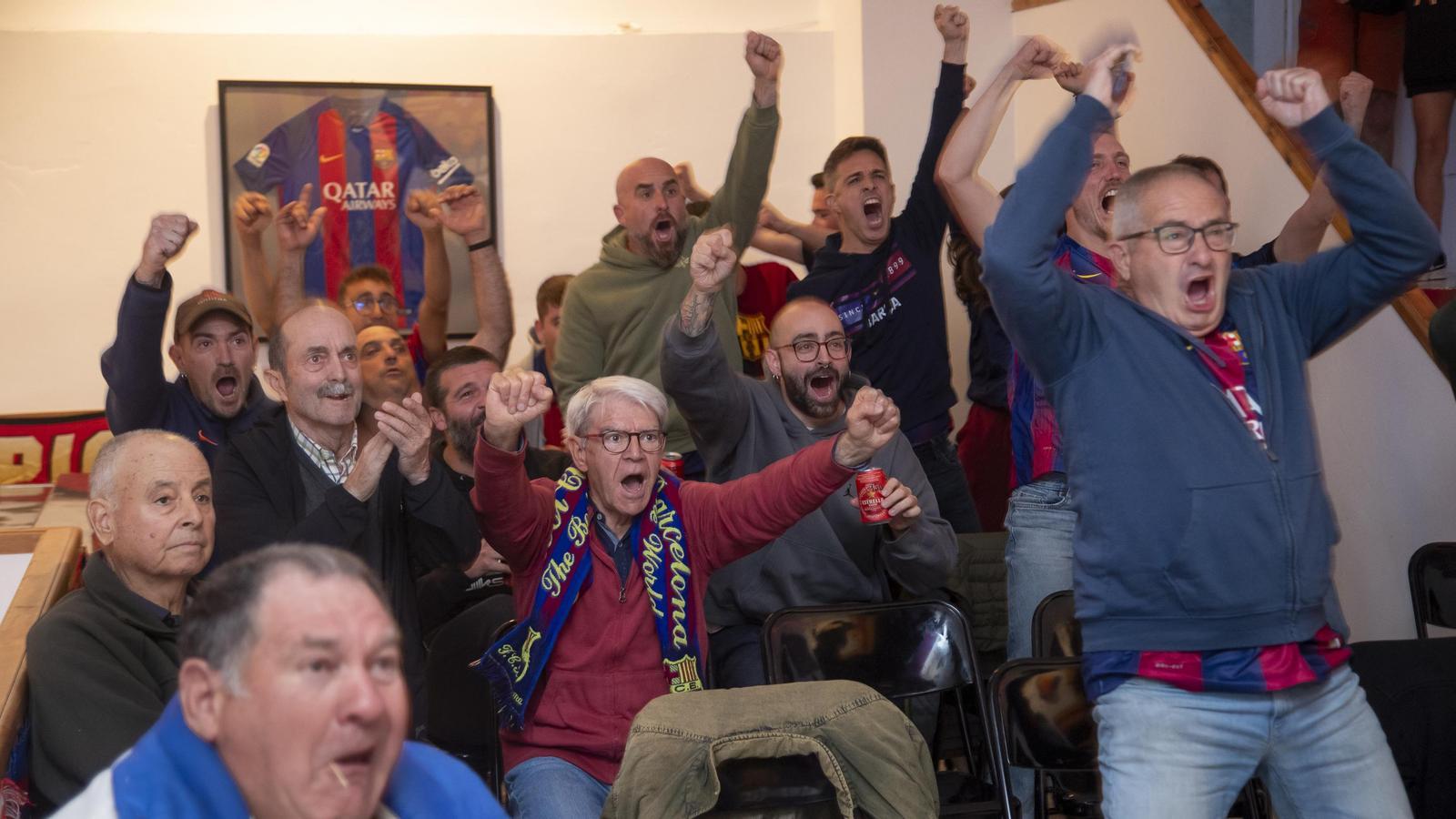
In Arnes, in Terra Alta, the same is happening. Known for its excellent honey, this town has fewer than 500 inhabitants. Arnes has been losing population in recent decades and, as happened in Sant Bartomeu del Grau, the football club ran out of players and disappeared. But what has given life to the town has been the Barça supporters' club. “From the club, they tell us they are noticing a rejuvenation phenomenon in the supporters' clubs. Some people think it’s for older people, but in many towns, people from other generations are joining the clubs because it allows them to bring life to the population,” explains Roger Blanc, president of the club. The day Barça won the League against Madrid, the Arnes club premises were too small: people sat on the stairs, children on their parents’ laps... In the fridge, they had bottles of sparkling wine chilled, ready to toast. They opened them in an improvised bar they created under a sign that reads “VAR”, as if it were what the referees use.

In many small towns in Catalonia, the same thing is happening: Barça fan clubs are reviving, united by the need to generate spaces for neighbors. In Tivenys, they are clear about it: “We want to build a community through Barcelonism,” comments Siscu Pinyol, the president of the Blaugrana fan club. We are just opposite the Ebre river, a beautiful town open to the river. Tivenys has about a thousand inhabitants, but here they certainly don't stand still. “Unlike others, it is a very active town. If you don't want people to leave, there must be associations that do things. In Tivenys, the fan club was born after the 1986 European Cup final lost in Seville against Steaua. And we have kept it alive. Now we need to incorporate young people. That's why we have organized PlayStation tournaments, for example,” comments Pinyol.
Resurgence after the pandemic
Curiously, in Arnes the supporters' club was also founded after that final lost in the 80s against the Romanians. “But in 2017 it ceased to be active. Football could be watched in bars and people no longer wanted to go to the club, where it was cold or hot. And covid-19 hurt us. For us it was also not easy, since to have the club we had to go to meetings of the territorial associations and we had to go to Móra d'Ebre. It was an effort, and everything went into decline”, says Blanc. In towns like Arnes, one of the key drawbacks is having to spend hours on the road to carry out certain procedures and manage. But in recent years a group of young people decided to change everything. “On the day of the Copa del Rey final against Madrid with Kounde's goal, a few of us were together at home. And it was then that we said to ourselves that it would have been very nice to see it in a club with more people from the town. Our idea was to socialize, to watch football together. And we have been very active for about three years now. The Town Hall has fixed up the club and air-conditioned it. On match days the club gets small, and when we have a fellowship dinner we are 170 members”, he adds. A very high figure for a town of less than 500 inhabitants.
The Tivenys supporters' club exceeds 150 members and always has a presence on the three buses that the Federation of Supporters' Clubs of Terres de l'Ebre organizes for each match. “Going to the stadium once a year is important. We manage season tickets to ensure people can take turns,” says Siscu Pinyol. “For people from villages like ours, being able to go to the stadium just once a year is exciting,” adds Blanc. With Joan Laporta's return to the presidency, the relationship with the supporters' clubs changed, as the president took a lot of power away from the Federation of Supporters' Clubs, leading to very tense situations. However, one of the changes has pleased many supporters' clubs: the way tickets are raffled. “Before, the territorial federations distributed the tickets, depending on who attended the meetings. Now Barça has placed itself ahead of the Federation of Supporters' Clubs, which no longer decides, and raffles are held. Many supporters' clubs don't like it, and we respect that, but in small villages it works in our favor.” This way, they don't have to waste hours on the road to attend meetings, as Blanc explains. “There is an open conflict between the Federation and the club's board. It's a shame, I hope they eventually come closer,” admits Pinyol, who has held positions in the federation of territorial supporters' clubs and tries to build good relationships with all parties.
The bars that disappear
Many fan clubs agree that bars play a key role. In many towns they have closed. “Think about the elderly. Before, you could go to the bar when Barça was playing and you weren't alone. Watching the match by yourself at home is very different,” says Joan Salvans. Some of these fan clubs even find that when they show the match at their headquarters, neighbors who are Real Madrid or Espanyol fans turn up... or people who aren't very interested in football either. The key is to have a lively town. “We have a girl married to a Real Madrid fan. They have a daughter who is a big Barça fan and she tried out for the club. And he's a member of the fan club while being a Real Madrid fan!”, explains the president of the Sant Bartomeu fan club with a laugh.
“People stopped going to the fan club to go to the bars. Then the bars stopped showing football because it was very expensive. And some bars have been closing. Now, when there's a match, we have an average of 50 people at the headquarters,” says Roger Blanc. “We have the premises inside the Municipal Hall. And next to it, we have created a small space with the history of football in Arnes, with photos from the 40s, shirts, boots, a book we made... We no longer have a team. We needed money to sign players from the Ebre region. I don't think football will ever return to Arnes,” he says.
Having a Barça fan club also allows us to occupy the space left by small clubs that have been disappearing all over the country, hit by depopulation or the high costs of an increasingly professionalized sport. In Tivenys, they do have bars. “We have three where you can watch the matches. One has a large screen, and they bring it out into the street on important days. Before, the fan club had an agreement to watch the match in a specific bar,” says Pinyol. If there are lively bars, the fan club members find their way there. When the bars close, fan clubs like those in Sant Bartomeu de Grau or Arnes step in to help.
“We have more than 170 members of all ages. Grandparents, mothers, children... All sorts. We can say that we are the true social engine of the town”, says Salvans proudly. “We have only one bar, which opens on Friday nights, Saturdays, and for a while on Sundays. People no longer live the bar life. Businesses have been closing and the town didn't have much life. The pandemic did a lot of damage, we had to do something to bring people together”, he adds. “Before, we used to go to a restaurant to watch football. The owner was a fan of Espanyol, but he still let us put the match on and we'd joke around, but it closed. If the club was born, it was to give life to the town”, he defends. Siscu Pinyol sees it the same way. “It's not just about having a club. We take care of the town and participate in all the activities we can. We have organized drawing contests for children, we hold workshops to revive local games from the area like bowling, we do book presentations... We don't just want to be a club”.

Roger Blanc sees it the same way. “We have recovered the club thinking about the town, it's all tied up. And because we are very Barça and footballers,” he adds. “There is always the typical person who suffers so much that they want to watch the matches alone at home. But for people who are now 75 or 80 years old, it gives them life. They arrive before the match to have a coffee or a drink and chat. The children run between the chairs and people chat while watching the match. The atmosphere is so nice that people who live in Vic want to come here, either because they have roots in the town or friends. People from Calldetenes or Perafita also come. These things have a lot of value,” says Salvans. On the day of the Barça-Madrid match, more than 200 people gathered in Sant Bartomeu del Grau. In Arnes, a hundred. In Tivenys, more than 100 members filled two bars, and others arrived home at three in the morning after watching the match live at the stadium.
In Sant Bartomeu, until they are an official supporters' club they will not be able to aspire to have tickets for the matches. But they have seven season tickets among the members available to the whole club. “We have done our best to try and ensure that the 112 people who have requested it can go to the stadium once this season. There are very nice people who lend their season ticket to the club so that others can go for a day”, explains Salvans. “Young people are joining who want to go to the stadium, but also to away games. Last year a lottery had to be held among the supporters' clubs for all away games except Las Palmas. There is more demand for tickets for away matches than ever before, something is moving”, adds Blanc, who highlights that the supporters' clubs help each other. The Arnes club, for example, went to Madrid to see the Champions League quarter-final match with people from Vall-de-roures, a town in Matarranya, already in Teruel, but a short drive from Arnes. “Yes, some supporters' clubs still look a bit old, but the feeling is that more and more young people are joining the supporters' club movement –says Blanc–. There is no association in the town or the area that is as active as ours. Neither the hunters' association nor any other. Young people have joined, but the pride is to have members aged 2 and 80 years old. And we rotate so that everyone can go to the stadium”, he defends. “Barça winning helps. If the ball doesn't go in, we'll see how people react”, he adds, half-jokingly. For now, the ball goes in and causes shouts of euphoria in a lot of small towns in Catalonia. Towns where a supporters' club is more than a supporters' club, just as Barça is more than a club.
