Aina Seriñana: "I charge about 13 or 14 euros more per bottle of wine compared to the selling price; if I put more difference, then people won't drink it"
Wine waitress

-
CAT -
CAST
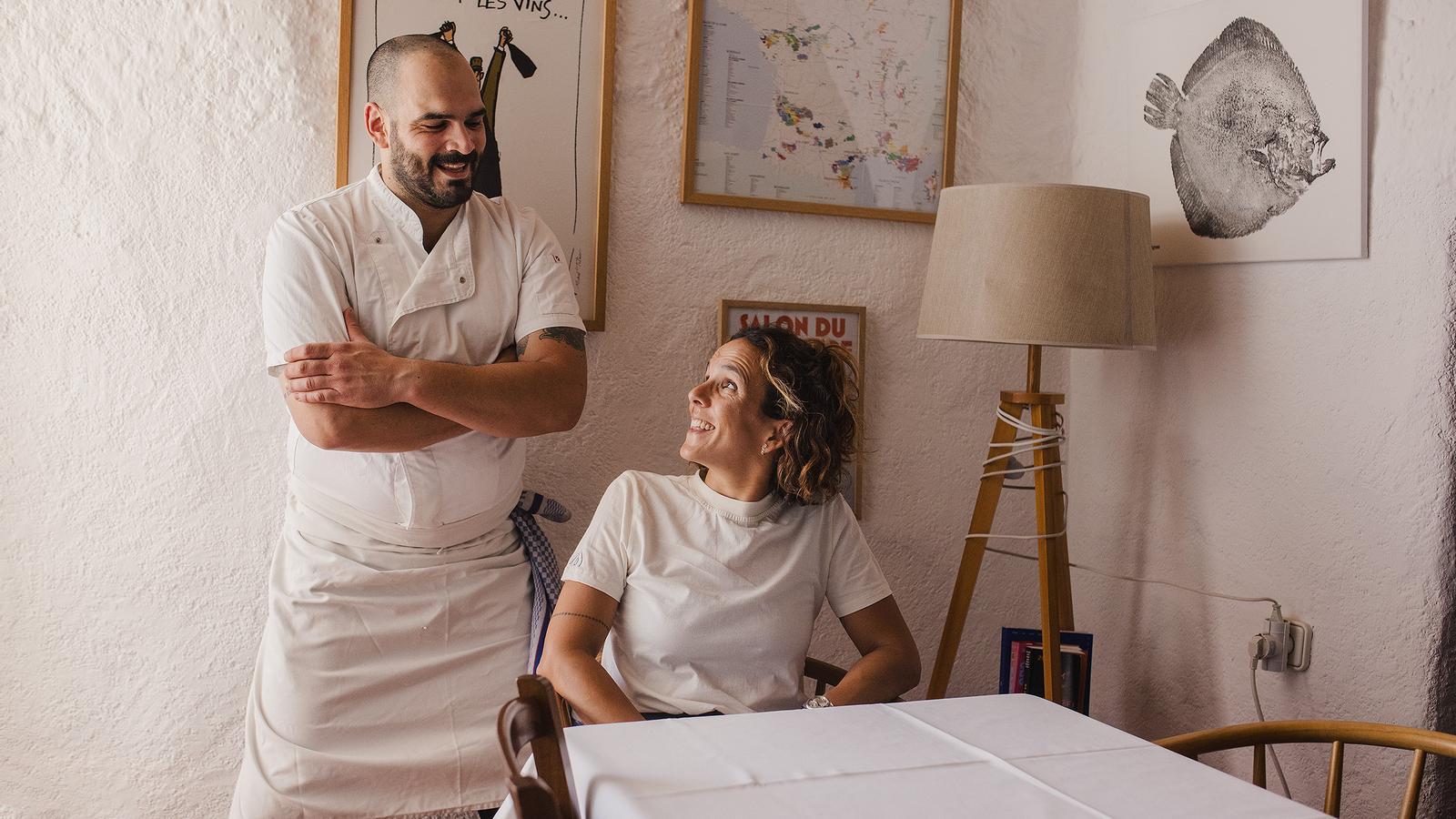
CadaquésI interview the wine waitress Aina Seriñana at Es Baluard, her family's restaurant, in Cadaqués on a day in August. Aina is a great defender of Catalan wines, and together with her brother Adrià, a chef, they have turned the restaurant into a benchmark for good gastronomy. Furthermore, Es Baluard has mythical tables, which have a waiting list to get them: two are by a window and another has a balcony. From all three you can see the sea. And all three, like all, all of them in the dining room, are good for having a good meal.

Explain the wine list to me, because I see you've written a piece of information on it that I've never encountered on any wine list before. You've put the number of kilometers that separates your restaurant from the winery.
— It was an idea I had after being asked for a wine from La Rioja. I started doing it a few years ago. Foreigners would come to me and ask for Riojas and Riberas del Duero, because they thought they were wines from our region. A North American might think we are next door. In Empordà we have an appellation of origin with very good wines, which are from our land. To explain it to them so they would understand me, I thought about indicating the kilometers. I put it there thinking it wouldn't be of any use, and I find that they tell me it's very good.
Are you asking for wines made within thirty kilometers, for example?
— Yes, and I also find that more than ever people have more wine culture, are more interested in the territory, and even want to get to know small projects, those that have a story behind them.
You explain them to him/her.
— I love doing it. I talk to them about who makes it, about the land, the varieties, the climate. And I defend what we have here, our people who do a very good, and complicated, job, because making wine in Empordà is very difficult. When I have clients who tell me they don't want to spend more than a certain amount on a wine, I tell them about all the work involved in making a wine in Empordà. Besides, I like to work with wines of little intervention, and, of course, from Cadaqués too. I have the wines made in Cadaqués, and I explain what they are like, a heroic vineyard.
You exude passion as you explain it.
— I just love my job. At 18, I entered the Sant Narcís Hotel and Catering School, and since then it's been like training. In winter, I do tastings, visit wineries, and I think it's the way I enrich myself with information to explain it later to clients. When someone enters the restaurant and tells me they don't understand wines, I tell them it's okay, that I don't understand many things either. I tell them they have to enjoy it.
For years drinking a glass of wine seemed very difficult.
— We distanced wine from people. I find that young people, thirty-year-olds, ask me for non-alcoholic wine, and I don't have any. I refuse. I have non-alcoholic beer, but non-alcoholic wine is not wine. It's highly processed, not natural. I offer them grape must, which I do have, and it's very good.
The other night, when I came for dinner, I saw many tables drinking wine.
— I have a segment, as I told you, of thirty years during which people have been asking me for non-alcoholic wines, but I have another segment, which is the majority, between thirty and fifty, who do consume wine. A lot of wine. At Es Baluard people come to drink wine, and I think that's because we have a menu that encourages it.
I've noticed the prices on your wine list, and I see they are not loaded.
— It hurts me when I see it. Since I know how much wines cost, it offends me that a restaurant charges thirty euros more. We are throwing stones at our own roof because, if not, people won't ask for them from us. We have to be more reasonable with prices. Look, now people are asking me for many glasses of wine, and sometimes I tell them that if they have so many individual glasses, in the end it's not as worthwhile as a bottle of wine.
What do you think should be the percentage markup a restaurant should charge on a bottle?
— I charge about 13 or 14 euros more per bottle of wine compared to the selling price. If I put more difference, then people won't drink it. I want people to order a second bottle if they have finished the first one and liked it. On the other hand, if it's a very high price, they won't do it.

I have seen that you sell your oil.
— It is made by the father, of the argudell and verdal variety, which is the law of Cadaqués. This oil is what we serve at the table, so that people can taste it with bread, in salads. We also use it for cooking.
Was the restaurant your parents'?
— From my paternal grandparents, who opened it in 1967. My great-grandfather had a beach bar, Piu's beach bar, which was here in the square. And then they rented this space, which belongs to the Diocese of Girona.
Is all of this from the diocese of Girona?
— Yes, they are three rooms; upstairs, lives the priest, who enters from the back, where there is a small green door.
Therefore, do you pay rent to the bishopric of Girona?
— Yes, and after my mother's death, we renewed the contract again for ten years. They have always treated us very well, even though we always have that idea that something could happen someday. The contract is now in my father's, my brother's, and my name.
Did your father stay at Es Baluard?
— Yes, and his sister at Rahola's orchard, where the grandparents had also opened a restaurant. My grandfather had studied pastry making in Sitges, he also worked in a hotel, and he was in charge of desserts. In fact, we still make the desserts he used to make today. The grandparents were in the kitchen; my father, in the dining room. When the grandparents retired, my father went into the kitchen, and my mother, into the dining room. They retired young, at 55, and I started working there. My brother worked in several restaurants, like Paco Pérez's Miramar. I didn't, because I loved being here. I had been here since I was little, and I didn't feel the need to go anywhere else.
You have kept the kitchen of the grandparents and the father.
— Yes, because it is what people expect at Es Baluard. There was a time when Adrià and I thought about changing it, to make contemporary cuisine, but it was a mistake. People come to our restaurant to eat fish, stews, zarzuelas, the traditional dishes, that our grandmothers used to make on holidays.
Fish are always a great draw.
— We have very good product, and we explain the ports of origin, from Roses, from Portlligat. I go to look for fish at Isca and Samu, the fishermen of Cadaqués. Fish also arrive to us from Blanes, Llançà and Palamós.
You find that rice dishes are requested at midday, and fish dishes at night.
— Foreigners eat rice at night; and in general, fish are very much in demand at night, yes.

I have to ask you about the famous tables. One, the one by the window. The other, the one on the balcony.
— It's a headache for me. I have to make people understand that they are not unique in the world, that I keep them according to the order of requests. They are the only two tables that I don't move, because I know that the people who have them will extend their stay. So if they sit down at the one o'clock shift or the eight o'clock shift, the table will be theirs for the entire service. I also have to say that we are very lucky with the clientele of Es Baluard, because they know us, they repeat, and they feel at home. They don't come to eat quickly and leave, but rather they stay for hours.
I'm back with the two tables that are by the balcony and the window. Do you have any free during August?
— None at all. They are full every day, both at noon and at night. At these tables, people come to celebrate special moments, such as marriage proposals, wedding anniversaries.
To finish, Aina, how do you see yourself in a few years?
— My brother is about to become a father; I recently lost my mother, and it's a question I have inside. There will be changes. I don't see myself here in the future. I really enjoy this job, but I'm eager to do something of my own.
Within the restoration?
— Yes, I would like to do a project because I think there is a gap in Cadaqués. Something different. I will always help my brother with everything he needs, also my sister-in-law, as they will stay here as family. I need to make a change, because I am here twenty-four hours a day, I don't know how to disconnect. I would like to do a project related to wines. I have many ideas, and I want to do it, because otherwise, I will regret it.
