ERC gets closer to the PSC and Vox surpasses the PP, Junts and the Broad Front
The ARA survey makes the right-wing bloc advance in Catalonia but the progressive majority is maintained for the 29-N

-
CAT -
CAST
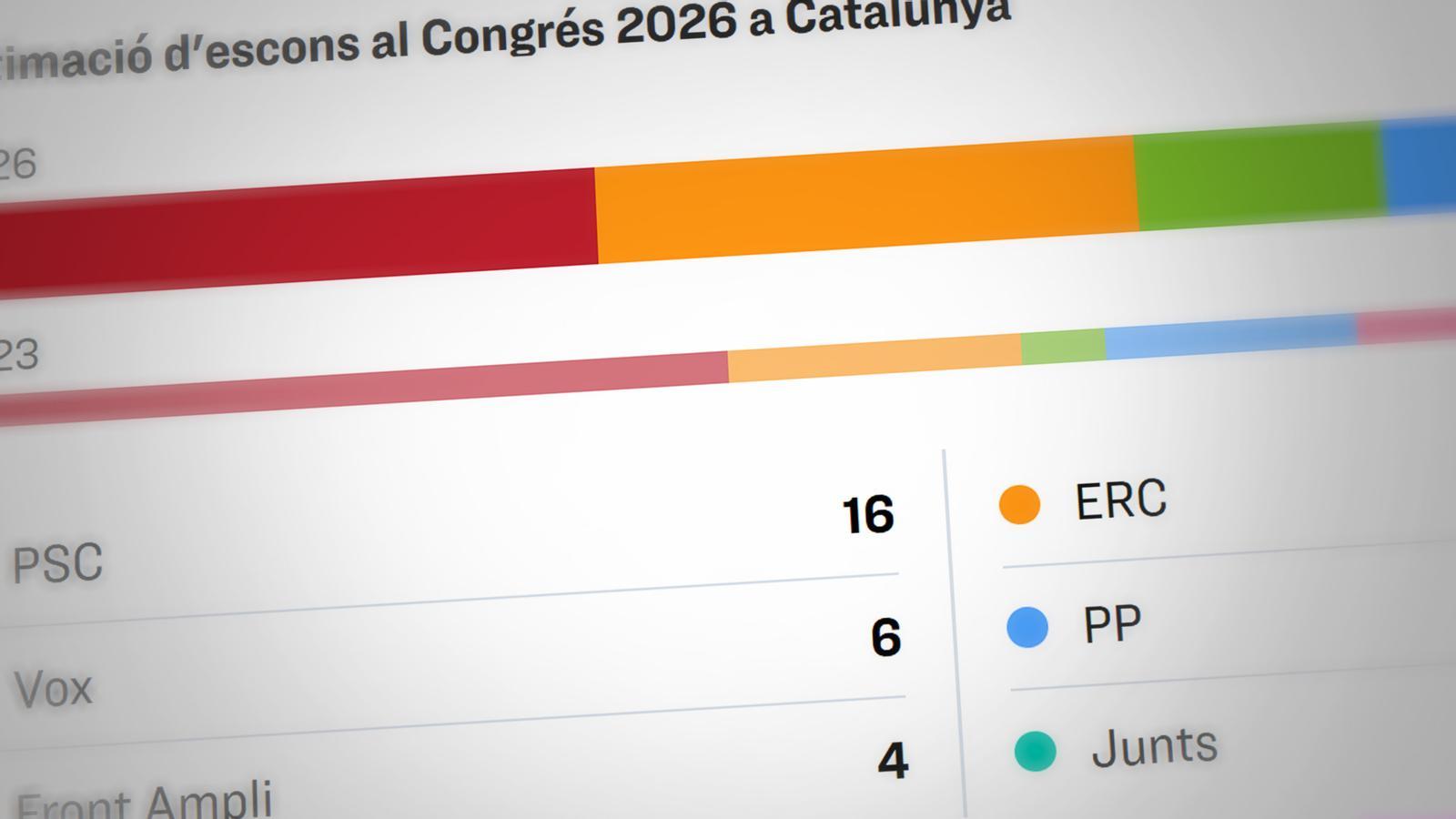
BarcelonaThe YouGov survey for the ARA ahead of the November 29th general election shows results in Catalonia slightly different from those of 2023. Progressive forces maintain the same clear majority as three years ago, with 33 out of 48 seats, but the right-wing bloc advances three seats, going from 8 to 11 thanks to the losses of Junts, which drops from 7 to 4. Within the blocs, however, the correlation of forces is changing. In the progressive camp, ERC is the one making the biggest jump, going from 7 to 13 seats, putting them just three deputies behind the socialists, who would drop from 19 to 16. And on the right, the one advancing is Vox, which goes from 2 to 6 seats, while the PP would lose momentum and go from 6 to 5.
With this scenario, Sánchez's investiture front would lose three seats in Catalonia and go from 40 to 37, while the alliance between the PP and Vox that aspires to make Alberto Núñez Feijóo Spanish president would advance from 8 to 11. This, for the PP's aspirations at the state level, represents a certain relief, since from having a score of -32 in Catalonia it would now be -26. Gaining 3 seats in Catalonia has double the value because you are also taking them from your opponent.
Vox and Aliança
Regarding political interpretations, what the survey detects is a notable drop for the PSC, the PP, Junts, and the Broad Front, while ERC and Vox are the parties that come out strengthened. In the case of the Spanish far-right, it may be benefiting from the non-participation in these elections of Aliança Catalana, a formation with which it shares a xenophobic discourse and a part of the electorate that may cast a kind of dual vote and opt for Santiago Abascal's party in a general election despite being an explicitly pro-independence formation. Junts sees neither its bet on voting for Sánchez's investiture nor its move to subsequently complicate the legislature for him by shooting down key decrees such as those on housing as having been strengthened.

In the case of the republicans, this result would have two readings, one external and one internal. The external one is that it would give Oriol Junqueras a good platform to challenge the PSC for the leadership of the left-wing bloc in the next Catalan elections. And the internal one is that it would strengthen the figure of Gabriel Rufián, who in recent times has not hidden certain tensions with the party leadership. In any case, the sector that Rufián represents within ERC, together with his mentor Joan Tardà, and which advocates for convergence with the Comuns and the CUP and the search for collaboration formulas with the Spanish left, would gain ground. ERC would also recover the leadership of the independence bloc – which would go from 14 to 17 seats – and would have left Junts behind, awaiting, mind you, elections with Aliança.
In contrast, the Socialists and the Broad Front would suffer the wear and tear of having been in the Spanish government in recent years, losing up to three deputies each. For Salvador Illa, getting these 16 seats would be bad news for a party that in 2008 managed to win 25 with Carme Chacón as a candidate. For the Broad Front, on the other hand, 4 deputies would not be a catastrophe, despite having a powerful candidate like Ada Colau, since most polls give them less representation.
In conclusion, Catalonia would remain a progressive bastion, although with more weight for ERC, while the right would reap the fruits of Junts' decline.
The survey was prepared by YouGov, based on interviews with 350 adults aged 18 and over eligible to vote and residing in Catalonia. The interviews were conducted online between October 26 and November 2, 2026, including an extension from November 11 to 12. The sample was designed to represent the electoral population according to sex, age, region, and previous vote in the 2023 elections, with subsequent weighting of the results. For a simple random sample of 350 interviews, the maximum theoretical margin of error is ±5.2 percentage points with a 95% confidence level.
