Jon Cake, pastry chef: "It is good that the guild improves the conditions, but in the end it will end up destroying the artisan pastry shop"
The sector finds itself with the difficulty of competing with cheap bakery chains and the drop in the purchasing power of consumers

-
CAT -
CAST
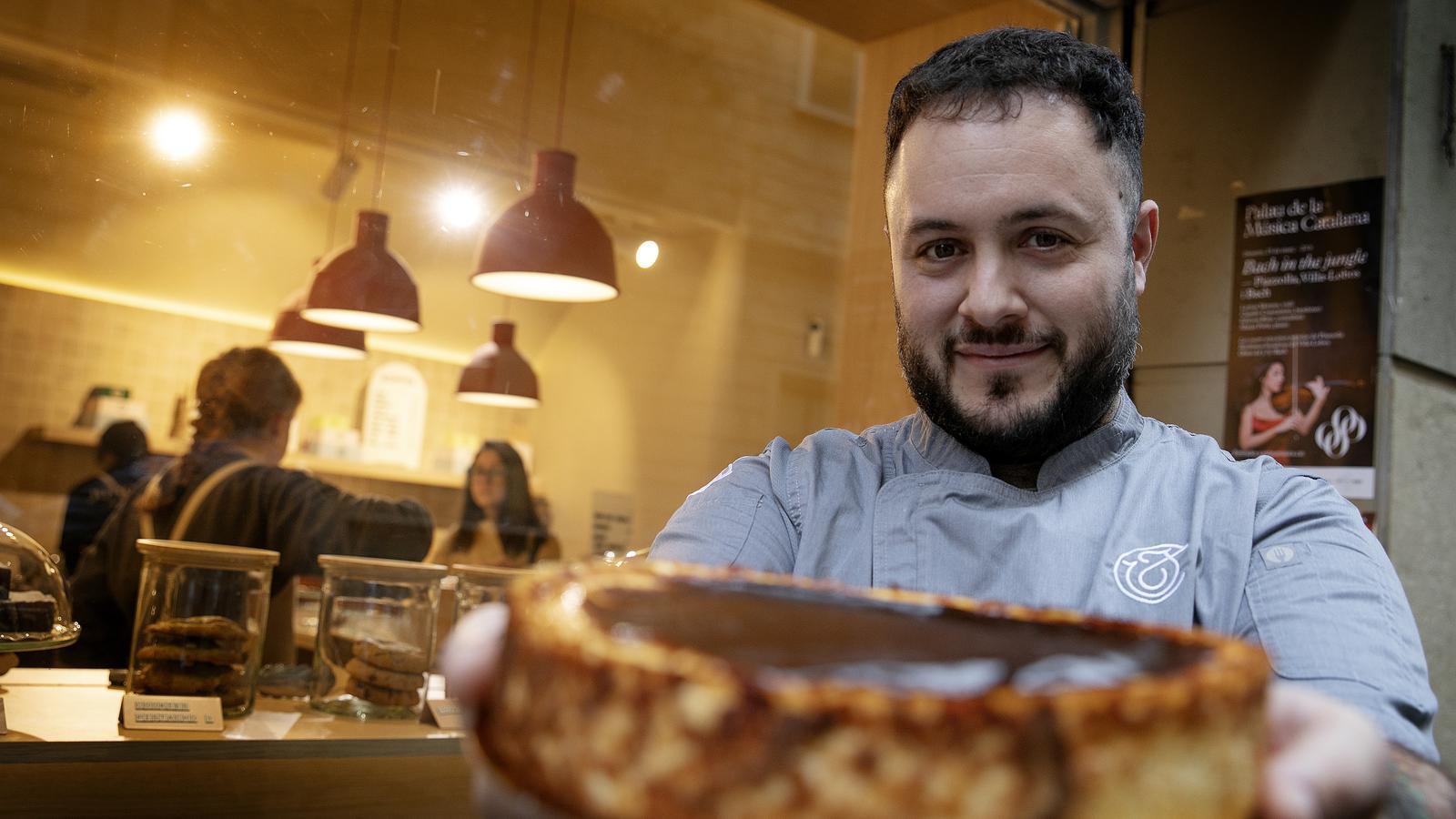
BarcelonaJon García (Bilbao, 1991), better known as Jon Cake, has not stopped growing since the day he decided he would sell cheesecakes. He has several shops in Barcelona and also one in Girona. His has been a meteoric rise. His cakes, based initially on the Basque recipe and later adapted into a thousand versions, including many with Catalan cheeses, have placed him in a segment where he is alone. He makes artisanal cheesecake, and his competition uses low prices as a draw. Furthermore, he has now delved deeper into the pastry business, which is why he won the award for the second-best butter croissant in Catalonia. But it goes without saying that there is even more cheap pastry competition out there.
For this reason, García calls me to meet, because he is visibly worried about the sector. “Artisanal pastry is at risk,” he states. His diagnosis is clear. On one hand, the chains of cheap bakeries, which have not stopped proliferating. “If you get surrounded by them, you're done for. There will be people who stay for the quality. We sell the croissant for 2.20 and they think I'm getting rich, when I barely make any money on it. There is a paradigm shift where we are going to extremes,” he explains. “The chains produce in a factory and offer two croissants for one euro... My raw materials already cost me that much. And you have to add that people are running out of purchasing power,” he asserts.
He acknowledges that spending is going down. Foreign spending as well. “Hotels have gone up between 50% and 200% since Covid. Now tourists, since they don't earn double, don't spend what they used to. They buy food to take away.” And regarding chains that sell cheesecake, he is not worried about the local client, but he is about the foreign one. “Now there are those who will make the cheapest tiramisu in Barcelona. And going for price is working, but they are targeting a different audience. I see their queues and they have a lot of young people. I have few between 15 and 20 years old. We compete for the tourist, that's for sure. They look for cheesecake and go wherever there are reviews, a queue, or a viral video. We haven't noticed it because we are at the other extreme. Those in the middle notice it more,” García explains. His cake slices are sold for 5.90.
The rules of the game and competitiveness
Jon García is governed by the confectionery agreement, where wages are currently being negotiated. And he considers that the decisions they want to make take away their competitiveness. “There are people who say that we pay more. The confectionery agreement is good. And now they want to improve it. I am in favor of higher wages, the higher the better, but in the end, who am I fighting against? Against supermarket cakes and bakery chains. These are not in the confectionery agreement and they pay less. I would already have to raise the price just for the raw materials. If you also add labor absenteeism, I always have between 5% and 10% on sick leave. I can sustain it because I have 50 employees, but what about the pastry shops that have three employees?” he argues. “I want to convey that it is good that the guild improves conditions, but in the end it will end up destroying the artisanal pastry shop. It is not that I think it is too much. It is that if you pay above the competition, you will have to pass the difference on to the customer”.
For him, the problem is shared with the restaurant guild. “Menu of the day restaurants have died, supermarkets have killed them. It will be hard for the artisan to survive. Small businesses hold on at the expense of the owners' hours, not the employees'. Whoever has a lifelong pastry shop, thirty years ago they worked 16 hours anyway, but they had a greater return. In the 90s, the hospitality industry was a great business. Not anymore”. He tells me that he has a long list of restaurants he intends to visit. Often, when he looks for them, they have already closed their doors. “I think a large number of restaurants in Barcelona will close”, he states.
He explains that recently he was looking for a business for transfer in the Eixample. It took him just one day to have to deactivate his mobile phone alarm. It would not stop ringing. “But the prices of the transfers were sky-high. From 250,000 to 400,000 euros. And you wonder who is playing in this league”. He blames the administration for the rising cost of license transfers, due to the fact that they do not grant many in many areas. The opening in Girona is also being difficult. “These are a franchise,” he hears people say on the street. “I try to change that impression. We are locals from Barcelona. We try to do things well, not just for the tourist. My goal is to make a quality product. What do I see that works? The collaboration with Trias cookies that Pilarín Bayés has illustrated for us. And for fairs, we make fair apple pie, ratafia... We try to get people to know us,” he explains.
Jon García's complaints about the administration and the obstacles it puts in his way would be enough for another entire article. “I spend money, I generate economy, I generate jobs. Instead of helping those who want to start a business, they go to see what other barrier they can put in their way,” he assures. The pastry chef states that many things would be solved in the following way: “Everyone should start a business for a year of their life and should work dealing with the public”.
