Anna Espelt: "My vineyard, the pasture and the cork oak forest made the fire that broke out in Cap de Creus in 2022 not reach Roses"
Biologist and oenologist

-
CAT -
CAST
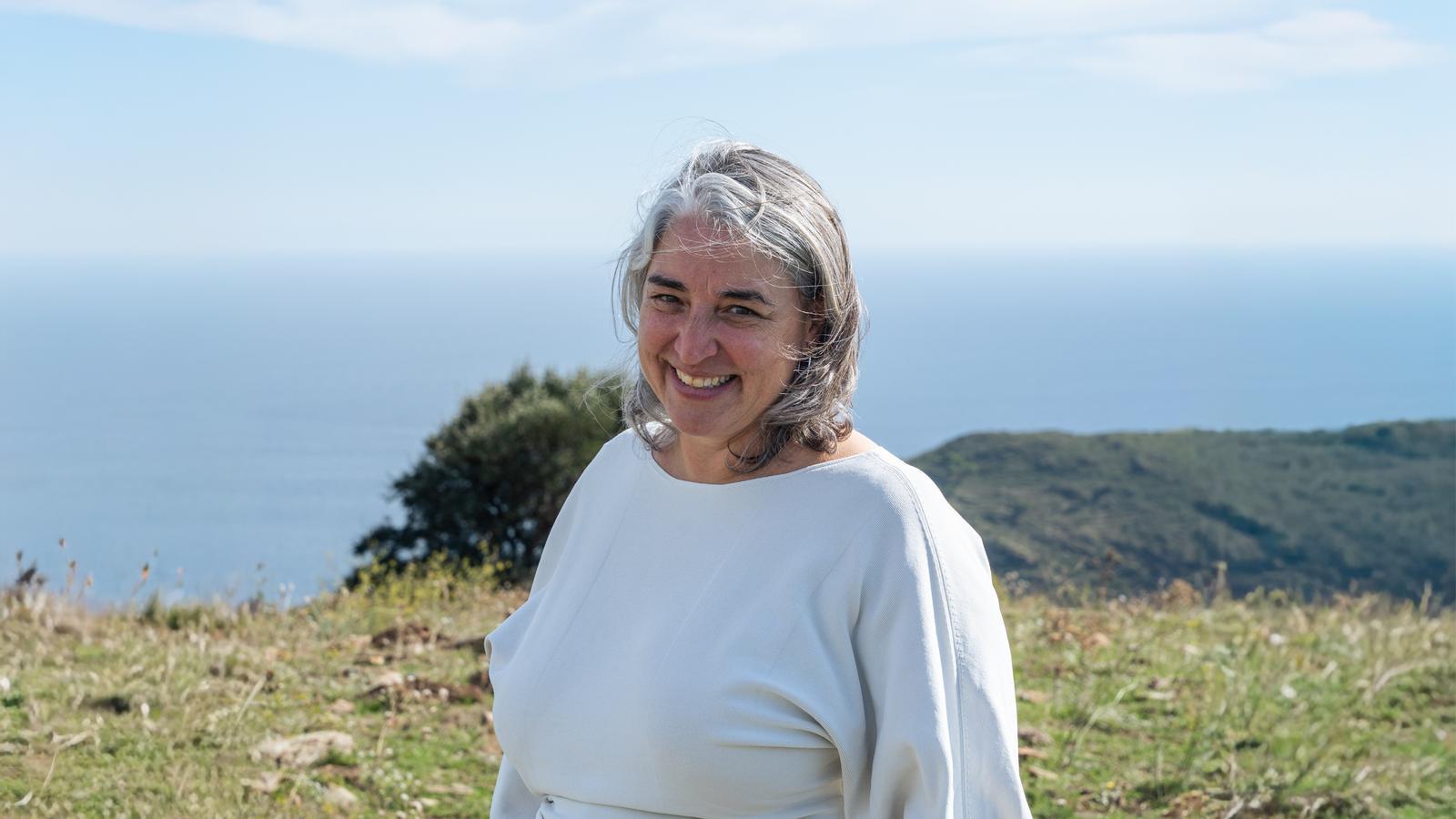
Cape of CreusI am interviewing winemaker Anna Espelt in her vineyards at Mas Marès in the Cap de Creus Natural Park, an estate that has one hundred and seventy-two hectares, twenty-five of which are vineyards. The sun has risen bright in the blue sky, and if it were not for the constant tramontane wind blowing there, it would seem like a summer day. We start talking near a menhir that stands among the vines, which for Anna is a symbol of the human life that existed in the vineyards in ancient times. She says that one day she will want to live in the farmhouse nearby. In the meantime, she balances her life between managing the family winery, Vinyes Espelt, in Vilajuïga, and her own winery, Mas Marès, where she produces a volume of ten thousand bottles, depending on the vintages, divided among three names: Pla de Tudela, Cala Rostella and l’Escumós d'Anna Espelt (a blanc de noirs). The DO Empordà and the Terrer Festival organized some tastings in the month of July in which Anna, also a biologist by training, captivated everyone who listened to her. For her wines, for the passion with which she conveys them and for her way of loving the vineyard, some call her "the queen of the Empordà".

The vineyards of Mas Marès are your personal project.
— I looked for a place to make terroir wines, and I found Mas Marès. Even though there have been wines in the Empordà since time immemorial, there was no vocation to make one that was profoundly Empordanès.
What do you mean by this concept of "deeply Empordà"?
— Look for the potential in it, just as Burgundy has clearly done. A good wine must be balanced, complex, and must show the place it comes from. For me, this last quality is essential. Since I like making terroir wines, I found that at Mas Marès, the combination of soil and climate was there. Currently, in the whole Empordà, there are one thousand nine hundred hectares of vineyards; before the phylloxera, there were thirty thousand.
What is different about this place where we are from the rest of the Empordà?
— It is slightly cooler due to the influence of the sea, which is nearby. Furthermore, we have a type of granite that is very interesting, which gives us transparent wines, meaning they show the place where they were made. I asked an expert to give me their opinion on this terroir; they conducted a study on it, and told me it was fantastic, but there was a problem.
Who?
— We are in the Cap de Creus Natural Park and, therefore, I did not know if they would let me plant vines there. So I went to talk to Xavi Vilavella, a park technician. I was expecting a no, or at most a reluctant yes, and I found an enthusiastic yes. They told me yes because with the vineyard we could work on the biodiversity of crops in the natural park, just as it must have been done millions of years ago. Hence the existence of a menhir and dry stone walls, which are a sign that humans had passed through here. Biodiversity in a natural park increases if you introduce agriculture and livestock.
Is agriculture and livestock farming in a natural park how fires are fought?
— Yes, it becomes fire-resilient. I was given permission to plant vines there on the condition that I do it as a mosaic, which is a methodology that is talked about a lot now, but twenty-five years ago, it was not.
How can I observe the mosaic?
— Let's head up and you will see it from the heights. In every space of the mountain there is a place for livestock, for cattle grazing, where we have patches of scrubland, a pond of water; another for the vineyards, which is based on regenerative agriculture, and another space, which is a landscape of cork oaks. With these three mosaics, three open spaces, biodiversity is increased. By the way, the cows are currently between Vallter and Núria. They are about to arrive here again.
Why is pasture so important?
— If you have pasture, you have birds, you have flowers. Look. Do you see those little white flowers? They are white clover.
Is the majority of the vineyard Garnacha?
— No, there are many other varieties. In Empordà we call grenache lledoner, so we have white, red, and black lledoner. I also have picapoll and monastrell.
Grenache is very popular in Empordà.
— It is the variety that best withstands the tramontana. The other varieties are weakened after a tramontana storm. On the other hand, the garnacha remains vigorous, because it is well adapted, and it tolerates drought well. The name garnacha is used by us, in the Empordà, for sweet wines.
You have vineyards that are near the sea.
— It is the vineyard with which I make the wines for the restaurants Disfrutar and Compartir, which is called Vins dels Amics. When the chefs worked at El Bulli, they passed by it every day. The variety with which I make the wines is Picapolla, which is a very transparent variety, I mean that it conveys well the place it comes from. Picapolla is a variety that naturally has a low alcohol content despite the high temperatures of climate change. It also makes balanced wines, which can be cellar-aged. This grape had been a storage grape, which means that it was hung in the basements of houses and kept until Christmas. They made it good for preserving and eating after months.
In what year did you start making wines at Mas Marès?
— The first vintage is from 2015, although I started there in 2002. At the family winery, at Espelt Viticultors, I started in 1999 working in the vineyard. Back then, in the early 2000s, nobody thought about making interesting white wines in Empordà; back then the kings were the red wines. For me, the paradigm shift was the lledoner roig. One year I made a white wine with the lledoner roig variety, I made a white from red, and the result was spectacular. That was when I realized that we could make good whites in Empordà. This happened in 2007, and I have continued with more white grape varieties, which are producing white wines with a lot of personality and a very important aging potential, with freshness.
With the blanks, mental frameworks have been broken.
— Yes, we thought that in the Mediterranean we could not make interesting white wines because of the warm climate we have, and what we needed was to rediscover the varieties that did allow us to make them. When I told my father that we had made an important Carignan blanc wine, he told me it was worse than not having done anything at all. And the sentence must be understood for the time, because back then a wine that had low alcohol content was worth nothing. On the contrary, now we want wines with balance, freshness, complexity, aging potential, and we make them with varieties that were already there all along.

I was surprised that you use monastrell.
— There is little of it, but we know there used to be. There are ancient texts that speak of the Empordà monastrell, therefore, it made sense that it would adapt well. We have made a sparkling wine from it, with long aging, seventy-eight months of storage. It contains no expedition liqueur, because we do not want to apply any makeup to it.
To finish, how do you fight the possible fires that may occur in Cap de Creus?
— For a fire to occur, you need three elements: a spark, oxygen, and fuel. On strong tramontane wind days at Cap de Creus, we have a high risk of fires. Therefore, it made sense for us to protect this space where we are from north to south because the probability of fire is one hundred percent. We cannot manage the spark. Nor the oxygen. But we can control the fuel: that is what we do with pastures, because cows keep the biomass less flammable; they clear the brush. Furthermore, vineyards are resistant to fires because the leaves have a large amount of water, which makes them difficult to burn. And, finally, there are the cork oak forests, which act as a shield. This strategy, vineyards, pastures, and cork oak forests, meant that the fire that broke out in 2022 did not reach Roses.
