Why predicting where and when there will be torrential rains continues to be so difficult?
Meteorological models have advanced enormously, but convective downpours like those that have fallen recently in Catalonia are still a challenge
-
CAT -
CAST
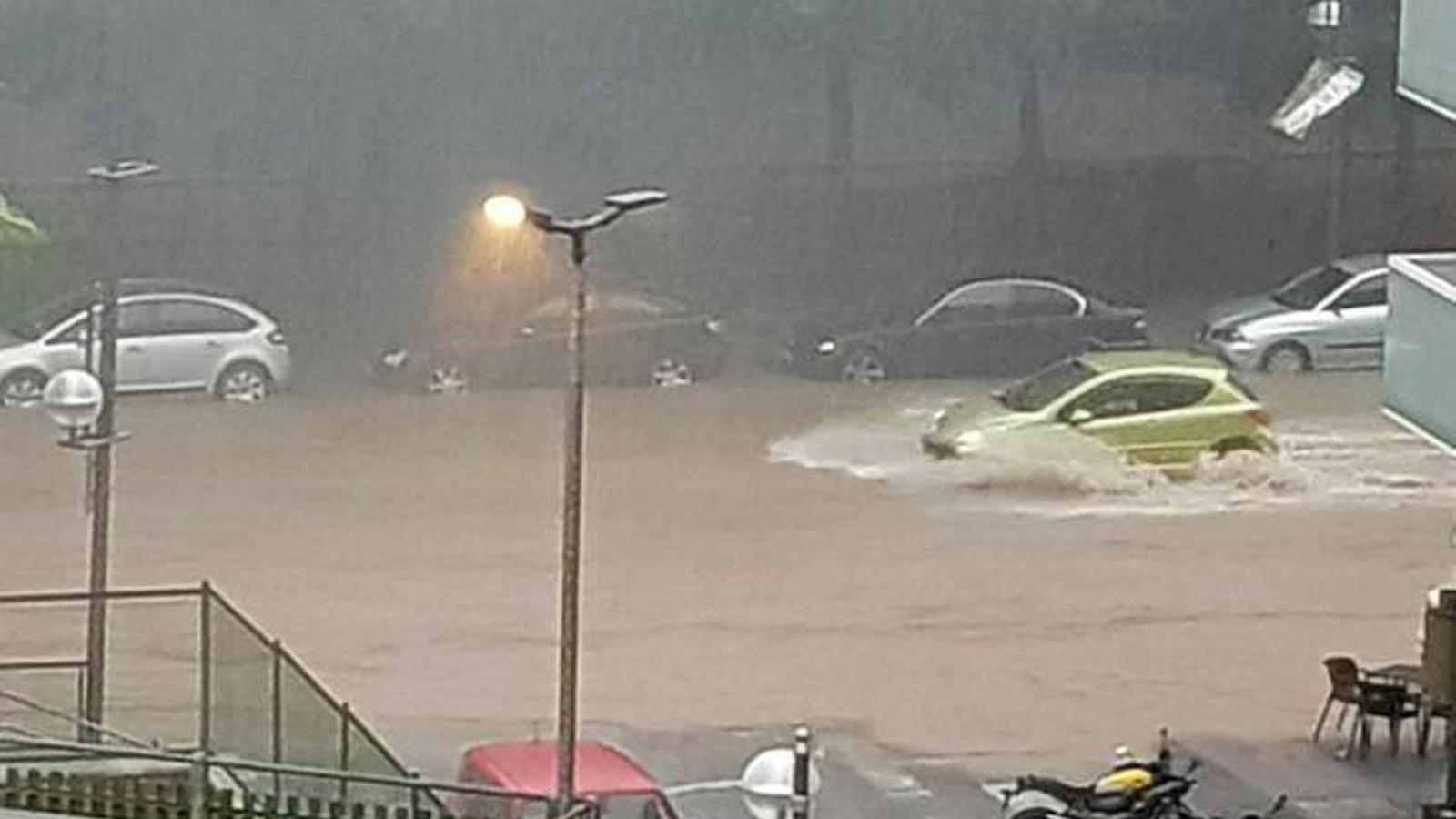
Although there are more satellites orbiting the planet continuously sending high-resolution images and atmospheric data, radars that detect precipitation in real time, meteorological stations, rain gauges, radiosondes, and supercomputers capable of performing calculations on a scale unthinkable just a decade ago, it is still difficult to know exactly if a strong storm will unleash, where and when it will do so, and how much rain it will leave.
This is what happened this week in Catalonia, with the torrential rains that surprised meteorologists. To better understand why, ARA has consulted three experts: Carme Llasat, professor of atmospheric physics at the University of Barcelona; Ramiro Saurral, researcher at the Barcelona Supercomputing Center (BSC-CNS); and Marc Prohom, head of climatology at Meteocat.
How the models work
First of all, it is necessary to understand what meteorological models are: mathematical representations of the atmosphere, based on the laws of physics, which start, from data from satellites, radars, stations, rain gauges and radiosondes, from a photograph as precise as possible of the current state: temperature, pressure, wind, humidity and precipitation, both at the surface and at different heights. And they calculate how it may evolve.
Possible scenarios
A prediction is not always a yes or a no. Meteorologists use different models or run several simulations with the same model by introducing small variations in the initial conditions. This way, they obtain a set of possible scenarios: the more they converge, the higher the confidence in the prediction; if they diverge, there is more uncertainty. However, the model can indicate a high probability of heavy rainfall, but it cannot determine the specific point where it will be concentrated.
Convective and non-convective phenomena
Strong storms and downpours that discharge in a short time and often with electrical discharges, like those of these days, are convective phenomena, different from non-convective or stratiform precipitation, which models can represent more easily. Convective ones can discharge a lot of water in a very short time and on a very small surface area. For this reason, the same episode can leave records of more than 110 liters per square meter in Granollers and only 40 or 60 in nearby points. In fact, this spatial variability is one of the pitfalls of prediction.
The limits of AI
Experts claim that better resolution observations are lacking, both on land and at sea, to feed the models. AI is already being used in weather forecasting, but it does not allow for the elimination of uncertainty. This technology allows for the analysis of enormous amounts of data and patterns from the past, but this does not mean that it can anticipate every situation.
Mediterranean "tropicalization"
The Mediterranean Sea is getting warmer and warmer, due to the climate crisis and global warming, which is why there is talk of tropicalization. A higher temperature brings more energy and water vapor into the system and, when it coincides with certain atmospheric factors, it can favor very intense precipitation. Models also incorporate these heat and humidity conditions, but the challenge they face is knowing how they will combine in each specific episode and how this will translate into a particular storm, with specific intensity and location.
Getting used to uncertainty
Furthermore, the entire Mediterranean basin and Catalonia are particularly complicated areas, due to the orography, the high sea temperature, temperature contrasts, breezes, and convection, which mean that small differences have major consequences.
Weather forecasting has improved enormously, but a certain degree of uncertainty will always remain, agree the experts consulted by ARA. Therefore, they say, "the challenge is not only to predict better, but to learn to live with this uncertainty".
