Without weapons but with all the rage: the day the neighbors of the outskirts hijacked a bus
In ‘Les segrestadores’, Odei A. Etxearte gives voice to the anonymous protagonists who earned the rights of the neighborhoods through hard work
-
CAT -
CAST
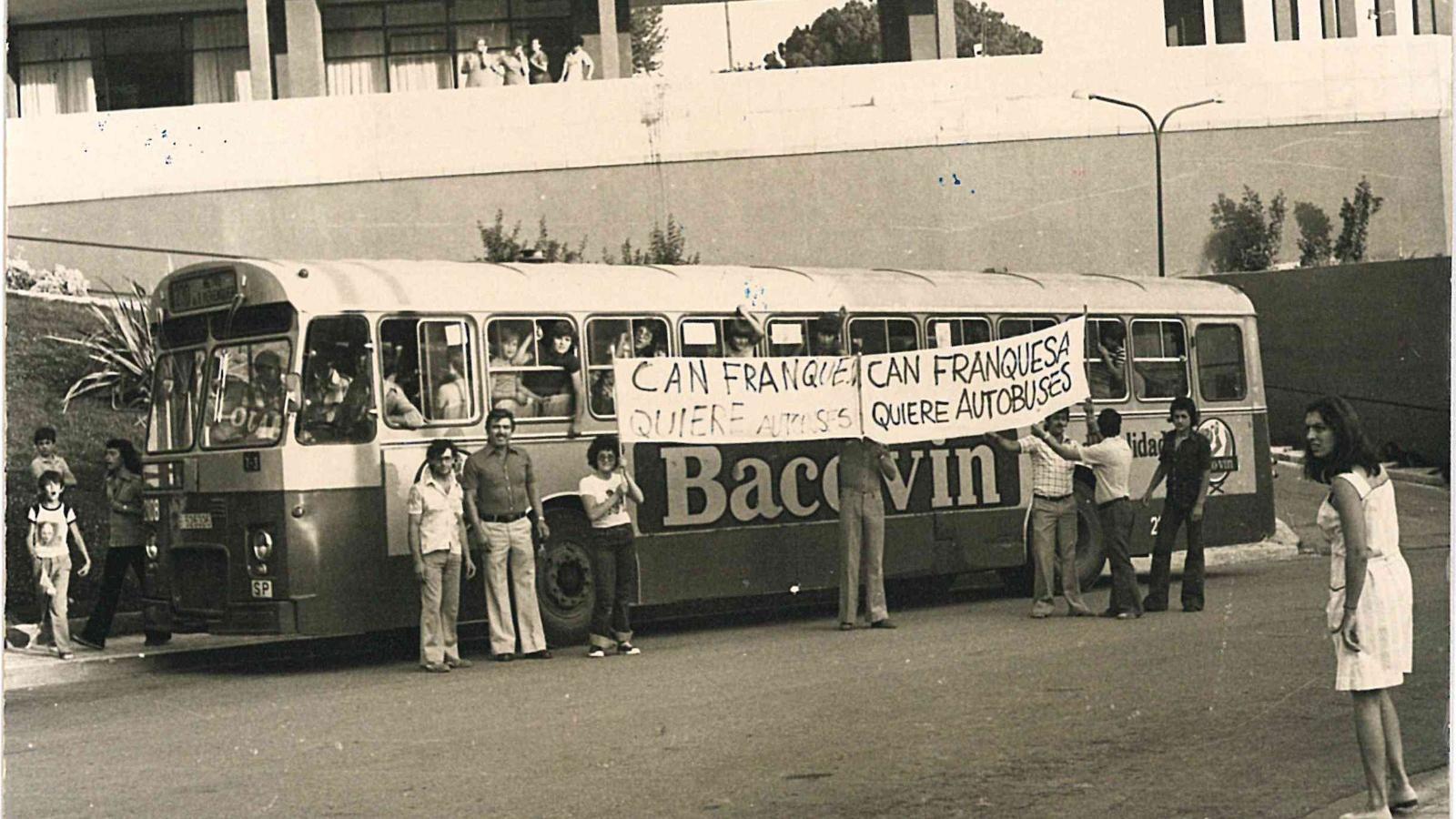
BarcelonaOn August 2, 1973, a hundred residents of the Can Franquesa neighborhood, in Santa Coloma de Gramenet, paid their fare, boarded the TUSA bus, and forced the driver to head up the mountain to Menorca Street. They wanted to prove that the council's argument for not reaching it—that the street was too steep—was false. Franco was still alive and, two hours later, the Civil Guard arrived with submachine guns. The women were not intimidated and said they wanted to speak with the mayor. They could not do so: they ended up at the police station, were tried, and fined. The story of that hijacking had haunted the journalist Odei A. Etxearte (Santa Coloma de Gramenet, 1982) since she was 17 years old. She knocked on many doors in a neighborhood she knows very well—it is where she grew up—to find out who those women were. Along the way, she discovered many more things, such as the story of her father, who had been a militant in ETA Berri, a splinter group of ETA. She also strove to find out who the boy in the red sweater was with whom Jordi Pujol had an altercation on November 6, 1988. She explains it all in the book The Kidnappers. Forgotten Memory of the Outskirts (La Segona Perifèria).
Etxearte learned the story of the hijacking when she started working at the magazine Fòrum-Grama (which still exists in digital format). “It was an innovative, popular publication, based in the neighborhoods and with a strong component of denunciation that often suffered Francoist censorship,” says the author. Working at this local magazine, she became interested in neighborhood movements and learned about the bus hijacking carried out by women. “I wanted to know the names of those women because I considered it unfair that no one knew them, unlike other neighborhood struggles in which male leaders are always remembered,” she explains. “They were housewives or worked cleaning apartments, in factories, or sewing at home, tasks that were little recognized but that sustained a good part of the neighborhood's life.” Etxearte does not believe they had a feminist discourse behind them, but rather that they were clear that problems had to be solved. And, if necessary, they took action.
While the journalist was investigating, the film El 47. “I had already started investigating some time ago, and some women were a bit indignant, always in a positive sense, because the film has helped a lot to make all these struggles visible. They regretted that they had hijacked a bus years earlier and no one had ever come to ask them anything,” she explains. When she started to pull the thread, she realized that it was not an isolated incident from 1973, but that many buses had been hijacked.
28 hijackings
Most of these hijackings –Etxearte rescues 28 of them between 1973 and 1985– relied on the complicity of the drivers. “The hijacking was often faked. Most of the drivers did not object because they were workers who lived in the same neighborhoods or nearby and showed solidarity with their neighbors. Even in March 1979, in Can Franquesa, the drivers took turns managing the service during the ten days that the buses were hijacked in the neighborhood,” she says.
Etxearte had to do detective work; searching extensively in archives but also among the memories and folders of the neighbors. The press did not report much on the hijackings, and the author searched in the clandestine press, in judicial archives, in neighborhood commissions, and even in the collection of the Ghost Station, where the Association of Metro and Bus Company Collectors has a museum. In the book, there is an explicit vindication of many people who have battled to preserve the collective memory and the value of these personal archives of ordinary people, which are often lost when the elderly die. For instance, without José Mora's website, a bus enthusiast who has collected a colossal volume of information, Etxearte would surely have had a much harder time.

The outskirts neighborhoods, such as Can Franquesa, were built with serious deficiencies (without schools, water, markets, or buses that would go all the way to the top) and at an excessively expensive price. Etxearte reports that there was a real estate scam linked to the corruption of the Franco regime: Agustín González Mozo sold the land to the Francoist City Council at a price that multiplied by much the amount for which he had acquired it only two years earlier. In this period of time, the forest plots would have been reclassified as developable. González, who was the twenty-fifth richest man in Spain between 1978 and 1979 and received the Medal of Merit at Work in 2001 from the hands of Aznar, was incredibly lucky that the forest plots he bought turned into developable land. “He bought forest land, they reclassified it, and he sold it to the City Council at inflated prices to build cheap and poorly made apartments, taking advantage of the migratory wave, even though there was flat land available,” the journalist laments.
The author also questions the narrative according to which all the Catalans who were there when the migratory wave arrived were bourgeois and benefited from it: “These speculators came from outside Catalonia, they had no connection to the country, and at the same time, many working-class and common Catalan people also suffered the grief of seeing how their rural town suddenly turned into a suburb without services,” she explains.
Pujol's visit
When Etxearte asked about the kidnappings, the memory of Jordi Pujol's visit to Can Franquesa in 1988 immediately came up. Pujol always used it as a display of authority before neighbors who had supposedly broken his windows and thrown stones. Neighborhood witnesses, however, claim that the man in the red sweater did not throw a rock but a clod of dirt, after the entourage ran over his foot, and that Pujol scolded them and left without listening to them. “The paradox is that the neighbors blocked Pujol's path precisely because they recognized his authority and believed he was the only one who could fix the structural deficiencies that the neighborhood was still dragging on in the middle of democracy. That episode, however, stigmatized them as 'savages and illiterates', and it still hurts them now,” says Etxearte.
Investigating these struggles changed Etxearte's perspective: she understood that Santa Coloma de Gramenet did not resign itself to being a marginal city, and that everything there—the metro, the buses, and markets like the one in Singuerlín—was not an institutional gift, but the fruit of neighborhood pressure. The book also led her to learn more about her father, who died in 2016 and had been a militant in ETA Berri during the dictatorship. “At home, he had almost never spoken about it; he didn't tell war stories and I have discovered episodes of his life that I did not know and that I can no longer ask him about,” she says. Writing the book, she hesitated about including her family history, but understood that it was necessary to do justice to the diversity of people who made the mobilizations possible, both the neighborhood residents and the clandestine militants who came from outside and “proletarianized” themselves (they went to live and work in working-class neighborhoods for ideological coherence and to promote political transformation there). Her father was one of those who stayed to live there.

