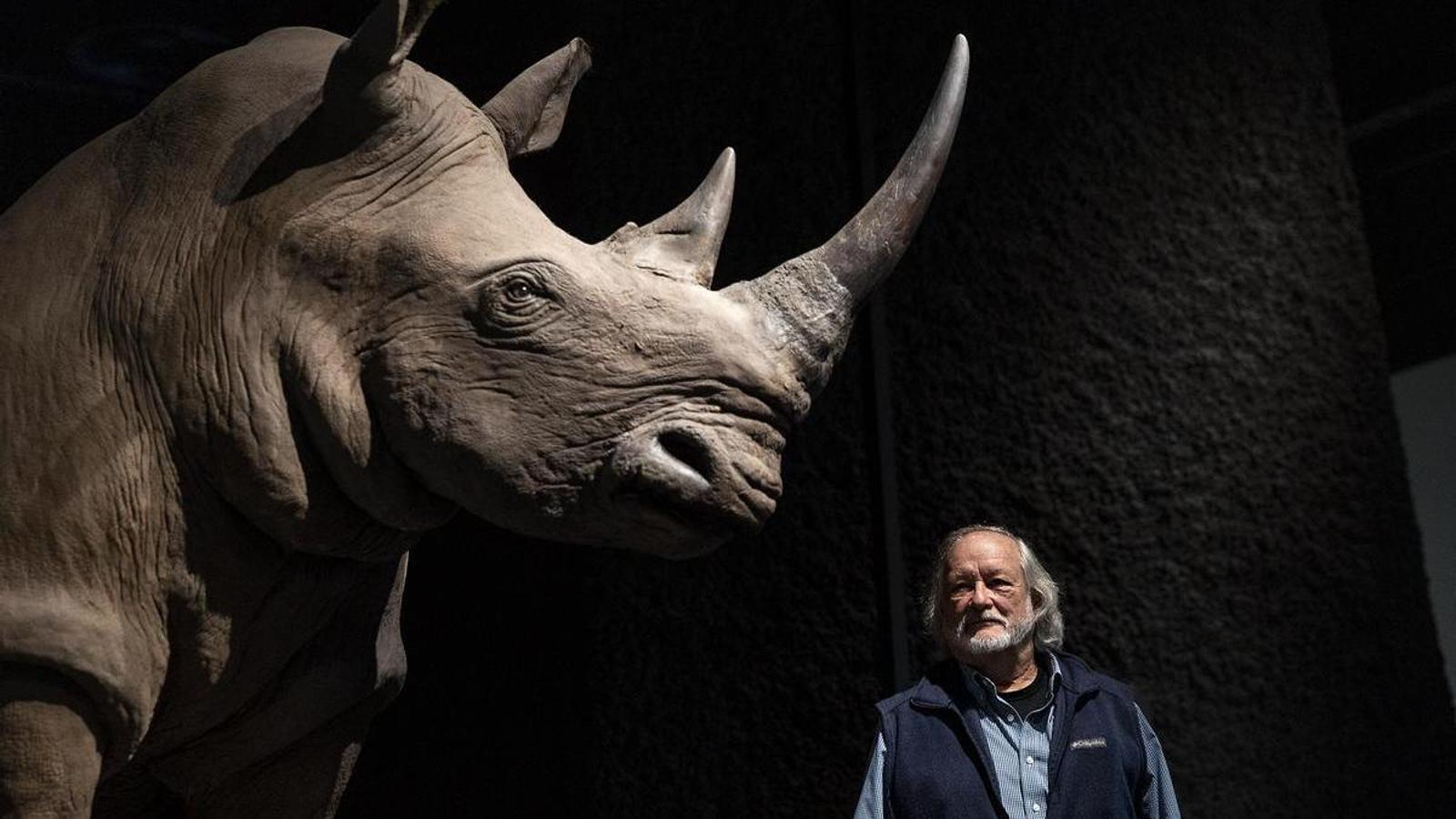
Oliver A. Ryder: I met Najin when she was one week old. Today she is the oldest living northern white rhino on the planet
Director of conservation genetics at the San Diego Zoo
-
CAT -
CAST
Oliver A. Ryder, an American geneticist and conservationist, has dedicated nearly fifty years to investigating how molecular biology can help preserve threatened animal species. Director of Conservation Genetics at the San Diego Zoo (California, United States) and co-chair of the Animal Biobanking Specialist Group of the International Union for Conservation of Nature, he is one of the driving forces behind the Frozen Zoo, a collection of thousands of animal cell samples that is, he asserts, a "genetic insurance policy" for the Earth.
For his work, which combines traditional efforts with cutting-edge technology—and which has been key in efforts to conserve iconic species such as the northern white rhinoceros, Przewalski’s horse, and the California condor—, he has just won the ninth Nat 2026 award, granted by the Natural Science Museum of Barcelona.
There are more than 7.7 million animal species, more than 20% of which are in danger of extinction.
— Almost all nations have signed the Convention on Biological Diversity, except for the Vatican and the United States, and, despite the global commitment to reduce extinctions, the loss of biodiversity is accelerating. There is collective goodwill towards nature and wildlife, but, at the same time, humans continue to contribute to the disappearance of species. The extinction rate far exceeds the natural one, and the decrease in the number of individuals of many species is even more alarming. This represents a loss of genetic capital, the diversity that gives them resilience and the capacity for adaptation.

Why do they become extinct?
— One of the main causes is the climate emergency, the result of centuries of burning fossil fuels. The fact that these energy sources have allowed us to achieve so much economic progress makes addressing the problem a global challenge. We are at a unique moment in the history of life: a single species dominates the activities of an entire planet and, at the same time, we have never had so much knowledge available to intervene in it.
You work to conserve the genetic material of endangered species. Will it allow us to save them or help them adapt to the climate emergency?
— We do not have a complete idea of everything we can achieve, but we know that there are significant possibilities. For about seventy years, we have been able to extract animal samples, grow cells outside the body, cryopreserve them, and recover their function after thawing. And we can do this even after the individual has died or a species has gone extinct. In the 3.8 billion years of the history of life on Earth, it is an extraordinary milestone. We do this in biobanks. In Barcelona, Tomàs Marquès Bonet [ICREA researcher and professor at UPF] started one five years ago, the CryoZoo. It is very important to understand that this effort must be made, because in five years we will not have more biodiversity to sample than what we have now. If we do not preserve this material, future generations will not have the option to use it.
What applications will this biological material have?
— One of the things that facilitates the conservation of biological samples is research in genomics, which is one of the great advances in the history of biology, as important as the microscope was, or, in astronomy, the telescope, because it allows for a completely new way of looking at the world. With the information it provides us, we can evaluate the vulnerability of species, reconstruct their history, and study their diseases.
The San Diego Zoo preserves cells of thousands of species at the Frozen Zoo, a pioneering project that was born 50 years ago.
— It was developed by my mentor, Dr. Kurt Benirschke, who began freezing living cells from some species with liquid nitrogen with the goal of studying the chromosomes of various animals to understand the differences between species, reproduction, and evolution. Those cells could be frozen, thawed, and grown again. A few researchers got involved with the idea of exploring what other applications that material could have. This coincided with the beginnings of conservation biology, which is a crisis discipline: we must find ways to save animals until humans have less of an impact on the planet.
And will we have it?
— The human population is expected to decrease. Perhaps in a hundred or two hundred years there will be more habitats available for animals. The question is how we can build a bridge to that future. And one of the ways is to maintain managed populations, like the ones we have in the San Diego and European zoos, and to preserve genetic richness in biobanks.
What have you done with this material so far?
— To begin with, unexpected discoveries. For example, for a long time it was thought that all genets, an African animal, were part of a single species distributed throughout South Africa and East Africa. But, when we studied their chromosomes from samples preserved in the Frozen Zoo, we discovered that the specimens from the two regions had different chromosome numbers. In gorillas, we were able to study genetic divergence and evolutionary relationships. And many more studies could be done if more samples were available. It would be especially useful for countries committed to the conservation of their biodiversity, because it would allow them to know and describe it.

Thanks to the material from the Frozen Zoo you have also cloned Przewalski's horses.
— We had identified a male that was especially valuable for preserving the genetic diversity of the species. We knew how to manage the crosses to reduce its loss, but we could only use live animals. So we wondered if the cells we had in the Frozen Zoo belonged to animals that could also reproduce. And we have managed to make two copies of that male.
Are there two live cloned horses, like Dolly the sheep?
— Exactly. I visited them ten days ago. The largest one is already producing sperm and soon we will put him with females, so we will be able to recover a genetic variation that had been lost. We are trying to do the same with the northern white rhinoceros, one of the largest land mammals that massive poaching has brought to the brink of functional extinction: only two females, mother and daughter, remain. May I tell you a personal story?
Go ahead.
— In 1989, I traveled with my wife and my young children, aged 7 and 10, to Czechoslovakia, when it still existed and was part of the Soviet bloc. The Soviet army was on the streets. There was the only zoo in the world that had successfully managed to breed northern white rhinoceroses (Ceratotherium simum cottoni), one of the two subspecies of white rhinoceros. I went there to study them and I stayed for a month. Just before leaving, we were notified that a rhinoceros had been born. We went to see it, and there was the calf with its mother. You already know how immense these animals are, and the calf was, by comparison, tiny. Mother and daughter were separated by thick steel columns from the rest of the rhinoceroses, about six of them, which were looking at that little calf with extraordinary curiosity and tenderness. That made a huge impression on me. That calf is today the oldest living northern white rhinoceros on the planet. Her name is Najin. I saw her when she was a week old and this year I visited her in Kenya.
Did they reintroduce it?
— Not exactly, because it was not the place where it originally came from, but they moved her to Africa with the hope that something would change. Unfortunately, that has not been the case. And now Najin is too old to reproduce. In these 37 years since I met her, I have been collecting cells from this subspecies and studying their genetics while the population was disappearing. Now from the San Diego Zoo, together with researchers from the IZW in Berlin, we are working to try to reverse the situation. We have twelve cell cultures of this species that provide us with access to the available genetic diversity. We have already managed to create induced pluripotent stem cells from samples of ten or eleven individuals and have demonstrated that they can be converted into other tissues, such as heart muscle cells. Our goal is to generate embryos in vitro and transfer them to southern white rhinoceroses, a species of which there are still thousands of specimens.
If we do not eliminate the threats that these animals suffer, what is the point of recovering them?
— The goal is not simply to create an animal to prove how good we are, but so that rhinos return to live in their habitats.
But these habitats are not safe.
— This does not mean that we have to give up. The populations of other rhino species are growing because some countries have protected them. In Kenya, for example, sanctuary programs have allowed them to be saved: in 1990 there were only about 300 or 380 black rhinos left in the country. Now there are between 1,000 and 2,000.
It is good news.
— Yes, but they need more space. This is a challenge that must be addressed with local communities and with good planning of conservation projects.
Where are the ethical limits? How far can we go to prevent a species from becoming extinct or to recover one that has already disappeared, such as mammoths?
— Who will benefit from these projects of supposed de-extinction? Nature will not. The argument that recovering mammoths would allow for increased carbon capture and preserve the permafrost in Siberia does not make much sense. Tens of thousands of animals would be needed. Furthermore, you cannot simply produce a mammoth: it would have to be gestated in a surrogate mother, which would have to be an Asian elephant, an endangered species. You would be diverting their reproductive efforts to create an animal adapted to the cold that, in reality, would not be a mammoth, but a kind of facsimile.
Will we genetically modify species to adapt them to the climate emergency?
— There is a lot of talk about it, but I don't know to what extent it will be easy to do. The International Union for Conservation of Nature (IUCN), the largest conservation organization in the world, has been debating this issue for twelve years. Last year, at the World Conservation Congress in Abu Dhabi, a resolution on synthetic biology was approved which establishes that, although these technologies can be very useful, they can also be very harmful. That is why they must be evaluated very carefully, with the participation of all potentially affected people and populations, including human communities and animal advocates. And it must be done on a case-by-case basis.
We have an increasing capacity to manipulate nature.
— And the great ethical question is what kind of nature we want. If we prefer to have genetically modified dogs, cats, and cows, cats with tiger stripes, and designer animals, what will the nature of the future be like? The fundamental question is how we see ourselves. Do we consider nature something that exists for our pleasure? Or do we understand that we are not separate from nature, but that we are connected to it and that our future depends on its future? Deep down, it is about understanding what place we occupy in the great web of life. With everything that is happening in the world—climate change, loss of species, social conflicts—what can we do for life? What can we do to benefit the future?
