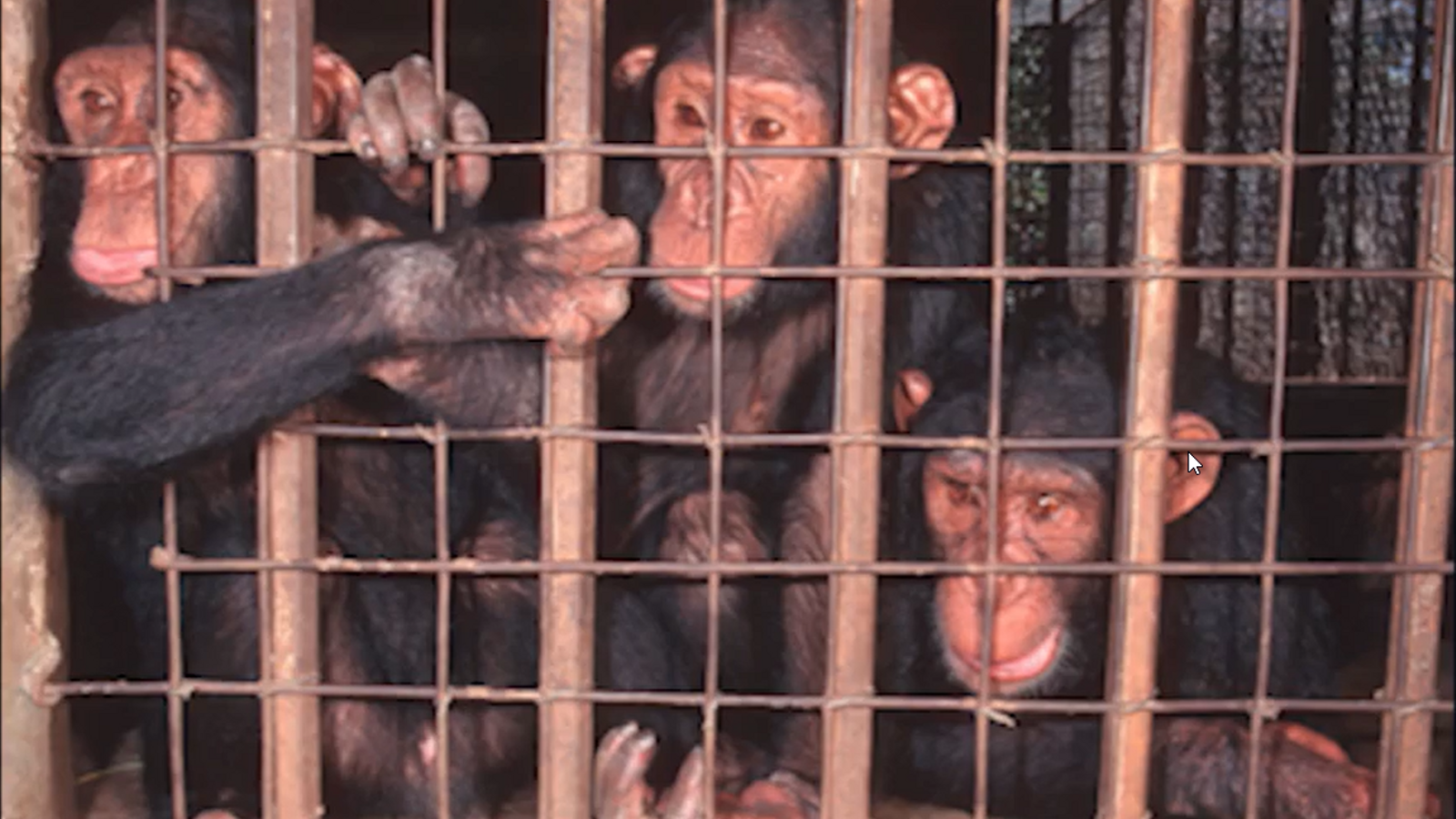
They were found completely sedated at Cairo airport on May 2nd. The three infants were traveling bundled up inside the suitcases of a passenger flying to India. When the Egyptian authorities intercepted him, they found, in addition to the little chimpanzees, ten bags full of rare reptiles.
All the animals were transferred to the Alexandria Zoo, where the veterinary team evaluated their state of health. In the case of the chimpanzees, they had to be administered treatment to counteract the effects of the anesthesia and the acute stress they had suffered.
It is not known for certain where they came from. Surely, they had been abducted hundreds or thousands of kilometers south of Egypt, somewhere in the forests of Central or Western Africa. Perhaps in Cameroon, Gabon, Congo, or Ivory Coast. Perhaps they had passed through several hands before arriving at that suitcase in Cairo. Often, the scarce information that accompanies a trafficked animal does not allow its history to be reconstructed.
If they had not been confiscated within the framework of measures to combat the illegal trafficking of protected species, provided for in the Convention on International Trade in Endangered Species (CITES), it is most likely that they would have ended up in some illegal zoo in Asia or, perhaps, at the home of an individual willing to pay hundreds of thousands of dollars to have a wild animal cub.
Due to illegal trade, more than 2,000 primates die in the wild every year, according to United Nations data: for every live infant captured, between five and ten adult specimens lose their lives.
"They prefer the infants because they are easier to transport and live longer -points out ICREA researcher Tomàs Marquès i Bonet, a professor at Pompeu Fabra University-. In Western countries it is strictly forbidden to take animals from the wild to put them in a zoo, but in Asia it is another story", laments the biologist.
Forensic genomics
Marquès Bonet is one of the world's leading experts in primate genomics and evolution. Throughout his career, he has dedicated himself to studying them from a molecular perspective to try to understand human biology and find out what makes us different from these close evolutionary relatives. He has now begun to pioneer the application of forensic genomics to combat their illegal trafficking.
"It will not save the great apes on its own, but it is one of the tools that can contribute to it," asserts a convinced Marquès Bonet, who has launched the Genomic Atlas of Great Ape Trafficking. The goal is to generate a map of the geographic origin of stolen primates and the routes followed by traffickers to remove them from the continent. This information should serve to work with communities in the extraction regions and try to cut off these routes. In the long run, it should also allow for the return of confiscated animals to the places where they belong.
For the moment, he already has the atlas for chimpanzees ready, which are the most trafficked great apes, and is working against the clock to also map out one for bonobos, gorillas, and orangutans. Marquès Bonet hopes that the results can be presented in the future within the framework of the United Nations annual report on the trafficking of great apes.
"We are working with wearable devices with the idea that, in the near future, when an animal is recovered, its origin can be known immediately and it can be returned as soon as possible, before it gets used to living in a human environment", explains the researcher. Now, for the moment, primates usually end up in sanctuaries, often far from their habitat and their natural group.
To be able to return them, technology is required, which they already possess, but also funding; as is usual in science, the main obstacle. Until now, a American foundation, Revive&Restore, which finances risky projects in which technology is applied to conservation challenges, had taken charge of it. But “at the end of 2026, once the atlas is already a reality, it ends and we have to seek funding”, the researcher resigns himself (donations can be made through the project's website).
A question and a challenge
The idea for the project stems from a question that had been stuck in Marquès Bonet's mind. For years, he was recurrently asked if he was capable of identifying, from an animal's genome, where it came from. And the answer was always the same: no.
Because to identify if an animal was from place A or place B, it was first necessary to demonstrate that the individuals from these two places were genetically different. And no matter how much he scrutinized the blood samples that arrived at the laboratory, Marquès Bonet could not find any association between the genetics and the place where they were told the animals came from.
"We needed GPS coordinates that would allow us to know with precision the origin of each sample," explains the researcher, who heads the comparative genomics group at the Institute of Evolutionary Biology (IBE-UPF-CSIC). And blood did not allow for this, but animal feces did. A risky idea, because studying the genetics of primates this way is extraordinarily complex: most of the DNA it contains is bacterial and only a very small proportion comes from some cells of the intestine.
"One of the great technological successes we have had in my laboratory is figuring out how to process samples that have very little great ape DNA," Marquès Bonet proudly highlights.
Once the technology was developed, they analyzed thousands of samples sent by the 16 African countries that are currently actively participating in the project, and cross-referenced the results with the GPS coordinates.
This is how they corroborated that the place of origin of the primates leaves an imprint on their genetics and were able to start placing it on a map. "A chimpanzee from the north of Gabon is different from one from the south of the same country," points out Marquès Bonet. The precision depends on the area and the available genetic information. In some cases, the system can identify specific protected areas, while in others the origin can only be located within a broader region.
Now, in collaboration with a United Nations group and with African sanctuaries where seized animals arrive, they have already analyzed nearly 600 samples of chimpanzees that were victims of trafficking. They have been able to find out the areas where the animals came from and have already identified the origins of the confiscated samples.
They have also analyzed samples preserved in European museums of great apes extracted from Africa during the colonial era. They have seen that the extraction is not homogeneous across the continent, but rather that there are places from which many more specimens come. "Most of the places from which chimpanzees were extracted during the first half of the 20th century, when they were colonies, have now changed. But there are two from which, continuously, an extraordinary quantity of animals has been extracted. And they should be a priority for action," warns the Catalan researcher.
Involving local communities
Marquès Bonet is clear that having maps with illegal trafficking routes will not, by itself, end the problem. "They will create new ones every time we point one out. The solution is not just about putting up barriers, but about education," considers the scientist, who cites the mountain gorillas of Rwanda, Uganda, and the Congo as an example.
During the 1960s and 1970s, mountain gorillas were hunted for trophies and live specimens destined for captivity. The capture of offspring could lead to the death of other members of the group, who were protecting them. Starting in the final decades of the 20th century, conservation programs combined the fight against poaching, habitat protection, education, and the involvement of local communities. Nature tourism also began to generate income for conservation and for the surrounding populations. "It is necessary to teach local communities that they can earn more money by conserving primates and attracting tourism than by killing them or capturing them to sell them," asserts a convinced Marquès Bonet. The researcher announces that, together with the United Nations, they will promote education and conservation programs to involve local communities in the protection and conservation of these wildlife species.
"The future of the conservation of these species may involve attracting tourists who want to pay to see chimpanzees, gorillas, and bonobos in the wild, and having this money revert to the populations in the area. In the end, it is a socioeconomic problem: people who are starving and find a way to generate money through animal trafficking. We hope that, from here, from Barcelona, we will be able to contribute to making the illegal trafficking of species more difficult," concludes the Catalan researcher.
Encouraging local science
One of the project's goals is to foster science in the participating African countries. "We cannot work with developing countries from a colonialist perspective; rather, we must train local teams so they can learn the process and benefit from it," concludes Marquès Bonet.
In this regard, this year he has hosted a student from the Congo, Ndelani Nkalla, at his laboratory, who has trained there and will do the same for other local researchers in her country in the future. This has been possible thanks to the German philanthropist Sabine Plattner, who has a foundation dedicated, among other objectives, to promoting the country's scientific development.
The team has also developed a small, portable, and easy-to-use device so that local researchers themselves can analyze stool samples in situ.
"We trained a primatologist, Luna Cuadrado, who had not previously done molecular biology here at the IBE. She has now returned to Africa. The project's idea, if we secure funding, is to send sequencing devices, which are like small USB drives, along with tutorials so that local researchers can routinely test confiscated animals."