Last minute tourism: behind a photograph of a disappearing beach
The impact of touristification in territories highly vulnerable to the ecological crisis, such as Iceland and the Ebro Delta, strains the ecosystem and citizenry

-
CAT -
CAST
Market logic justifies that what is only within reach of a few generally increases its value. This dynamic that sets the price of goods and services also infiltrates human behaviors, which end up conditioning decision-making. But what happens when what is at stake is an element on which the daily lives of citizens depend? The tension between the desire to collect travel experiences and to ensure the lives of the population of a vulnerable territory is what highlights the dynamics of tourism in the midst of an ecological crisis.Already in 2007, the award-winning editor-in-chief of the digital publication Travel Age West, Kenneth Shapiro, gave a name to a tourism phenomenon that was then beginning to proliferate: last-chance tourism. At that time, the concept referred to trips to areas threatened by environmental changes, such as the imminent threat of a volcano eruption or an expedition to observe an endangered species, among others. Over the years and with scientific evidence that the ecological crisis affects every corner of the planet, this word used in the jargon of travel agencies and nomadic gurus has undergone some nuance. Now, last-chance tourism is also the experience of visiting destinations that are at risk of disappearing or radically changing in the coming years due to damage caused by human pressure. Examples include visiting Australia's Great Barrier Reef, due to ocean acidification and rising water temperatures; or the Maldives islands, due to rising sea levels.Living between the thaw and the AMOC
But there is no need to change continents to observe the loss of ecosystems in areas where tourism plays a significant role. “In Iceland, the most evident change at first glance caused by the climate crisis is the retreat of glaciers. It is something that can be perceived even when comparing photographs taken just a few days or weeks apart,” explains Catalan photographer Natàlia Antequera, who lived in this Nordic country from 2021 to 2024. The Arctic is the region in the world suffering the highest temperature increase and, as a result, causes Iceland to lose 10 billion tons of ice per year, according to NASA data.At this rate, the European island could run out of ice by the year 2200. In nature's balance, every element plays its part, and melting is not only a sign of collapse in itself, but also a trigger. Specifically, in recent years, Nordic countries have been suffering from the stoppage of the AMOC (Atlantic Meridional Overturning Circulation), the part of the thermohaline circulation that passes by the Icelandic coasts and plays a key role in regulating the climate in the Northern Hemisphere. This danger prompted the island's government to declare the AMOC a national threat last November, becoming the first European state to take this stance.

Tourists and accomplices
This context does not slow down the arrival of millions of annual visitors to the island. Quite the contrary. In 2015, the country received 450,000 visitors and, in 2025, 2.2 million set foot on it. The growth of more than 400% in ten years is even more remarkable considering that Iceland's population is 401,000 inhabitants. “Just a few weeks ago it was announced that Air China will open new flights to connect Beijing with Reykjavik. Everything suggests that these figures will continue to increase in the coming years,” recounts the Icelandic geographer and professor of cultural geography at Wageningen University, in the Netherlands, Edward Huijbens.According to him, visitors arrive on the island as a unique place and one that "must be visited once in a lifetime". The fact that they end up choosing this destination over others is caused by two main reasons: the great transport interconnection the island has by sea and air, and by the knowledge that part of the landscape is threatened with disappearing. "One of the main attractions are the glaciers and, obviously, they are melting here just like everywhere else," points out Huijbens.

Paradigm shift: no to tourism, yes to experiences
However, the professor points out that this thought is not due to the effects of the climate crisis, but to losing the option of having "travel experiences". "Due to the thaw, many excursions to ice caves and glaciers can no longer be made, but this does not cause a drop in tourist arrivals. After all, visitors will be able to take a photo of the glacier, which is their main objective," he concludes.The geography professor at the University of Barcelona Carles Barriocanal also relates what could be last-chance tourism with the profile of a visitor who seeks to go beyond conventional visits. “In an era when you can go everywhere, we no longer talk about doing tourism, but about seeking experiences. From witnessing icebergs breaking, to visiting endangered animals. There is a need to create more vivid memories with the capacity to connect,” he explains. This phenomenon often involves approaching natural spaces or local communities that, faced with a massive arrival of visitors, can generate an imbalance in the ecosystem.In fact, different studies point out the paradox of the desire to seek unique experiences in virgin areas with the impact generated by travelers themselves in the destinations they land in. Whether through the infrastructure that must be deployed – roads, airports, hotels or parking lots – or the emissions generated by commercial flights. “I am worried to see how places that were completely virgin a few years ago are now full of signs, fences, demarcated paths and restrictions. I understand why it has to be done, but it also makes me feel a certain sadness. In fact, as a photographer, I often wonder to what extent it makes sense to continue promoting these places on social media,” explains photographer Antequera, who has seen the island change in just a few years.
The thaw reaching the Ebro Delta
Despite the reality of thepolar ice cap warming may be far away, the consequences of glacier loss in Iceland have been affecting Catalonia for years. It would be logical to attribute the loss of ice masses to rising sea levels on the Nordic coasts, but this assumption is wrong. In fact, areas close to melting are the territories that suffer least from the risk of rising sea levels. This is explained by a gravitational issue. The immense volume of glaciers means they have their own gravitational force, which generates the attraction of seawater towards them. Thus, as long as glaciers exist, they accumulate more ocean water around them. When they melt, they lose mass and this attraction decreases. This causes the countries most affected by the melting of ice masses to be thousands of kilometers from the Arctic.
In Catalonia, one of the most vulnerable territories due to coastal exposure and low altitude is the Ebro Delta. But beyond its geographical and topographical characteristics, this territory has a third element that makes it particularly vulnerable: its strong dependence on the sediments carried by the river. Today, 95% of the sediments that guarantee its existence are retained in the Mequinenza and Riba-roja reservoirs, causing a phase of severe retreat and erosion.For these reasons, projections by the Intergovernmental Panel on Climate Change (IPCC) estimate that in fifty years a large part of the Ebro Delta will be below sea level. Part of this situation is caused by the thawing of polar regions and part by the lack of sediments. Urban areas such as Riumar, els Muntells or Poble Nou del Delta would be flooded, along with areas of high ecological value such as the dunes, lagoons or springs.
“Who will come here?”
In addition to ecological vulnerability, this area, declared a Biosphere Reserve by Unesco in 2013, receives tourist pressure that has been increasing in recent years. According to data from the INE, in Terres de l'Ebre in 2020, 567,000 visitors were registered, while in 2024 almost 900,000 people passed through, the majority of them accumulating in the coastal area and, especially, in the Ebro Delta. Again, the number of visitors clashes with the number of inhabitants of this territory, which is 190,600 people, which means that for each citizen, almost 5 tourists are registered annually.“The Delta is being lost and will end up being for a few tourists, because they haven't wanted to bring down the sediments. Who will come here if rice cannot be grown? Tourists. Because young people will not stay here with rice fields that are drowning in salt water and everything around them is flooded,” relates Marga Quera, a resident of Poble Nou del Delta, with force. The regression of the Delta has been rapid enough for considerable ecological, social and economic changes to have occurred in just one generation.The inhabitants of the Poble Nou del Delta area have experienced it firsthand. “Back then we had a school, a priest, a grocery store, and a bakery. Now we have nothing,” states Quera, who explains that to get bread she has to go to La Ràpita, while there are more than twenty-five tourist accommodations in the village. A similar transformation dynamic has followed Reykjavík: “You will hardly find any supermarket in the capital, beyond the small 24-hour establishments made for tourists. The inhabitants have to go to the outskirts of the city. It’s not a big bother either because, in fact, only a few do not live in residential areas,” explains Huijbens.
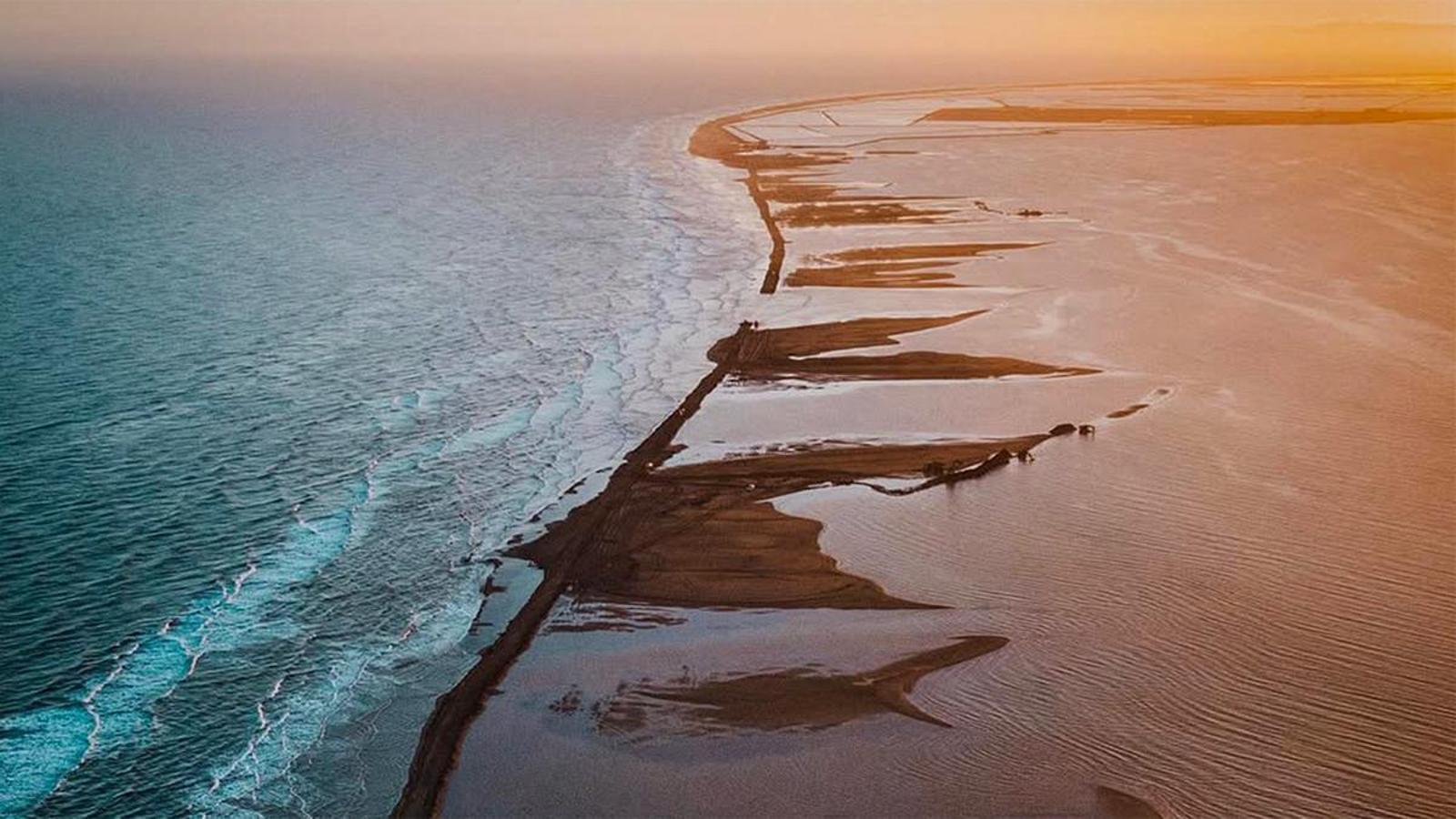
Like Marga, many of the Delta's residents remember Trabucador as a wide and solid beach. “Before, to go from one side to the other of Trabucador beach there was a distance of 20 minutes walking, now there are barely 5 minutes between the inner sea part and the coast. So much so, that before people from the surrounding villages built huts to spend the summer months by the sea. Now there would be no space to do so,” she recounts.Social protests for the defense of the territory
The most recent storms such as Glòria (2020), Filomena (2021), and dana (2025) have been a simulation of the landscape projected for the following decades. In each of these storms, the rice fields have suffered saltwater floods that have devastated the crops and dismantled coastal systems, with the Trabucador beach being especially vulnerable.“We have no fear, those of us who grew up here. We have already seen the landscape change so much... and in the end we have adapted. But, obviously, it does hurt us to see what we have around us disappearing”, says Quera. But the pain is not always passive. Each of the storms has been followed by different citizen mobilizations that demand more attention and measures to address the regression of the Ebro Delta.In fact, demands for measures to be resilient to ecological disasters – especially in the face of landscape loss, due to the symbolic component in terms of identity – can become an opportunity to generate social cohesion and mobilize for action. In Iceland, in 2019, a similar success was also experienced. At the summit of Okjökull, which had been a long tongue of ice, the first "glacier funeral" was held, attended by a hundred people, in addition to the Icelandic Prime Minister, Katrín Jakobsdóttir, and the UN High Commissioner for Human Rights, Mary Robinson. A commemorative plaque titled "Letter to the Future" was installed at the event, which stated the following: "This monument is to record that we know what is happening and what needs to be done. Only you will know if we managed to achieve it".
