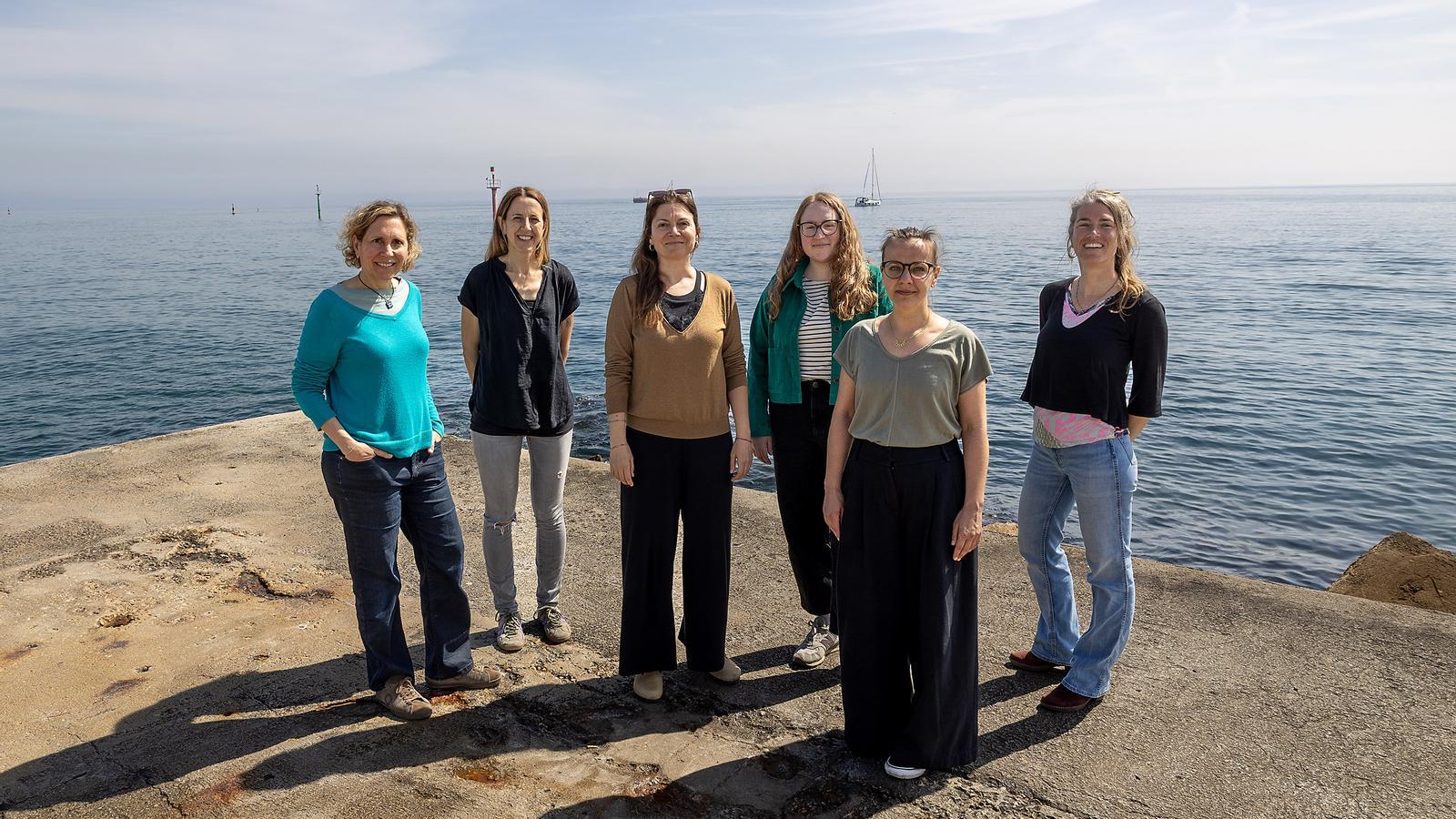
"What happens in the Arctic affects the entire planet." Six Catalan scientists are leading research to better understand the fundamental role of this region in global climate.
Six researchers in Catalonia lead research in this region to better understand its role in regulating global climate
-
CAT -
CAST
The Arctic is the fastest-warming region on the planet and is doing so at an unprecedented rate: up to four times faster on average than the rest of the Earth's land areas. And this has an enormous global impact because the ice in this ocean played a key role in regulating the Earth's climate, and it is now melting at an unprecedented speed. This is also changing the structure of the oceans, with a brutal impact on local communities and biodiversity.
The rise in temperatures is thawing the permafrost, which until now stored carbon and methane and which is now releasing them into the atmosphere, thus contributing to the accumulation of more greenhouse gases, and further worsening global warming. Furthermore, the thawing of this frozen ground layer is impacting the Arctic population, who are seeing houses and infrastructure collapse, suffering floods, and being exposed to the risk of illness from pathogens previously trapped in the ice.

Geopolitically, some countries see the situation as an opportunity to obtain and (over)exploit new resources, from valuable and hitherto inaccessible rare earth elements, to strategic routes and passages that cross the planet from one side to another in an extremely fragile area.
In this regard, in Catalonia, researchers from various universities and research centers are leading projects to better understand the fundamental role of this region of the planet, foresee the effects of the changes that are occurring, and fight for environmental justice.
The projects

"We can learn a lot from the local population of the Arctic"
Mariana García Criado
Marie Skłodowska-Curie researcher at CREAF, expert in plant ecology Mosses and lichens are very small plant species about which we have little information and do not know how they are reacting to climate change, despite being an essential piece in the Arctic. They are among the few that can survive in very harsh climatic conditions and play a vital role in regulating the carbon and water cycles, in addition to being essential for many animals in these latitudes.
What we are seeing in the Arctic is that rising temperatures are causing many shrubs to grow very rapidly, blocking light access for lichens. Consequently, lichens are decreasing, leaving reindeer without food, forcing them to change their migratory routes to find other food sources. This, in turn, affects local communities that rely on herding these animals.
Furthermore, shrub growth contributes to the thawing of permafrost, releasing carbon and methane that had been stored until now, which contributes to an increase in greenhouse gases and, in turn, to climate change. One of the consequences of climate change is an increase in extreme weather events. I research the effect of climate change on these plant species and the cascading consequences for people and animals in the Arctic, and for the global climate. I lead the Bipolar project, focused on bryophyte and lichen species, where we try to calculate climatic niches: the temperature, humidity, and rainfall ranges in which these species can survive.
In the past, science was conducted in a rather colonial manner: people would go to the Arctic, collect samples and data, and leave. Now, the priority is to establish collaborations with local populations, who possess ancestral knowledge of the biodiversity and natural resources of this region. We can learn a great deal from them.
"We have studied the underwater canyon of Cape Creus, key in prawn fishing"
Anna Sánchez-Vidal
ICREA Academia Professor and oceanographer at the University of Barcelona
In some areas of the seabed, waterfalls occur that are crucial for regulating the planet's climate. My research group has been studying this phenomenon for years in the underwater canyon of Cape Creus, where seawater cools very rapidly due to the tramontana wind, becomes denser, and sinks. This, for example, has an impact on sediment transport or shrimp fishing. We are now studying this process of cold water sinking a few miles off Greenland, where we measure with instruments anchored to the seabed and analyze how the underwater relief influences how they move.
The rise in temperatures due to climate change is causing warmer waters from the North Atlantic to reach the Arctic, which seep into underwater morphologies that act as heat transporters and promote melting. This adds fresh water to the sea, and if there is too much, no matter how much it cools, it will not gain enough density to sink, and will alter the formation of cascades that, in the end, are the engine of thermohaline circulation, the regulator of global climate, a kind of conveyor belt that moves cold, dense waters from the poles and warm waters from the planet's equator.
In two weeks, I will deploy instruments to study dense waters near Greenland on a German ship. These instruments will record oceanographic data, such as temperature, salinity, current speed, and turbidity, until July, when we will recover them aboard a Spanish ship, the Odón de Buen. With this record, we aim to obtain information on the impact of melting processes fostered by climate change on thermohaline circulation and, therefore, on global climate. We will also study this phenomenon with satellite images, because we believe that the melting caused by this influx of warm Atlantic water near Greenland should be identifiable as a turbidity plume near the continent.
"I am surprised by the little research on the Arctic that is done here"
Carolina Gabarro
Telecommunications engineer and researcher at the Institute of Marine Sciences (ICM-CSIC), where she leads the Polar research groupI began my scientific career working for the European Space Agency (ESA) studying the oceans with optical satellite data.Subsequently, I did my PhD and worked at ICM defining the algorithms to measure ocean salinity from the SMOS satellite, which ESAlaunched in 2009. I remember going to conferences for many years and hearing about the extreme vulnerability of the Arctic. I got goosebumps hearing about the impact that all the changes happening in Earth's global climate could have. That's why I decided to promote the creation of a research group focused on the Arctic, here at the Institute of Marine Sciences. I am surprised that currently in our country there is little research on the Arctic, when what happens there affects us all, as it changes the global climate.
My current research focuses on measuring sea ice thickness from satellites. Until now, efforts had been more focused on quantifying ice extent, but we know that thickness also plays a crucial role in ocean currents, water salinity, and melting. That's why we are applying all the knowledge and experience we had from measuring salinity with SMOS to now calculate sea ice thickness with the same satellite. Now, in fact, we are developing new algorithms for ESA to improve the quality of thin sea ice thickness measurements, which are becoming increasingly frequent due to rising temperatures, and combining different sensors to enhance their quality.
One of the focuses of our current research is to see how Atlantic waters, saltier and warmer, are reaching further north into the Arctic than 30 years ago, which is changing circulation patterns. Now we want to look at the impact of this water on the Barentsz Sea ice, a very fragile area, and we want to study if it has already passed a point of no return. In addition to satellite data, we also conduct campaigns where we take instruments to the territory to take in situ measurements, to validate and improve satellite data.
I am the Spanish delegate to the International Arctic Scientific Committee, where scientific research in the Arctic is coordinated on an international scale. The committee is made up of 23 countries from around the world.
"In Greenland, fresh water from melting is accumulating"
Marta Umbert
Oceanographer at the Institute of Marine Sciences (ICM-CSIC)I investigate the impact of freshwater on the Arctic and, consequently, on the thermohaline circulation and Earth's climate. To do this, I have funding from the European Research Council, with an ERC Starting Grant. We know that freshwater is accumulating in Greenland from the melting caused by rising temperatures; also from rivers, such as the Russian ones, which are becoming more voluminous as the permafrost thaws.
All this water mass will potentially reach at least in part the North Atlantic and may affect the AMOC [Atlantic Meridional Overturning Circulation], the part of the thermohaline circulation that passes through this region and plays a key role in regulating the climate in our hemisphere. There is evidence that this system may undergo significant changes if the freshwater input continues to increase. And it would eventually cease to guarantee that the planet's climate is suitable for human life.
In my group, we study this mass of freshwater that accumulates to understand when, how, and where it will reach the North Atlantic, and to try to predict its effects. To do this, we feed and train an artificial intelligence with data taken in situ and from satellites of different oceanographic variables shared by the scientific community. Our goal is, afterwards, using only satellite data, to be able to reconstruct what is happening in the marine currents that transport this freshwater. Next, we integrate this information into an ocean-ice model that allows us to make predictions in different climatic scenarios.
Thermohaline circulation is a complex and slow system, but for decades now it has been accumulating the changes derived from global warming. Currently, we are in a transition phase in which processes such as the decrease in Arctic sea ice are accelerating. In the Barents Sea, summers with very little ice are becoming increasingly frequent.
"The U.S. base in Greenland generated a lot of radioactive waste"
Ksenija Hanacek
Socio-environmental researcher Beatriu de Pinós at ICTA-UAB and the Global Atlas of Environmental JusticeI study social movements that organize in the Arctic and are intrinsically linked to environmental issues. I started by researching southern Siberia, Lake Baikal, where a few years ago an important movement was born that defended its territory, such as water and soil. Communities organized to preserve their traditional customs, their lands, and the right to self-determination. That case made me realize that the mobilization occurring throughout the Arctic, a territory divided among eight nation-states, was related to environmental justice.
Since then, I have been working directly with indigenous peoples, local organizations, and activists, such as the Sami, who live in a territory spread across four nation-states: Finland, Norway, Sweden, and Russia. I also document cases in Greenland, where 80% of the population is Inuit, and which, like the rest of the Arctic territories, has a history of colonization heavily marked by Denmark. During the Cold War, for example, Denmark gave the USA permission to open a military base in Pituffik, which was then an Inuit hunting village, leading to the forced displacement of the entire community from their lands, which they considered sacred. And not only that, but the construction of the base, which still exists and Trump uses, generated a lot of radioactive waste.
Now again, as the Arctic is losing a lot of ice, especially on the coast of the island, there are strong commercial interests to open new mines to extract rare earth elements. Greenlanders oppose this, arguing that since these precious minerals are mixed with radioactive rocks like uranium, it will cause significant levels of radioactivity. From theGlobal Atlas of Environmental Justice we are trying to document all these aggressions. What happens in the Arctic has repercussions all over the planet.
The reduction of deep waters would lead us to the scenario of "Tomorrow's "
Núria Casacuberta Arola
Principal Investigator at the Institute of Marine Sciences and Professor of Physical Oceanography and Tracer Oceanography at ETH ZurichIf what is posed in The Day After Tomorrow (2004) were to happen one day, the world, as happens in the movie, would also collapse. In the movie, the process of deep water formation, which is the engine that keeps the thermohaline circulation and the AMOC running, stops, and this causes the entire Northern Hemisphere to freeze. It is clear that this is an exaggeration, but it brings to the table something that scientists are studying: the impact of global warming on the oceanic circulation belt, the main regulator of Earth's climate. In particular, I investigate how these deep waters form, and to do so, I use radioactive tracers.
I led the Titanica project, funded by the European Commission, from ETH Zurich, and now I have launched another continuation project, Nautilica, funded by the Ramón Areces Foundation, which I will carry out at ICM, in Barcelona.
We have already begun to see changes in the patterns of how Atlantic waters circulate and enter the Arctic. In September, I participated in an expedition led by the German Alfred Wegener Institute for Polar and Marine Research north of Greenland. We ventured as far north as had ever been done, to the Fram Strait, with the aim of better understanding the East Greenland Current, which channels the waters leaving the Arctic towards the North Atlantic, and whose formation is not precisely known. A better understanding of what waters this current carries, with what composition, would allow us to know where and how they are created, and also how they evolve over time.
All the data we obtain is injected into prediction models, which are very valuable for the reports generated by the IPCC, which is the body that evaluates whether the formation of deep waters occurring in the North Atlantic will continue to be stable or if, on the contrary, it is already decreasing, because that would lead us to a scenario in line with a science fiction film.
