Raymond T. Pierrehumbert: "Faced with the floods that will come, the only possible adaptation will be for people to move to places with less risk"
Professor of planetary physics at the University of Oxford and at MIT
-
CAT -
CAST
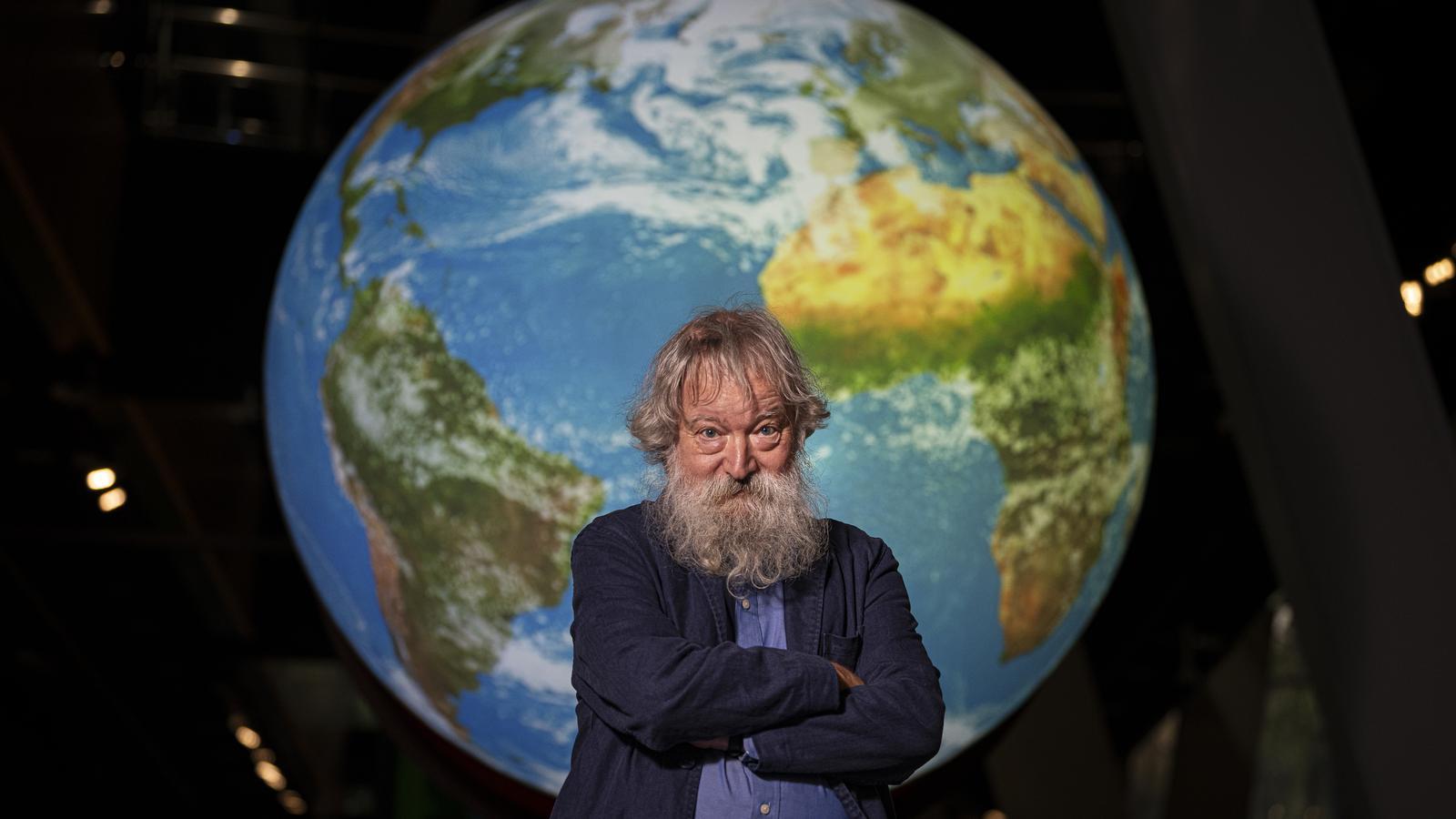
Raymond T. Pierrehumbert (United States, 1954) studies the most extreme climates in the Universe, those of distant planets where it rains glass or that of gaseous worlds where the daytime temperature is so high that the molecules of the atmosphere break down into atoms. Also that of Earth, both the current one and the one from 4.5 billion years ago. This perspective allows him to put into context to what extent the pale blue dot on which we are lucky to live is exceptional – and at the same time fragile. Professor of planetary physics at the University of Oxford and the Massachusetts Institute of Technology (MIT), he is one of the most recognized specialists in climate crisis. He has visited the CosmoCaixa Science Museum in Barcelona to convince us that we must reduce CO₂ emissions to zero. Because there is no other option.
I would have liked to interview him in person and not by video call, but there is a warning for torrential rain and public transport is in chaos.
— I almost didn't make it to Barcelona. Even though they are rather moderate rain episodes, they triggered the alarms on my phone and three flights on my way here were cancelled. It took me an extra day to arrive in Barcelona! The authorities are very cautious with alerts, and it is understandable, after the extreme episode that happened in Valencia 2 years ago.
Are these episodes linked to the climate crisis?
— Basic physics and climate models demonstrate how global warming causes more episodes of heat, floods, and drought. We cannot say that a specific one was caused by climate change, but we can say that these types of episodes would have been almost impossible to occur without global warming as a backdrop.
In the information age, why is it so hard to know what will happen tomorrow?
— Even if we can write the exact equations, the weather depends a lot on small errors in our initial knowledge of the atmosphere. Measurements with satellites and weather balloons and models have improved, as has our knowledge of the state of the weather system. We can predict the average number of storms, because it is statistics, it is climate. However, when it comes to individual episodes, such as downpours and strong storms, there is an irreducible unpredictability. Heavy rain is one of the most difficult things to predict. You may know that there will be heavy rain somewhere, but it is easy to be off by a few kilometers about where it will fall.
Can artificial intelligence help us?
— It would help us more to have better observation systems. Satellites offer a very blurred image of the atmosphere in the vertical, because they only look at the infrared light that comes out of it and try to figure out where it comes from. Even so, they are improving, and machine learning can help to better extract information from them. New climate models also try to predict uncertainty: they run many simulations, with different initial states, and observe how the prediction progresses. This allows us to say, for example, that there is only a 10% probability that it will rain, but that if it does, it will rain a lot.
Will torrential rains, floods, droughts, and heatwaves be the “new normal”?
— Yes. What would have been a relatively exceptional episode in 1960 can now end up happening every few years. In this sense, it is indeed a new normal. The hotter it gets, the more extreme rainfall we will see, and more extreme heat waves. This 2026 is the hottest year we have experienced so far, but it will be one of the coolest years of our lives. In the future there may be slightly less hot years, but each new extreme will be higher as long as we continue to put CO₂ into the atmosphere.
The UN warns that we will exceed 1.5 °C of global warming.
— Land warms more than the global average, and this is important because it is where people live. So, depending on how far you are from the ocean, your region could see temperatures rise by more than 2 °C. And the more heat, the more extreme precipitation and drought. But even if we exceed 1.5 °C, we are still in time to avoid reaching 2 °C. A 1.75 °C world is not fantastic, but it is much better than a 2 °C or 2.5 °C one.
You state that the only way is total decarbonization.
— We cannot expect fossil fuels to run out, because they will not. They will become increasingly expensive due to political turmoil in the Middle East, Venezuela, or wherever it may be. We must actively grow renewable energies. Spain is doing very well in this regard. China is also working aggressively to replace coal. It is much cheaper to produce electricity with photovoltaics than with coal. And the fact that fossil gas prices—I refuse to call it natural, because there is nothing natural about it—are rising in Europe and the USA gives even more economic advantages to solar and wind energy. But we must press the accelerator on the energy transition, because the faster we reduce carbon dioxide emissions to zero or near zero, the less warming we will have.
It does not seem that there is a real political will.
— Despair is not an option. Things will still get worse if we give up. In fact, I am an optimist. I believe we will reach close to zero emissions, because the rise in oil and gas prices due to wars has produced a great national security incentive to abandon fossil fuels, especially in Europe, China, and Africa, places that do not have large sources of their own. The faster we get to zero, the better our climate will be, but it will be this climate we live in now that we will be stuck with. There is no solution to turn back.
And then what?
— We must adapt to it. Europe will need air conditioning; it is no longer a matter of comfort but of protecting life. And this must be linked to other energy efficiency measures. There will also be many more floods, in the face of which the only possible adaptation will be for people to move to places with less risk.
Will we replace fossil fuels with electricity to maintain the current consumption model?
— Although I personally believe it would be better if people did not consume so many things, because I do not think it necessarily makes us happier, I do not like telling anyone how to live. What we can do is show that it is possible to have a richer life while consuming less energy. In Europe, this is already happening, compared to the United States: there is more public transport, and a good part of leisure time does not involve traveling in large cars and using an enormous amount of energy. We live in denser cities, close to schools and services. In the USA, many people live far away to be able to have a large house and spend many hours in the car going to and from work. What value does a house with 12 bedrooms and 6 bathrooms have if it comes at the cost of spending less time with the family or depriving children of seeing their friends?
How can we prevent the energy transition from penalizing people with fewer resources?
— There are people who can barely afford housing, food, and energy. For them, what is needed are policies that reduce the cost of energy. And it is not just about renewables, but also about deploying heat pumps, improving insulation, and making homes more efficient. This would reduce the cost of living and allow for healthier homes.
You study the climate of Earth as well as that of distant planets. What do you find most extraordinary about our planet?
— We have not found life anywhere else, although there is probably simple life. I wonder if we could be the first conscious beings in the entire galaxy. If so, we have a special responsibility to survive and thrive. This is the final exam question: what could humanity do if it managed to survive the next hundred years? Because we have done some truly magnificent things and others that are truly horrible.
Are you optimistic?
— The Universe is wonderful: the same basic elements of physics combine to give rise to stars, planets, Jupiter, the Earth... And another extraordinary thing is to what extent we are capable of understanding it. We are small beings, in a very young civilization, on the periphery of the galaxy, and we can look halfway across the Universe and see the first stars. And that is extraordinary.
