Government and Comuns propose to convert premises, hotels and offices into protected housing
The agreement includes ending construction for tourist rental, seasonal rental, or co-housing

-
CAT -
CAST
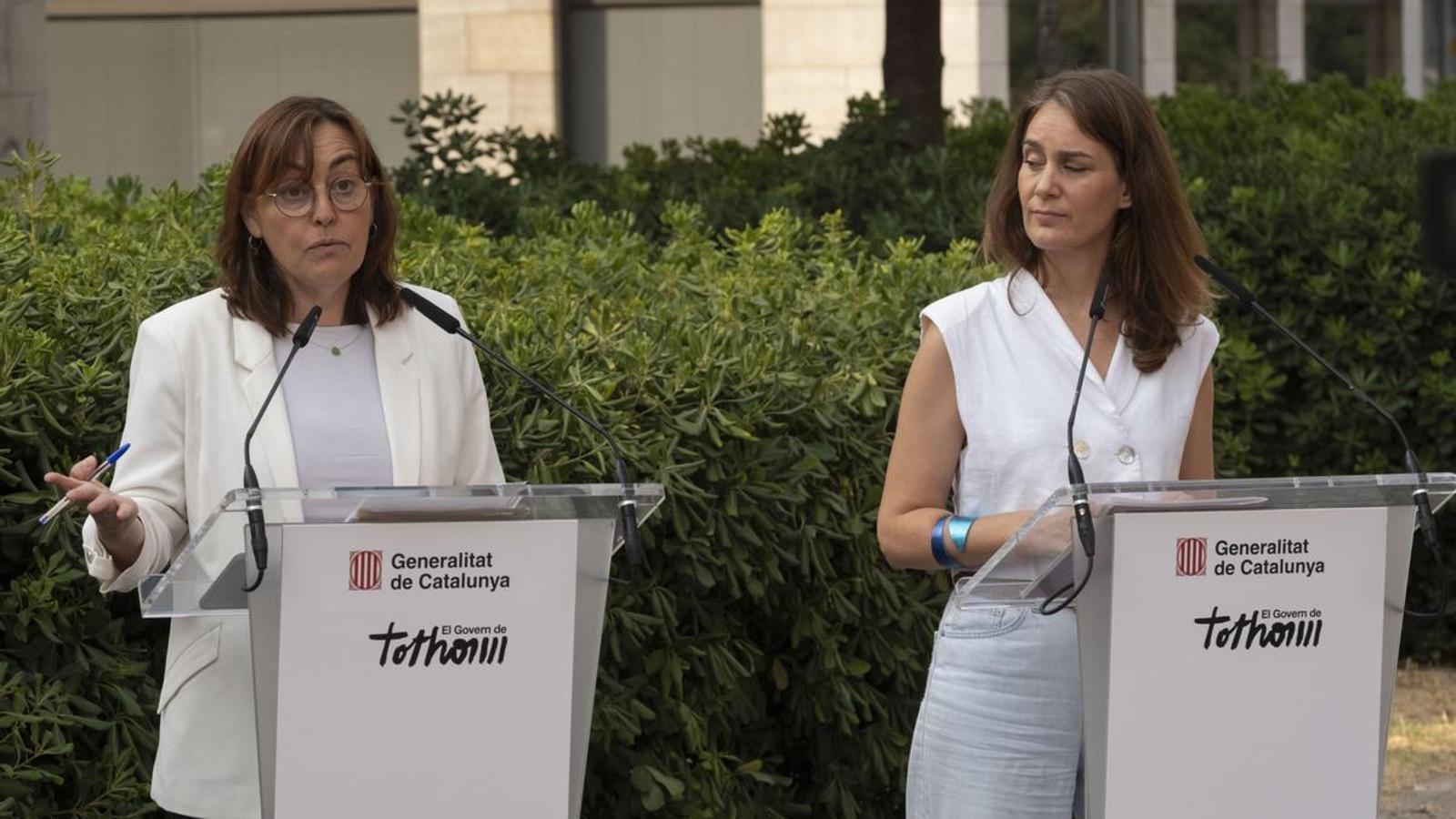
BarcelonaIn the midst of the housing crisis, the Government has made officially protected housing (HPO) one of its flagship projects. This Friday, the PSC and Comuns have presented a bill to accelerate the creation of officially protected housing that includes five measures, one of which is to give interested owners the option to convert commercial premises, offices, and hotels into protected apartments. According to sources close to the negotiation, "if everything went well and the entire package of measures worked" it could serve to incorporate up to 20,000 apartments. "It was an unavoidable priority to expand the stock of protected housing and ensure that housing fulfills its essential function of being a home," defended the Minister of Territory, Sílvia Paneque, at the joint presentation of this regulation alongside the leader of Comuns, Jéssica Albiach.
The intention is that owners and developers can take advantage of these measures during the four years after the rule comes into force, extendable to eight once the period has elapsed, in municipalities declared tense areas or areas of strong residential demand, around 270. "With this law we are telling the private sector that it cannot wash its hands of this wild housing crisis," Albiach defended, who highlighted the "facilities" they offer the private sector to "speed up procedures," but also "increase" their "demand." "We must activate all possible actors in front of a national objective," added Paneque. The Government and the commons defend that these are "exceptional" measures and that, therefore, they must be limited both geographically and temporally.
All homes that are converted or built thanks to the advantages proposed by the regulations will be considered permanent HPO (Affordable Public Housing), and none will be able to enter the free market. Their promoters will be able to market them, but they will have to do so at a determined price, and they will only be able to sell or rent them to people registered on the housing exchange and who meet the income requirements. In parallel, during these four years, all flats that are built must be intended for permanent housing: thus, socialists and commons want to put an end to building for tourist rentals, seasonal rentals, or co-living. Second homes are protected in the preamble of the law because they are considered an extension of the habitual dwelling.
The proposal quarantines urban planning regulations such as urban density – which sets a maximum population that can live in an area– and the maximum height of buildings: they will only have to comply with habitability conditions. It also lowers the minimum floor area to 50 square meters. The objective is to facilitate private action: "They are positive and voluntary measures, we want to put an end to excuses," say the same sources.

The 5 measures, in detail
Regarding the conversion of office buildings and hotels, those that wish to adhere to the regulation will have to convert at least half of their surface area into HPO, while the rest may continue to have the use they had until then. The objective is to reach municipalities with an oversized and aging hotel offer, mainly located on the coast.
Secondly, the law will allow the subdivision of apartments and single-family homes over 100 square meters: the resulting dwelling (or more than one, if applicable) will become HPO, while the original will retain its free status.
Thirdly, it will allow the construction of HPO on plots that do not have the minimum building conditions, provided that the resulting dwellings meet the basic buildability requirements.
Fourthly, it provides that buildings to be constructed may increase the planned residential area by 20%. In the same proportion, buildings already constructed in open spaces and community facilities may be expanded. The additional 20% must be entirely allocated to HPO and, if there is already a higher reserve –as in the case of Barcelona, which is 30%–, it will be added to the existing one.
In this line, buildings that have already reached their maximum number of inhabitants but are lower than their neighbors can add floors to match their height. In fact, socialists and commons anticipate that these last two initiatives will allow more apartments to be incorporated into the public housing stock.
Municipal autonomy
The fact of enshrining these measures in law will mean that, if Parliament approves them, they will be immediately applicable, without the need to modify urban planning. However, in order to maintain municipal autonomy, it gives municipalities the possibility of excluding the entire municipality, or a specific area, from the application of the rule. With this loophole, municipal governments will be able to protect certain streets to maintain the fabric of small shops and prevent commercial premises from becoming housing.
Since the autumn of 2024, the socialist executive has promoted a plan to add 50,000 homes to the public housing stock by 2030 – the famous Plan 50,000 – Salvador Illa's party have been proposing various strategies to achieve this, under the premise that "every little helps", in the words of the president.
The initiative presented this Friday is part of the agreement between the Government and the Commons to approve the 2026 budgets. The norm will have to go through Parliament, although it will do so through the urgent procedure to speed up the process as much as possible. "This extraordinary urgency route is justified by the housing crisis," defended Paneque. The minister is confident that the norm will be approved before the end of the year. Sources from the negotiation believe that it aligns with the positions of ERC, an essential support for the law to move forward, and recall that the groups will be able to propose amendments that will lead them to endorse the text. "Since the objective is shared, I am convinced that there will be good dialogue with the rest of the parliamentary spectrum," Paneque was confident, looking specifically at the "progressive forces." From Junts, the deputy Judith Toronjo criticized the Government's "permanent improvisation" on housing matters and its "constant and absolute subservience" to the Commons, and announced that the group will analyze all the details of the text once it knows it, in the hope that "it does not represent a new attack on fundamental rights," as she considers happened with the proposal to prohibit speculative purchasing.
