ARA awards Catalan technology with impact in the first FAR awards
The winners provide innovative solutions in sectors from health to agriculture or mobility

-
CAT -
CAST
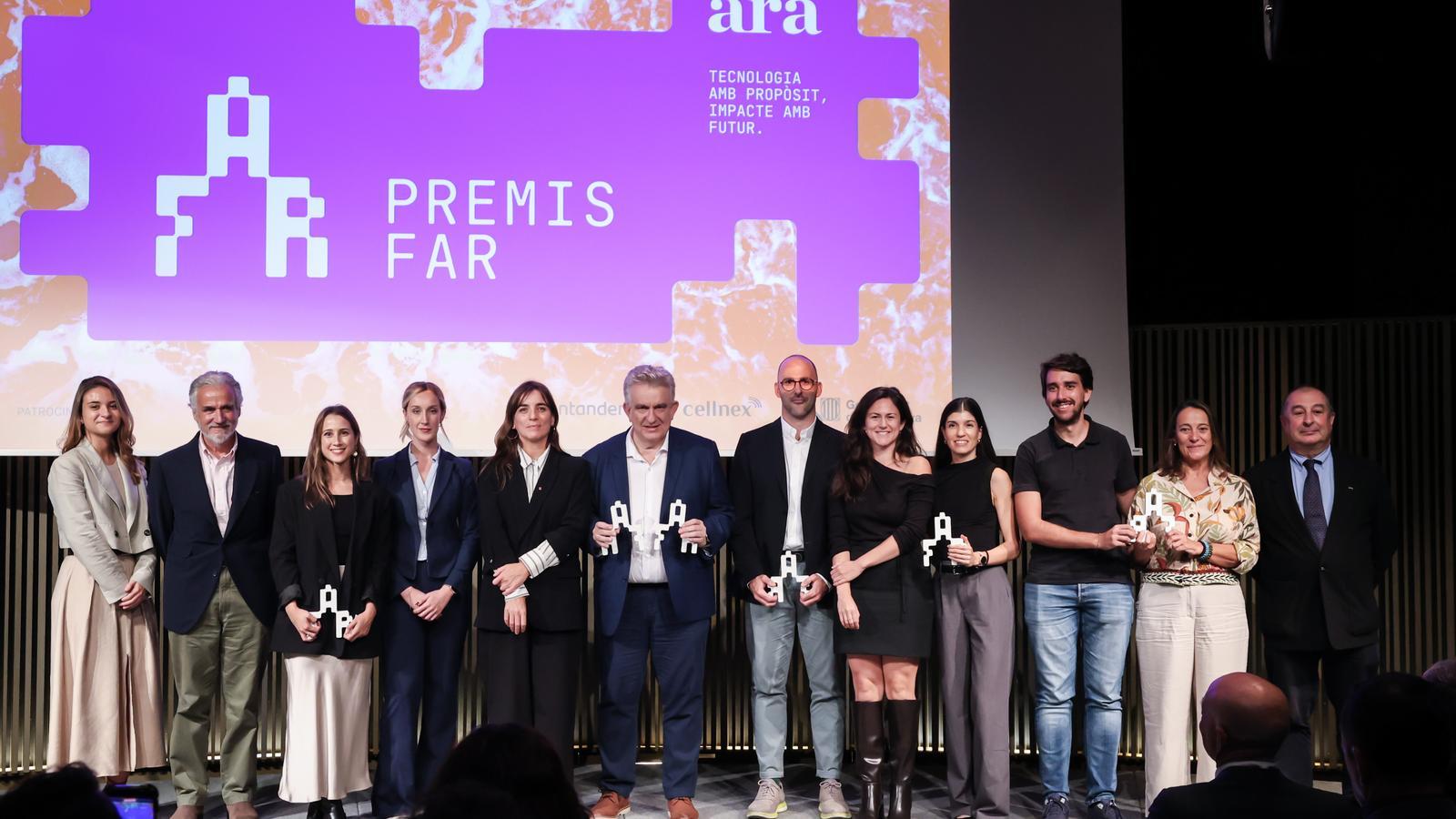
BarcelonaCatalonia shows off, whenever there is a forum, its capacity to innovate. Startups, hubs digital, international investments; find their home more and more in the Principality. The technology figures, however, quantify a host of projects that, in the words of the director of ARA, Esther Vera, "work to seek not very complex solutions to very complex problems". To give a voice —and bestow some well-deserved laurels— to a handful of these initiatives, the newspaper celebrated this Thursday the first edition of the FAR awards, dedicated to technology with an impact on society; in fields as diverse as education, health, or environmental preservation. The evening was hosted by journalists Laura Rosel and Cristina Sàez.
In this first gala, held at the MACBA and which has counted on the collaboration of Banco Santander, Cellnex, and the Government of Catalonia, the FAR awards have recognized five companies that apply technology where it is most needed. In a speech during the event, the Minister of Research and Universities of the Government, Núria Montserrat, praised the initiative, as well as its title, which she considered a great success. "It reminds one of the lighthouse of Alexandria, an infrastructure that served to guide and instruct, mentioned in many works to shed light on what is important", celebrated the minister.

A spirit that Esther Vera has also reflected, who recalled that while "technological progress is cumulative, often moral, ethical, and social progress is not." The solutions highlighted in the FAR awards aim to remedy this historical dysfunction.
Against pessimism
The initiatives that have come away with a FAR award statuette demonstrate the thesis presented by Genís Roca, a technology expert and president of Accent Obert: there is no room for depression in Catalan technology. "There is a certain pessimism surrounding the digital fact," observed Roca, "which I do not share. We have enormous opportunities and enormous responsibilities," he reasoned. A flattering attitude shared by Laia Corbella, the brand new executive director of the Mobile World Capital foundation, who has elevated Barcelona and Catalonia to "a technological hub." "And it does not have to argue that they are," she stated.
According to the executive, digital talent, which today is "a country infrastructure," generates much of the value that the Principality can offer. "The first question a company asks when it wants to come is what capacity we have to generate and retain talent," she recalled. The competition, however, is fierce and international. "It is a battle of cities: we are competing with Shanghai, with Berlin..." she listed. In this sense, she focused on the companies awarded at the gala, from whom she highlighted the ability to generate "referents to encourage vocations and choose preferences." "It is very difficult, if we do not have them, to define where we want to go," she reiterated. The FAR awards, therefore, seek to point out the way.
Market and ideas
A good part of the cutting-edge technological activity generated in Catalonia stems from highly competitive knowledge infrastructures. Among the most prominent is the Institute of Photonic Sciences. Its founder, Lluís Torner, was one of the authoritative voices of the evening. Torner acknowledged the relevance of technology transfer, the engine for bringing scientific advances to where they can be used. However, he warned against an excessive focus on market leaps: "we must focus on transferring, but also on continuing to generate ideas." After all, he stressed, scientists "want what they research to be useful." "That what they research reaches the market and ends up improving people's lives is a spectacular prize," he assured.
For his part, the rector of the Polytechnic University of Catalonia, Francesc Torres, has taken on the challenge of transferring knowledge to daily use; a task that the school fulfills, he defends, "through its graduates." "We try more and more for the profiles that come out to be closer to what companies need," he continued. Beyond the avant-garde ideas, more than present in Catalonia, Torres shed light on "a very active, very export-oriented and very competitive industry" that the country can boast of. A good part of the task of the Catalan knowledge ecosystem, therefore, is to maintain excellence also in the productive areas of day-to-day life.
The winners of the night
Among the evening's award winners at the FAR, honoring their purpose, there were projects with goals such as the rapid detection of breast cancer, accessibility in children's education, or the accompaniment and care of the elderly. In the field of Health innovation, the recognition went to The Blue Box, one of the leading biotechnological start-ups in the Catalan ecosystem in recent years. The company has developed a technology to perform a rapid, non-invasive, and radiation-free test to facilitate the early detection of a breast tumor. The company's technology is capable of detecting markers compatible with this type of cancer in a urine sample. The company's CEO, Judit Giró, adopted the evening's maxim, arguing that "technology and innovation make no sense if they are not dedicated to doing something good for the world".

The winner of the FAR award for transformation in education demonstrates that screens, when well-directed by teachers, can be an essential learning tool. The recognition went to Nextus Social Learning, an audiovisual platform with more than 2,000 educational resources that offers teachers educational resources to bring the lessons from documentaries and other teaching materials into the classroom. The project manager at the company, Eloi Trullàs, has claimed the capacity of audiovisual media to "help foster critical minds" among students.
Far from the uncertainty that they can generate in the furthest reaches of society, artificial intelligence and robotics can have more than desirable applications. This is demonstrated by Som Care, the winner of the award for social and community contribution. The project, which is part of Grup Saltó, combines social robotics and AI to accompany elderly and dependent people, and facilitate the tasks of social and healthcare professionals by putting "technology at the service of people". In addition to the sectoral award, Som Care also took the grand jury prize of this first edition of the FAR awards. Jaume Saltó, CEO of Grup Saltó, has emphasized the importance of recognizing "companies that work with a purpose".
The sea is, increasingly, a companion to the local business ecosystem, especially in a Barcelona that is increasingly aware of the scope of the blue economy. In the field of environmental preservation, sustainability, and mobility, the winner was Bound4blue, which has developed a wind-based propulsion technology for ships, the eSAIL sail, which allows for the reduction of fossil fuel consumption and emissions linked to maritime mobility. Lorena Herreros, director of marketing and digital communications at the company, recalled their journey: "It all started in a warehouse in Rubí 10 years ago, and the idea has become a reality: we are almost 100 people".
At a time when food sovereignty, and its sustainable character, is at the center of the European debate. The winner of the rural development award demonstrates that the sustainability of agricultural activity can be guaranteed; and that it can be done, moreover, from the territory itself. Altinco, a company of the Cerestia-MatHolding group, develops from Mollerussa biostimulants and biocontrol solutions that help to grow more efficient crops with fewer residues. The CEO of Altinco, Joan Minguella, has claimed his project, "very ambitious and with great capacity to transform agriculture". "We have the opportunity to transform agriculture both on a national and global scale", he concluded.
