Why is Josep Lluís Sert not as famous as Gaudí if he was a world-class architect?
The CCCB organizes a seminar to claim the validity of a pioneer of rationalism in Catalonia and professor at Harvard

-
CAT -
CAST
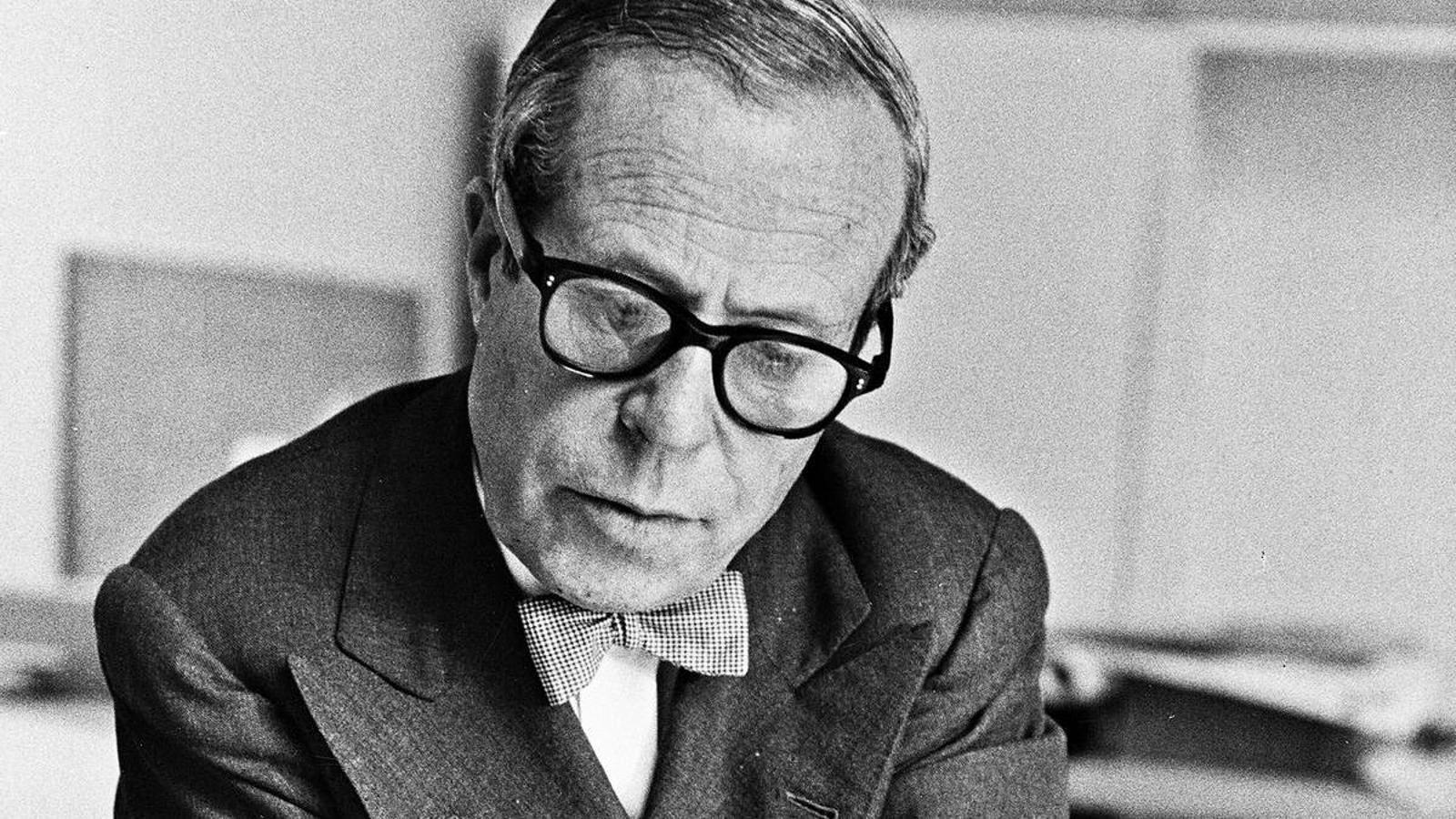
BarcelonaIn Catalonia, the architect Josep Lluís Sert (Barcelona, 1902-1983) is remembered above all for being the author of the Joan Miró Foundation. But his legacy is much broader, from the pioneering works of rationalism in Catalonia, among which are the Casa Bloc and the Antituberculosis Dispensary, both in Barcelona, to the most emblematic ones of his period in the United States, where the Peabody Terrace stands out, that is, the residential complex for married students of Harvard University.
In fact, Sert is considered the most internationally recognized Catalan architect after Antoni Gaudí. So, why is Sert not more popular in Catalonia? Do his works and his thought stand the test of time well? What is the most relevant part of his legacy? Coinciding with the World Capital of Architecture in Barcelona, the CCCB hosts on Thursday the 1st and Friday the 2nd of October a seminar in which fifteen architects and experts will address all these questions. Among them are Emiliano López, Eduardo Prieto, Carolina B. García Estévez, Dolors Rodríguez Roig, Joan Busquets, Reto Geiser, Josep Maria Rovira, and Jaume Freixa.
"Sert has indeed had an impact, but more internally regarding the discipline of architecture and internationally, and not so much for the general public," states Lluís Ortega, architect and curator of the Josep Lluís Sert Seminar together with the also architect and editor Moisés Puente. "On the other hand, his architecture is from another moment and has another style," explains Ortega. "Sert is one of the representatives of the modern movement and has a more austere, more contained formality. Therefore, perhaps it draws less attention from the general public, and his work has had less capacity to communicate in certain circuits."
In the middle of the 21st century, for Ortega and Puente, Sert is a "trans-scalar and polyhedral" figure. More specifically, they highlight Sert's relevance above all as an academic and intellectual. "In the United States, the figure of Sert always appears as a benchmark of modern Spanish architecture, more than others that we have more present here, because he built a school in which he suddenly mixed knowledge that in the United States was always very separated, such as architecture and landscape. Furthermore, he had a very cultural vision of architecture, in the sense that he had the vocation for architecture to have a social impact," says Ortega. "Sert is almost the inventor of what is called an "urban project," which does not correspond to the scale of a building or to that of the city, but rather to the intermediate scale that he developed with his housing groups," points out Puente. "From Sert, we can bring to the present day all the work he did in the field of housing and his ideas about health, well-being, the environment, and the relationship with nature," adds Ortega.

The creation of the GATCPAC
Sert's political consciousness awakening took place during the Primo de Rivera dictatorship. He obtained his architecture degree in August 1929, one year after Le Corbusier's visit to Barcelona, whom he had discovered on a trip to Paris in 1926. Spurred on by Le Corbusier, in 1929 Sert organized an exhibition critical of the official architecture present in Montjuïc. And that same year he attended the second edition of the International Congress of Modern Architecture in Frankfurt.
Sert was one of the founders of the Group of Catalan Architects and Technicians for the Progress of Contemporary Architecture (GATCPAC), with the aim of introducing rationalism in Catalonia, but without neglecting the Mediterranean climate and idiosyncrasy. And, in the cultural field, he was a friend of Joan Miró, Alexander Calder, Joaquim Gomis and Joan Prats, and he became involved in the ADLAN group (Friends of New Art).
Exile in France and the United States
One of Sert's milestones in the early 30s is the Macià Plan, drafted jointly with Le Corbusier between 1932 and 1935, which proposed a radical intervention in the urban planning of Barcelona: the administrative center would occupy an area reclaimed from the sea and the port was to be destined for tourism. Of Ciutat Vella, Sert and Le Corbusier only left the historical monuments.

Due to his aristocratic origin, and with the excuse of an invented commission, Sert and his fiancée, Moncha Longás, went into exile in Paris a few weeks after the outbreak of the Civil War. In the French capital, Sert worked on the Republic's pavilion, the Commissariat of Catalan Art, Le Corbusier's Pavillon des Temps Nouveaux, and participated in CIAM VI and in the meetings of the International Committee for the Resolution of Problems of Contemporary Architecture (CIRPAC). Sert and Longás were married in Paris on October 1, 1938. Sert had been receiving letters from Sigfried Giedion and Walter Gropius calling him to the United States, as Josep Maria Rovira recalls in a monograph on Sert. In March 1939, Sert and Longás were in Havana, where they acquired a false nationality, and shortly after they embarked for New York. That same year, 1939, Sert was one of the founders of the Town Planning Architects studio, whose projects include a pilot plan for the city of Havana. In the academic field, in 1952 he held a visiting professor position at Yale University, and the following year he was appointed dean of the Harvard Graduate School of Design. He held the position until 1969.

During this period, in 1955 he was a co-founder of the studio Sert, Jackson & Associates. In addition to Peabody Terrace, the studio's North American works also include the Center for the Study of World Religions at Harvard University and the Boston University Campus. "In the United States, Sert was able to work on a larger scale than in Europe, so he was not only able to test some of his more urban hypotheses, but also to deploy them. He was able to build buildings on campuses that have the capacity to organize the territory and the community, while in Europe the works were always smaller, more isolated," says Ortega. "This larger scale forced him to have a studio infrastructure that has nothing to do with the European dimension, but rather takes on a more corporate character," says Puente. Another aspect that interested Sert was how the arts are integrated into architecture, something he concretized in an essay on monumentality.

The architectural return to the State
The construction of Joan Miró's studio in Palma marked Sert's return to architectural activity in the State, and about twenty years later he built the Joan Miró Foundation, the model for which had been the Maeght Foundation in Saint-Paul, in Provence. His professional rehabilitation culminated in 1975 when the Architects' Association of Catalonia and the Balearic Islands readmitted him. And after his death, the demands of figures such as Oriol Bohigas, who considered him a benchmark, were key to keeping Sert's memory alive. "Sert did not specialize, but he was clear about his public vocation: he understood and believed that architecture had the capacity to transform what is public and to build a better society. That is to say, it was a very political issue, he was a militant of this," concludes Ortega.
