"Toads and governments have the Rambla clogged with big tufts of tourists who don't let us pass"
The Ateneu Barcelonès celebrates an artistic bingo with the participation of Enric Casasses, Maria Sevilla, Oriol Sauleda and Xavi Lloses

-
CAT -
CAST
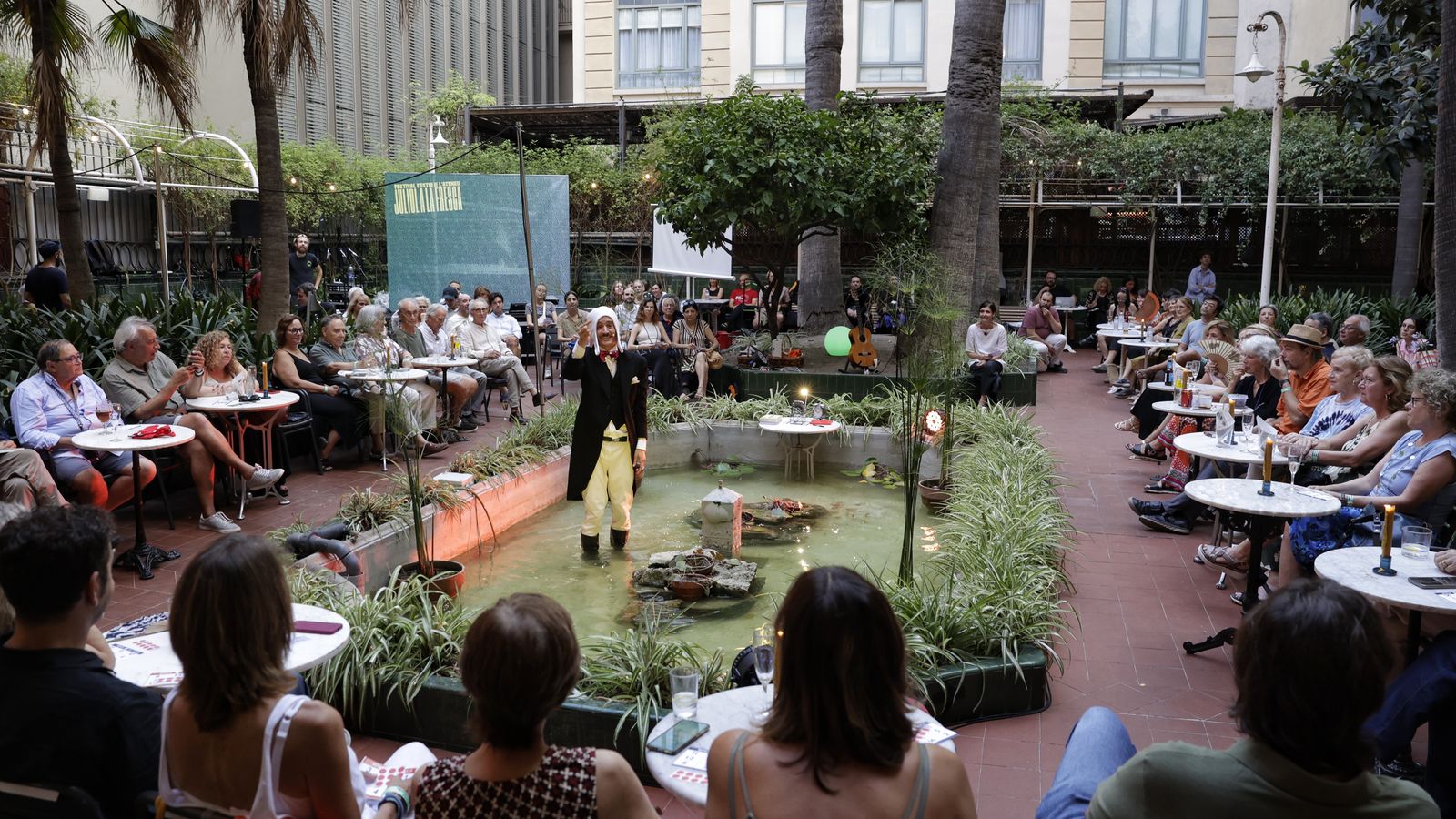
BarcelonaIf you arrive at the Ateneu Barcelonès and are greeted by a large head with the wrinkled face of Josep Carner, it is the unmistakable sign that only good, different, and exciting things can happen that evening. "Today we will be guided by the most important and one of the most overlooked institutions in our lives: chance," proclaimed the poet and rapper Oriol Sauleda at the beginning of the show The square root, a production by La Clota Cooperativa that is a heterogeneous collage of artistic actions that included readings by Enric Casasses, Maria Sevilla, and Júlia Bacardit, a fencing duel between Modernists and Novecentists, sonic actions by Xavi Lloses, and even a small session of choral gymnastics to the rhythm of a violinist from the Riba Orquestra.
Sauleda officiated as master of ceremonies for a fun and meaningful bingo game of almost two hours in the middle of the heatwave, a week after Biel Mesquida inaugurated the Juliols a la Fresca cycle. "If there are landlords in the room, consider yourselves addressed, I would tell you Jacint Verdaguer – proclaimed Maria Sevilla after reciting Charity, a poem that the author of Canigó wrote in 1885–. Verdaguer had the guts to get too involved with the poverty of Barcelona, a city that if we think about it now, it is inevitable to refer to the housing crisis."
Each number that Sauleda sang from the pond in the romantic garden, with rabbit ears on his head and rubber boots on his feet to avoid slipping, invoked one of the participants. The architect Benedetta Tagliabue paraded a model of the renovation of the Santa Caterina market while defending the transition "from a closed and walled city to an open city, with many trees and full of light." This praise contrasted with the proclamation "I am a postcard fox" repeated by a member of the Arcoiris association shortly after the participation of Enric Casasses, who recited a love poem set in present-day Barcelona and one that proposed a journey "to the end of the Franco years and the beginning of the transition [sic]". If at that time a "total social revolution, not political," made from La Rambla, which was "the main street of home," was believed to be possible, in 2010, the year the poem was written, things had changed: "cops and governments have La Rambla clogged with large clumps of tourists who do not let us pass."
A neighborhood with many layers
Júlia Bacardit has read a fragment from the book El Raval a deshora (Núvol, 2024). "El Raval is a place of sun, but it has many layers", she began, before recalling that in the neighborhood there is "drugs, noise, dirt, high and low intensity harassment and insomnia", a place where "everyone has a license to shout". Also to show off, with the biting irony of Remi Fa, the French singer-songwriter based in Barcelona who has frozen a part of the audience's smiles: "We are the tourists who speak Catalan / 1 percent of the entire Costa Brava".
Shortly before eight people in the audience sang bingo, Enric Casasses recalled that until "the graffiti is painted, a house is not finished", and Maria Sevilla invoked Mercè Rodoreda from El carrer de les Camèlies and the Kentucky bar from one of her poems: "It's not dawn if I don't end up at Kentucky, begging for a drink".
The show continued for a while longer, with the reincarnation –for five minutes– of an Ildefons Cerdà angry with all the modifications to his plan. On behalf of the Arrels Foundation, Sergi Mejías also took the stage, who went from being "a wealthy person to having nothing because of alcohol and having to live on the street". "When you see someone like me on the street, think that I'm just one more, but before ending up like this, I had a life like yours – he said –. And every time, unfortunately, there are more people like me, in Barcelona".
