Esperança Sierra Serra: "We have violent men too close"
She debuts with the novel 'Totes les cases felices', a story of overcoming of four friends in their fifties

-
CAT -
CAST
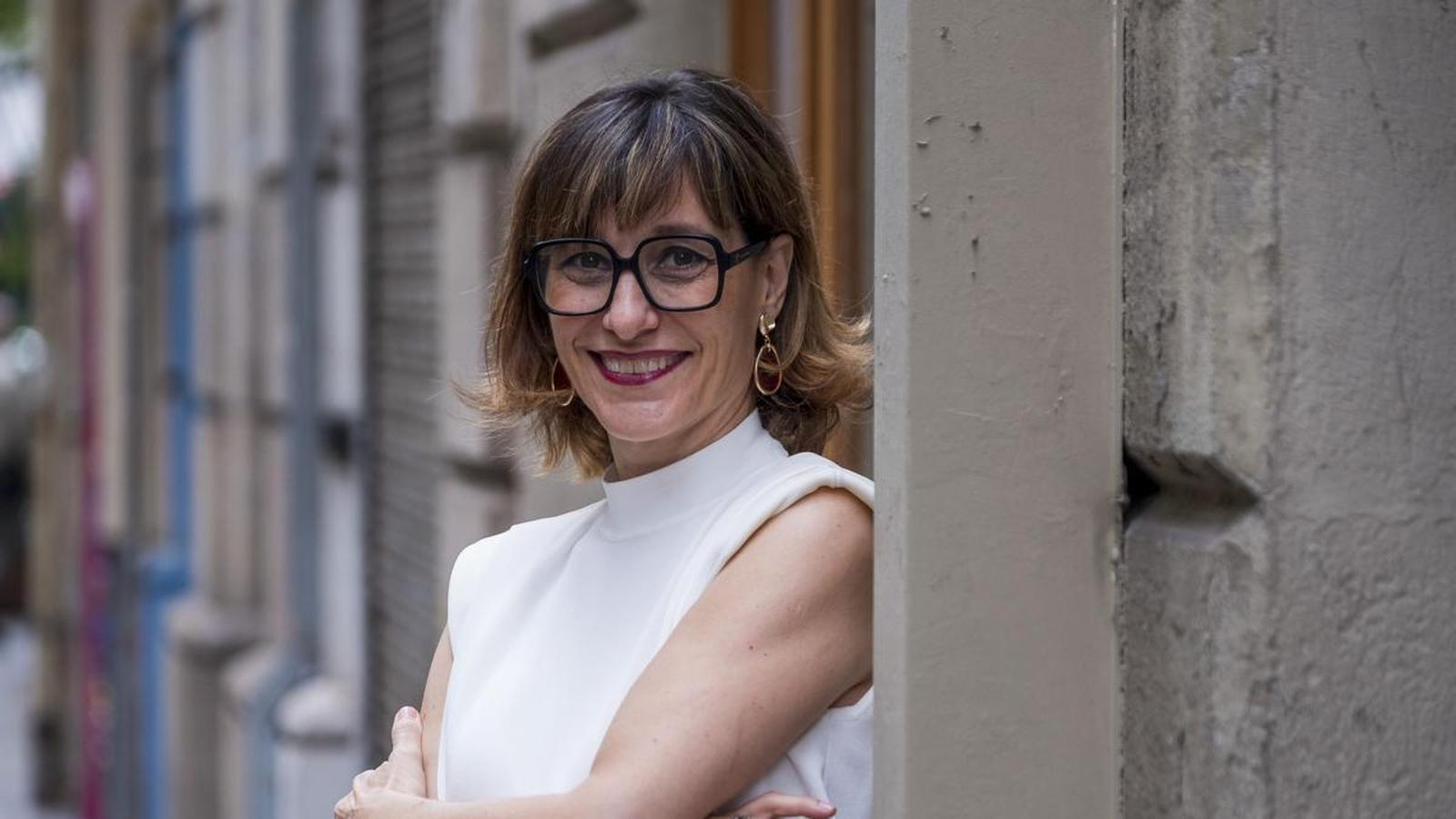
BarcelonaThere is an underground path that connects All the Happy Houses (La Campana), the debut novel by Esperança Sierra Serra (Terrassa, 1974), with some of the author's own experiences. But what is fiction and what is truth in this story of four friends in their fifties is only known to the writer, who does not hide the need to narrate what she has observed. “I feel very committed to the women who live made up by the day-to-day, by commitments they established many years ago,” says Sierra. Crossing the 50-year-old threshold was, for some of her friends, the trigger against these “corsets that tighten them but that fit them well.” In the novel, Raquel, Sita, Helena, and Míriam represent four women of her generation who will experience a journey of liberation after becoming aware of wrong decisions.
“You have a group of friends and each one forms her appearance, until one of them breaks. It usually happens around 40, the age when there are the most divorces. At the moment of the breakdown, the group of friends questions everything. In this ruin, which exists, a very healthy shared essence grows,” the author explains. In the book, the first one to break is Raquel, who disappears suddenly. The rest will find out later that she has depression and feels guilty and ungrateful, because she does not understand how she has everything and is not happy. “Since I was very little, I have had a feeling of sadness. What I tell about Raquel is very lived. Depression is very subtle both when it comes to sinking into misery and when it comes to bringing you out into the light,” she points out. For Raquel, the small moments of respite—which Sierra calls sparks of light—are linked to her immediate surroundings: an understanding husband and daughter and friends willing to help her with whatever is needed.
The protagonists of the novel live in Vallubach, an imaginary town with strong similarities to Matadepera, where Sierra grew up. It is a place of wealthy women, some with domestic help, who do not face financial hardship and do not need to work. One of them, Míriam, has the perfect life: she is married to a good catch and has a house with a garden and a pool. Behind closed doors, however, she inhabits a hell. Her friends will bear witness to this when her husband, Marc, bursts into a dinner party drunk and assaults Míriam and Sita. "We have violent men too close by. We must be able to spot them at the slightest sign. I have experienced it in a very gradual, subtle way. It doesn't seem like it, but they are here and at any moment they can destroy you," the writer states.
A ‘feel good’ novel, Catalan-style
Although she has just released her literary debut, Sierra has been working with words for years. A proofreader by profession, she is also the author of several sections in the cultural magazine Catorze. The novel was born as a proposal from La Campana editor, Mireia Lite, which Sierra took on with enthusiasm. "I created a scientific, methodical, and disciplined method to write every day from six to nine in the morning. And if some days I spent it staring at the blank screen, it didn't matter," she recounts. She had in mind to shape "a kind and at the same time poignant story, that gives you warmth and makes you think, that when you finish reading it makes you feel at ease," she explains. Her references were English authors of novels categorized as feel good and designed to transmit joy to the reader.
In this sense, approaching the story through humor was essential for the writer. "People with this kind of depressive streak use it a lot. I am like that and it works very well for me, it is a fully selfish attitude, which grants me a kind of inner peace. It is evident that everyone prefers to be with someone with whom to have a good time and not with someone who is a perpetual drama," she emphasizes. The formal construction of the novel also has its particular mark: the plot advances through short chapters, focusing each time on a different character. "When writing, I am very much into taking photos, portraying scenes," says Sierra. "Each scene is very contained because I have nothing more to say, and because lengthening them would be counterproductive.
