"If we look for women, we find them": 90 historians to explain a new history of Catalonia
From prehistory to the contemporary era, the book covers many areas of women's lives
4 min
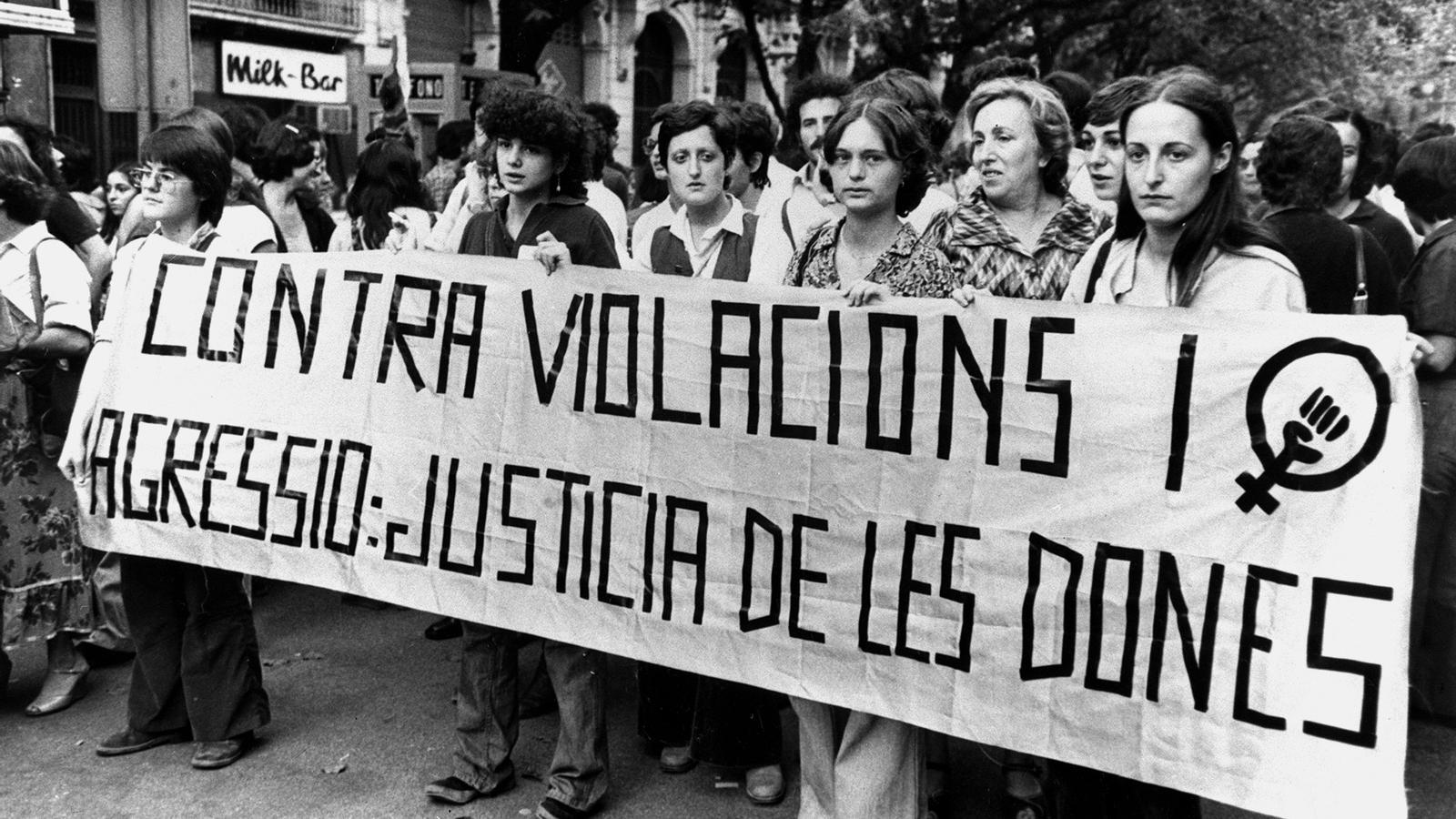
A demonstration of women, organized by the Feminist Collective, the Feminist Coordinator and Independent Feminists, in protest against rapes, pornography and crimes in September 1977.EFE
Barcelona“Women have participated in many social, cultural, and political dynamics... but they have not managed power. Instead, they have been very active in social movements and against power. And although the dominant discourse was 'Adapt, this is your nature,' there have been those throughout history who have not adapted,” explains Montserrat Duch Plana, historian and professor at the Universitat Rovira i Virgili (URV). She is the coordinator of a monumental work that seeks to overturn the traditional historical narrative: History of Women. A New History of Catalonia (Edicions 62). This 726-page volume, prepared by 75 female and 15 male researchers from the universities of the Catalan Countries, reviews many dimensions of life in society and amends a historiography that has focused, mostly, according to Duch, on the elites and the activities of men.
The work is structured thematically: family, reproduction and sexuality; religion and education; power and social movements; work and inequalities; creation, art and writing; science and thought. In this way, one can follow the thread of continuities and changes in each of these areas. In her analysis of the present, Duch emphasizes how the historical burden of domestic and care work continues to fall on women, which translates into overload and stress.
“Statistics show that women live longer, but with less quality of life. And one of the factors directly related to this loss of quality of life is stress and multitasking,” points out Duch. The historian openly questions the myth of the woman who can do it all and points to the management of care as the great unresolved structural problem of contemporary society: “We are not superwomen. We have historically done multitasking, and there is an issue that is not resolved as a society, which is the whole question of care. That is why the birth rate is falling, that is why couples –and specifically women– are postponing motherhood.
Without time to create
This overload of the double burden not only has consequences for health or demographics, but also deprives women of a fundamental vital space for intellectual and artistic creation. “Throughout the centuries, very few women have been able to have a space and time to create. We wanted to write this work not only to find that exceptional woman who was able to write in the 15th century [this is the case of Isabel de Villena, who wrote Vita Christi, where she defends women against misogyny and sexism], but also to value an aspect that is deeply satisfying for people's lives, which is creativity, and which has been inaccessible to many women,” reflects the professor. Historically, the lack of access to education has also prevented many women from asking themselves fundamental questions.
Beyond offering a popularizing synthesis, the volume seeks to transform academic research from the roots. “History has been a discipline tributary to cultures that have given weight to one type of human activity and have belittled another. It is a history, still, mostly of power, of elites and of men's activities. A new history of Catalonia means trying to change the perspective,” argues Duch.
According to the historian, gender studies cannot be treated as an appendix or a secondary element. “Until now, the history of women and gender has run as a line parallel to the mainstream history. We have the will to challenge the existing historiography and provide tools to correct this bias,” says Duch, who maintains that information about women exists if the right research questions are asked: “If I draw any conclusion, it is that if we look for them, we find them. The issue is a change of perspective. That logic of positivism that the person investigating does not intervene in what is being investigated is a falsehood.”
This new thematic perspective allows for the rediscovery of fragments of the history of Catalonia. Researchers such as Maria Carme Belarte and Lídia Colominas, for example, highlight the need to re-examine the archaeological record to understand pre-Roman societies. At the Bronze Age site of Minferri (Les Garrigues), Aurora Grandal and Ariadna Nieto focus on Bronze Age society and how, alongside great men, there were also great women with active, recognized, and differentiated roles.
The persistence of inequalities
The work reviews many other aspects, such as the importance of women in the provision of groceries and resource management, but also in medieval prostitution –often linked to the lack of a dowry, orphanhood, or the need to pay for freedom in the case of slaves–, the role of charitable institutions, the persistence of inequalities in the labor market, the role of domestic servants, women on strike.
It is quite clear that there have been many obstacles. The book details how women were relegated from guild structures. From the end of the 18th century, the master craftsmen of Barcelona used unregulated female labor to reduce costs in poorly paid and precarious jobs. In social movements, the volume highlights the role of women in protests over the rise in the cost of living, strikes, the fight for access to the teaching profession, and mobilizations for contraceptive methods and abortion during the dictatorship and the Transition.
The work also rescues all the contributions of women to literature, music, art, and cinema, with representative trajectories such as that of Montserrat Casals i Baqué, known as Elena Jordi. An actress and theatrical entrepreneur, in 1918 she became the first female film director in the whole of the Spanish state by directing, producing, and starring in a short film.
For Montserrat Duch, the path of academic research from a gender perspective has been historically hampered. “The rupture of the Civil War and the Franco dictatorship cut short the trajectory of the first researchers of the 20s and 30s,” she explains. Duch also regrets the lack of powerful research structures comparable to other scientific fields in current Catalonia. “In Catalonia, we have not managed to have an inter-university institute for women's and gender studies endowed like the Catalan Institute of Chemistry or that of Cultural Heritage. There has not been enough political will and perhaps academic feminism has not known how to articulate it either,” she asserts.
“The persistence of sexist violence makes it more urgent than ever to review the past,” says Duch, who also considers that on issues of violence against women, in terms of historical research, there is still a long way to go.
The historian Montserrat Duch.Pere Tordera
More readings on women's history
La revolució amb veu de dona. Dietaris i records (1936-1939)(L’Avenç)
Llúcia Oliva collects and analyzes diaries, memoirs, and testimonies of a group of women who lived through the Civil War in Catalonia and the republican rearguard. Through their voices, the work makes visible how they experienced the social revolution, the conflict, and daily life, offering another perspective far removed from the purely military history narrative.
Dones de foc. Internacionalistes a Catalunya (1936-1939)(Angle Editorial)
Historian Dolors Marín traces the trajectory of the many women – journalists, photographers, nurses, militants, or intellectuals like Simone Weil, Emma Goldman, and Margaret Michaelis – who traveled to Catalonia during the Civil War to support the Republic and the libertarian movement, and risked their lives. Marín highlights their anti-fascist commitment and the decisive role they played in the rearguard and at the front.
Catalunya feminista(Rosa dels Vents)
Historian Isabel Segura Soriano provides a historical journey through the struggles, milestones, and movements of women in Catalonia. The book offers an overview of the construction of Catalan feminism from its historical precedents and key moments (such as the first Catalan Women's Conferences in 1976) to contemporary demands, and shows how female emancipation has been a driver of social and cultural transformation in the country.
Putas rebeldes. Historias sobre el trabajo sexual y la lucha social(Descontrol Editorial)
From the New York insurrection of 1741 to the 15-M movement of 2011 in Spain, anthropologist Livia Motterle and historian Rodrigo Vescovi review the lives of sex workers who also participated in major social struggles. The work rescues little-known episodes of history, in which prostitutes have played an active role, questions narratives of stigmatization, and vindicates their importance in movements for social transformation.