They sell a Coderch house with a fake power of attorney and the death certificate of a woman who is alive
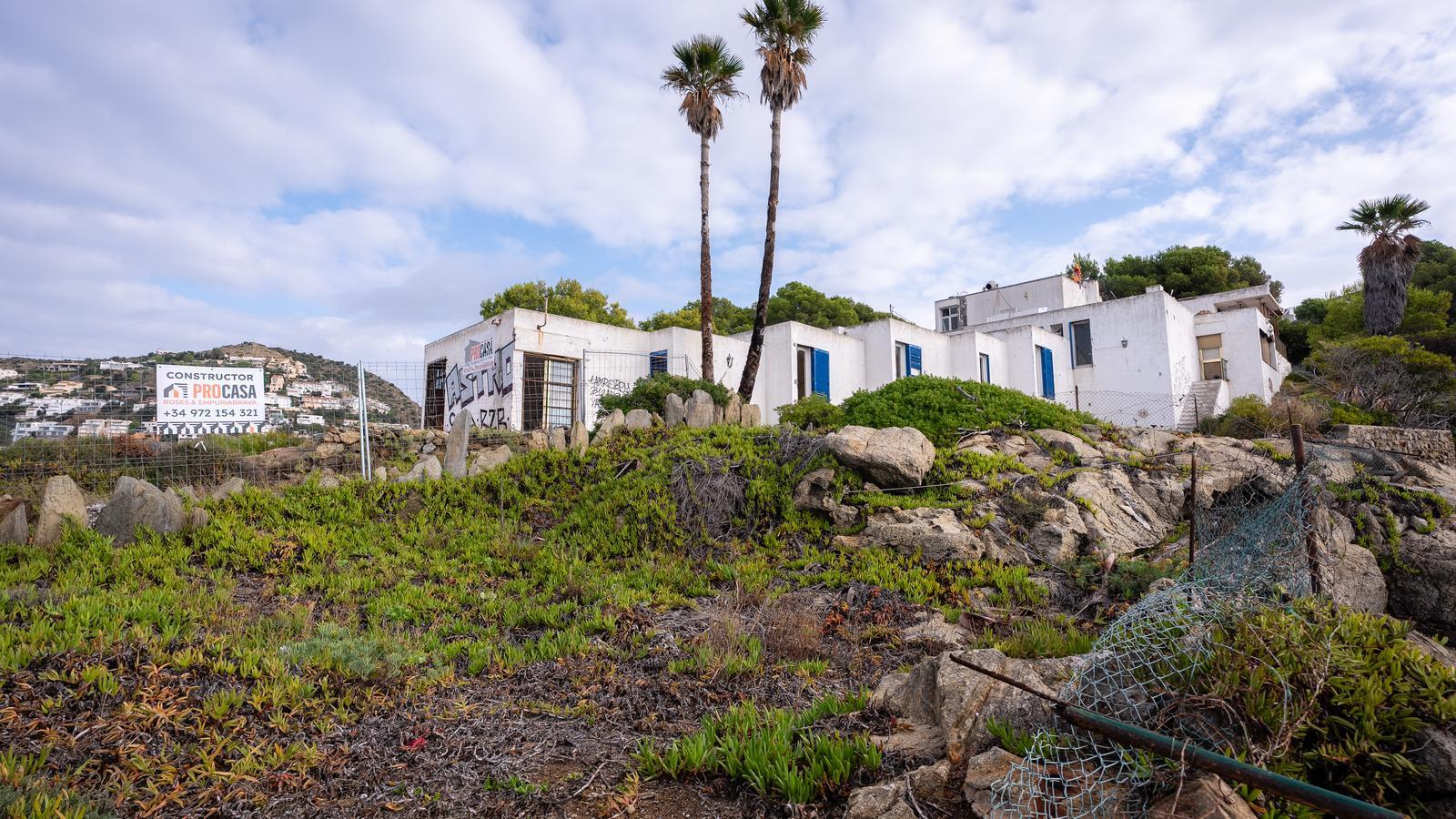
A buyer pays more than one million euros for the Casa Rozes and is restoring it by requirement of the Roses City Council

-
CAT -
CAST
BarcelonaOne of the masterpieces by architect Josep Antoni Coderch, Casa Rozes, at the tip of Almadrava in Roses, is trapped in a judicial maze. It was sold without the owners' consent and with forged documents, and five years later the case is still not resolved. One of the owners of the house, Monika Laskowska, lives in Poland and is very much alive. Even so, according to the deed with which the property was sold in March 2021, she had died in Nuremberg.
After reading two articles published in ARA about the change of ownership of the house, Laskowska and her daughter, Melody Ponsatí, contacted the newspaper through their lawyer, Bartlomiej Michalowski, to deny it and explain their story.
The story goes back to the previous owner, Marc Ponsatí, to whom Laskowska was married and who was the father of their daughter Melody. In 2002, Marc Ponsatí donated the house to his daughter. "In the most recent registry note, from September 16 of this year, Melody appears as the bare owner of 100% of the property. Her mother, Monika, and Marc Ponsatí held the usufruct, at 50% each. Marc Ponsatí has already died, but he still appears there as the owner," states Bartlomiej Michalowski.
When the couple separated, mother and daughter went to live in Poland, while he continued living in the house in Roses. Ponsatí spent his last years admitted to a center supervised by the Generalitat due to mental health problems, where he lived until he died. During that period, according to Michalowski, a man who had direct contact with Ponsatí tried to obtain some title of possession of the house. Since he did not succeed, he installed a family there in a squatting situation. Meanwhile, the owners wanted to sell the house and had already spoken with several interested parties, but they all set as a condition that the occupation had to be resolved first.
The facts were uncovered in 2021, when a buyer appeared. Michalowski requested a simple note from the Property Registry and found an unexpected annotation: a deed of sale for the house was pending registration. He called his clients, who knew nothing about it, and requested a copy of the deed from the notary. "That's where the cat was let out of the bag," says the lawyer. The deed lists as the seller a French real estate agent who works in the Roses area. "The real estate agent was acting there with a supposed power of attorney that Melody had allegedly signed at the Spanish consulate in London. The death certificates of Marc Ponsatí and Monika were also provided, so it seemed that there were no living usufructuaries left," points out Michalowski.
Regarding the buyers, the IBI holders are Stéphane Sánchez and Stephanie Mendes, according to documentation from the Roses City Council, to which ARA has had access. The sale price was 1,010,000 euros, even though when ARA spoke with Marc Ponsatí in 2017 regarding the deterioration of the house, he assured that he would not sell it for less than 7 million. The false power of attorney gave "precise" instructions: more than 600,000 euros were to be transferred to an account in Switzerland and the intermediaries kept the rest. Furthermore, the lawyer claims that these intermediaries took more than 300,000 euros and that months before they had created companies to be able to issue invoices and collect them.
According to the lawyer, the real estate agent declared that they received the commission "by email". In that message, they promised that they would have power of attorney to sell the house and that they would keep 30% of the amount. "There is no such commission on the market," says Michalowski, who notified the registrar of Roses not to register the sale. Later, at the family's request, the court ordered the Registry to suspend the registration of the deed due to signs of forgery. "This case is like those horror movies that sometimes happen in the field of law. My client is the only victim of this scam," states the buyer's lawyer, Sílvia Requena. "My client paid a price for this house – the lawyer defends – and also obtained the keys to it. This, in civil law, is known as the acquisition of civil ownership of this house. Therefore, he can be considered the civil owner for all purposes of this house. The deed was only halted, not annulled, by the direct intervention of the sellers' lawyer."

A crime of fraud and another of document forgery
The family reported the facts to the duty court in Figueres. The notary who had authorized the deed also filed a complaint. The investigation confirmed Melody and Monika's suspicions: the London consulate responded that it has no record of any such power of attorney, and the Nuremberg City Council communicated that it has no death certificate registered for Monika, who, furthermore, has always lived in Poland. According to the lawyer, the fake power of attorney was "well done" but contained errors. For example, it included a NIE for Melody that was obtained after the date on which the power of attorney had supposedly been signed.
For these events, there are currently two ongoing proceedings: one is criminal and the other civil. In the criminal case, open since August 2021, the lawyer states that the real estate agent who acted with the fake power of attorney and two intermediaries who collected a commission are listed as suspects. The buyers initially appeared as injured parties, although the Public Prosecutor's Office, in a document from July 2026, refers to them as suspects. The civil proceeding seeks the annulment of the purchase and sale. Several investigating judges have already passed through the criminal case. Now the investigation is stuck at the point of finding out where the money transferred to Switzerland went, which for Michalowski is "practically impossible". "The notary's error is blatant. The notary already knew Melody and Monika, because they had been to his office to grant powers of attorney in my favor. He did not verify either the power of attorney or the death certificate," he laments.
On the other hand, Requena has managed to have a letters rogatory commission established to discover who is the holder of the Swiss account where his client deposited the amount for the house. Furthermore, on April 24 of this year, the criminal court rejected the eviction because the case is still in the investigation phase, without entering into the substance of the matter.
A house with the highest degree of heritage protection
Indeed, another aspect of this conflict is the conservation of the house, which is cataloged as a Cultural Asset of National Interest (BCIN). Marc Ponsatí tried to reach an agreement with the Roses City Council to help him restore it, but he did not succeed. In 2017, the poor state of the house was alarming. At the request of the City Council, in 2023 Sánchez applied for a building permit to rehabilitate the house and reverse its deterioration, when the criminal case had already been open for two years and the court had already suspended the registration of the deed. If he had not done so, the City Council could have ended up expropriating it from him. "The house was a ruin," points out the lawyer.
The initial budget for the works, which began a few weeks ago, exceeds 1.2 million euros, that is, more than the house itself. "To obtain a license, you do not need to be registered as the owner, and Sánchez relies on the deed he has, but it is void," says Michalowski. The lawyer explains that he has warned the architects in charge of the renovation, Collgorgot, and the developer Procasa, that the sale will end up being declared void and that they will not be able to recover the investment.
The decree with which the Roses mayor's office ordered the restoration of the house is addressed to all possible possessors, that is, Melody Ponsatí, Monika Laskowska, Stéphane Sánchez, and Stéphanie Mendes. In contrast, Requena points out that the only one who received "the executive order from the municipal urban planning services to carry out the works immediately" is Sánchez. "I myself informed Mr. Michalowski of the existence of this executive order," she adds. "According to article 21 of the Catalan Cultural Heritage Law, everyone who has a right over a BCIN must be compelled to facilitate its restoration, but my client is the only one paying."
On the other hand, Requena points out that Monika Laskowska and Melody Ponsatí could have sold the house for a higher price, to the same buyer or a third party, and that they did not do so because no one would be willing to pay that figure given the poor state the house was in. "The only thing we would want is to recover the money and that's it," says Requena. Furthermore, the lawyer reproaches Laskowska for having let all this time pass without carrying out any maintenance work as the usufructuary of the house. "Civil property is not just any nonsense. A usufruct can be recorded in the registry, but if one does not act according to the law afterwards, this usufruct lapses. The registry only confirms what you do."
ARA contacted Mario R. Spengler, partner and director of Procasa, but he did not want to make any statements. To try to unblock the situation, Michalowski asked the court to lift the suspension of the civil nullity proceeding, which was halted due to the existence of the criminal case. He expects to have an answer in the coming weeks. If he succeeds, he plans to initiate the procedures to evict Sánchez. He regrets that this whole legal mess has stalled a sale. "The family wants to recover the house; for Melody, it is her father's inheritance. This will continue," the lawyer concludes.
