These are the 2026 National Culture Awards
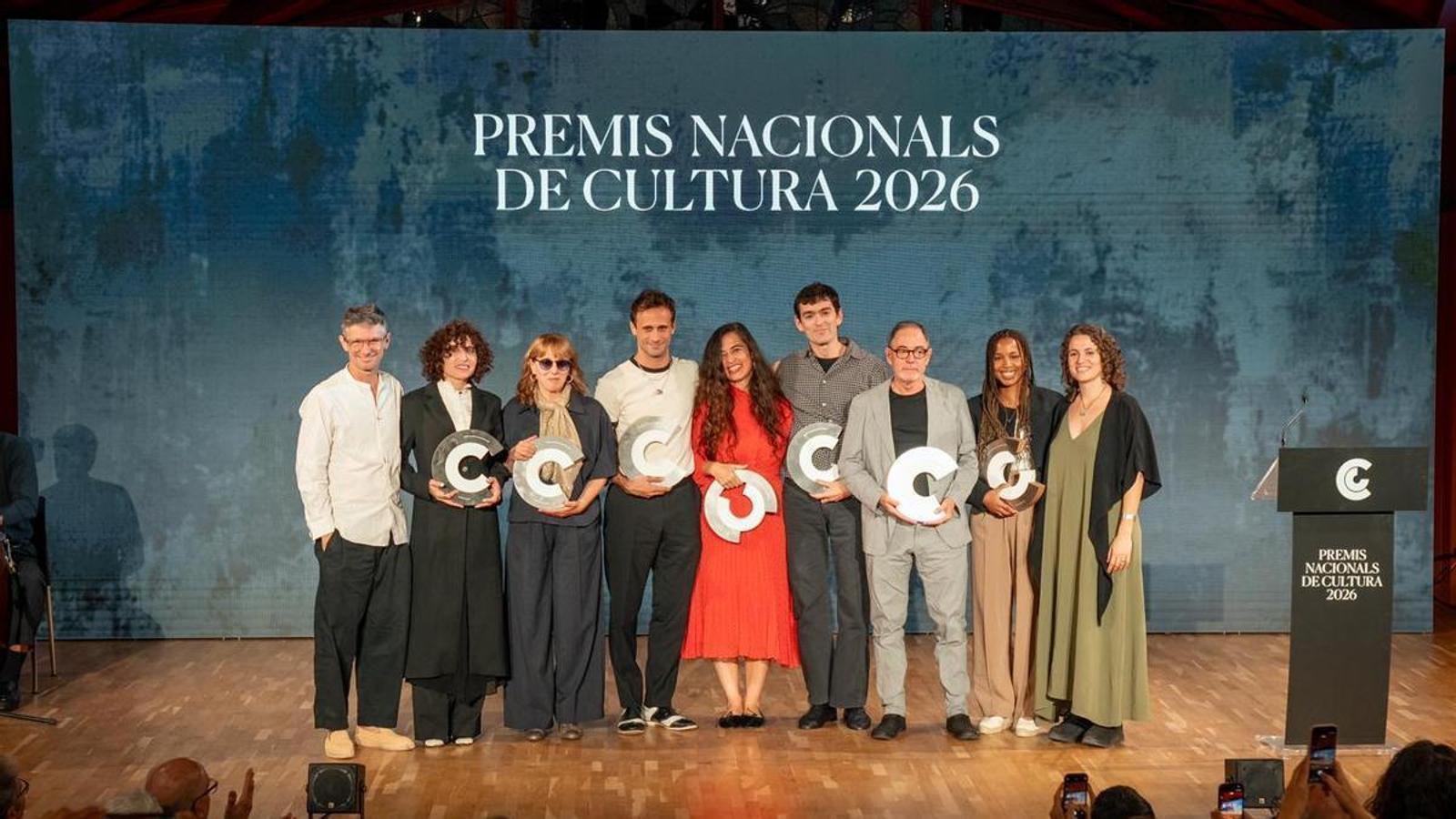
The highest award of the CoNCA is received by Cabosanroque, Pol Guasch, Jande Editorial, Àlex Ollé, Sílvia Pérez Cruz, Oriol Pla and Victoria Szpunberg
-
CAT -
CAST
BarcelonaA sound artistic duo, a writer, a publishing house, a stage director, a musician, an actor, and a playwright are the winners of the 2026 National Culture Awards, the accolades that have been presented since 2009 by the National Council for Culture and the Arts (CoNCA). The winners are Cabosanroque, Pol Guasch, Jande Editorial, Àlex Ollé, Sílvia Pérez Cruz, Oriol Pla, and Victoria Szpunberg, as announced this Friday at an event held at the Pau Casals Auditorium in El Vendrell, coinciding with the 150th anniversary of Pau Casals. The ceremony was hosted by journalist Andrea Gumes and was attended by the President of the Generalitat, Salvador Illa, the Minister of Culture, Sònia Hernández Almodóvar, and the President of the CoNCA, Margarida Troguet. Each award comes with a prize of 20,000 euros, and starting this year, there are no longer five winners, but seven. In their acceptance speeches, the winners agreed on championing culture, collective values, and public services as tools to confront reactionary forces.
The 7 National Culture Awards 2026

Cabosanroque
Sound architects
Laia Torrents (Barcelona, 1976) and Roger Aixut (Barcelona, 1975), the sound artists who form the Cabosanroque collective, receive the National Culture Award for "the originality of their artistic practice, straddling the line between music and visual installations." Temporada Alta Festival, Teatre de Salt, autumn 2009: dressed in blue overalls, Cabosanroque premiere the show Torn de nit. The protagonists of the show are not exactly them, but the machine that occupies the entire stage: a mechanical orchestra they have built using parts from a production line of a cookie factory in Granollers that closed due to the crisis. The expectations are met.
Torrents and Aixut trained as an industrial engineer and an architect, respectively, and have often said that they do not recycle objects but rather extract their soul. Their work is known for how it overflows the boundaries of visual arts, music, and performing arts, and they themselves have explored the limits of found objects and newly created ones, such as the newly created ceramic pieces they commissioned from the Cumella studio for the immersive sound and visual art installation based on Mercè Rodoreda's book Viatges i flors. As the CoNCA says, Torrents and Aixut "turn sound into sculptural matter within an architectural interpretation of space." "From Catalonia to the world, they establish dialogues with the Catalan literary and cultural heritage through rigorous research and the use of technological devices at the service of a poetic and, at the same time, political idea. Interdisciplinarity and collaboration with other musicians, writers, thinkers, and playwrights place them at the forefront of contemporary creation," summarizes the CoNCA. Through their collaborations, Cabosanroque can be considered creators who have acted as a hinge between the generation of Carles Santos, Jordi Savall, Pascal Comelade, Perejaume, Enric Casasses, and Frederic Amat and younger artists such as La Veronal and Marcos Morau, El Conde de Torrefiel, and Maria Arnal. In their acceptance speech for the award, Torrents and Aixut have claimed the art they practice as a tool to "help combat new fascisms and the globalization of technology.

Pol Guasch
Limits explorer
The writer Pol Guasch (Tarragona, 1997) has been awarded "for the solidity of his budding literary career, which spans from poetry to narrative," and in his acceptance speech he defended public libraries, public education, and public services in general, which are fundamental to "not hand over the keys to the country to the far right." He also criticized "the political class that continues to destroy what is necessary and important" for the working class.
Guasch has published this year Relíquia (Anagrama), which arrived after Napalm al cor (2021, Anagrama Novel Prize) and Ofert a les mans, el paradís crema (2024). The CoNCA highlights that "his works explore the limits of the body, language, queer experience, and the contemporary world to address classic themes such as love, desire, violence, and death with his own voice and style." It also underscores his ability "to attract diverse audiences," the translations of his works into sixteen languages, and the theatrical and cinematic versions that have been made of them. Napalm al cor was adapted for the Sala Beckett stage in 2023 and Relíquia will premiere at the Teatre Lliure in 2027.
Aside from his narrative work, Guasch has also published the poetry collections Tanta gana (Francesc Garriga Prize, 2018) and La part del foc (López-Picó Prize, 2021). "Writing can provide movements of vital transformation," said Guasch in an interview about his books. "They helped me understand things about family, desire, abandonment, and sadness," emphasized the author, who is also a contributor to ARA.

Jande Publishing
Identity, literature and diversity
One of the National Culture Awards has gone to Jande Editorial, a young publishing house specializing in fiction and non-fiction in Catalan and Spanish that was born in 2025. Its founders, Aissata M’ballo Diao from Cervera and Diana Rahmouni Audenis from Mataró, have set out to discover new local racialized voices or those of migrant descent and to incorporate translations of authors who address identity. Among the names in their catalog are great contemporary literary voices like Zadie Smith and debut authors like Fàtima Saheb. The jury awarded them "for the initiative of creating a space for Catalan literature with authors, experiences, and imaginaries often absent from the publishing ecosystem, which enriches Catalan culture". At the ceremony in El Vendrell, the two editors received the award as "a burden of hope and denunciation", a hope for a more diverse and broader literature that contributes to denouncing "the reactionary front" before which they do not intend to remain silent.
The editors have a social vocation and work to give space to references that appeal to identity diversity. "We seek not only to publish voices of migrant origin for the mere fact of being so, but also to take care of literary quality, offering authors the opportunity, financial compensation, support, and the framework of dignity and equality they deserve: that they may, finally, access our country's cultural network without it being an anecdotal or instrumentalized fact," the editors emphasize.

Àlex Ollé
Transgression with criteria
According to an unwritten law in the field of the performing arts, a theater director is consecrated in the world of opera. The challenge is significant, because they must know how to bring works that have often become outdated up to date and must know how to do it in large productions. Yes, in opera budgets are higher, but not everything goes. Among all the creative directors of La Fura dels Baus, Àlex Ollé (Barcelona, 1960) is the one who has gone the furthest in the field of opera. This is confirmed by the National Culture Award granted for a "particular creative vision that reinterprets scenic languages and traditional classical works with a transgressive contemporary approach," always with criteria. "I am a team player," he claimed in El Vendrell this Friday.
At the beginning of his operatic career with La Fura dels Baus, Ollé co-directed five operas with Carlus Padrissa, among which three of the collaborations with Jaume Plensa stand out, as well as the exceptional work of the architect Enric Miralles in the world of opera in DQ. Don Quijote en Barcelona, by José Luis Turina, premiered at the Liceu almost three months after the architect's untimely death. On his own, Ollé has directed about thirty operas, often with the collaboration of set designer Alfons Flores. Some include memorable scenes, such as that of a giant female figure, the Clàudia, who vomits the characters in Le grand macabre (2009-2011); the evocative sphere of the Death Star from Star Wars in Tristan und Isolde (2011); the overwhelming whirlwind of crucifixes in Norma (2016), and water as a receptacle for moral filth in Lady Macbeth of Mtsensk (2024).

Sílvia Pérez Cruz
Music in every breath
It is surprising that Sílvia Pérez Cruz (Palafrugell, 1983) did not yet have the country's highest cultural recognition. It is worth celebrating, then, that the CoNCA is awarding her for "musical excellence and vocal and interpretive quality, the fruit of rigorous and continuous training." There is training, yes, and a lot of hard work, but also a special instinct when she is on stage. Then, her entire self—voice, body, and soul—is music. Sílvia Pérez Cruz breathes music, and her breath has perfumed artists such as Rita Payés and Rosalía. As says Daniel Gómez Sánchez, doctor in musicology from the Complutense University of Madrid, Pérez Cruz "has created a school of vocal technique from which many Catalan artists drink." Oral abisal, the album she released in 2026, is for the moment the latest step for a singer and composer who just as easily takes on major challenges—the album Toda la vida, un dia (2023), for example—as she shares adventures with friends like Salvador Sobral, always with the rigor and freedom she has also shown on albums like Granada (2014) and Vestida de nit (2017). In her acceptance speech, Pérez Cruz championed "the collective in these very individualistic times," because "together many more things move." "Let us take care of culture and thus culture will take care of us," she added in a speech in which she also thanked the "financial aid" of the award, because it will help her to "rest so she can continue working."

Oriol Pla
A true stage animal
In a single year, the actor Oriol Pla (Barcelona, 1993) has received the National Culture Award for his career, the National Theater Award for his role in the show Gola, the International Emmy for the series Yo, adicto and the Gold Medal for Merit in the Fine Arts together with his family for Travy. There are not enough awards in the world to highlight the acting quality of a true stage animal, whom the CoNCA recognizes precisely for "a talent and a physical expressiveness" that "manifests itself in the great stage presence that characterizes him". "I want to share this award with the public space, with the squares where we can no longer play the guitar, with the popular athenaeums, the theaters, the libraries, the folk tales, the songs, the grassroots culture that nourishes us and lifts us up", he said upon receiving the award.
Forged in street theater at the hands of his parents, Quimet Pla (linked to the founding of Comediants) and Núria Solina (at Germans Poltrona), the actor has picked up the legacy of the historic Catalan circus companies (the Escarlatas, the Marduix, the Poltronas, who marked the 70s) and has brought it into the contemporary, as his friends from Baró d'Evel (the company of Tortell Poltrona's son), with whom he has worked in Falaise. "There is a friend of mine who says that I am the Rodrigo Cuevas of clowns," he said a couple of weeks ago from San Sebastian. His resume is as extraordinary for what he has done as for what he has not done. Despite having worked in mainstream audiovisuals (Truman, Merlí, Dime quién soy), he has not opted for the path of the mainstream but has defended auteur cinema projects (Agustí Villaronga, Elena Martin, Mar Coll, Jaime Rosales, Luis Miñarro and the latest is Javier Giner) and has never abandoned creation theater.

Victoria Szpunberg
Critical and lucid
With her last two works, the playwright and director Victoria Szpunberg (Buenos Aires, 1973) has collected more than ten theatre awards, culminating now with the National Culture Award. L’imperatiu categòric (Ciutat de Barcelona award, the Critics' Award for best text, the National Prize for Dramatic Literature and the Lletra d’Or 2025 award) and La tercera fuga (Max awards) condense the qualities of the author's theatre: "The ability to combine humour and irony in complex dramatic situations of contemporaneity where philosophical ideas are also mixed in, which are expressed in everyday situations that have connected deeply with the public", according to the CoNCA.
Szpunberg recalled that Bertolt Brecht had already warned in the 30s of the 20th century that these were "dark times for lyric poetry". And after summarizing a family biography crossed by repressions, exiles, grandparents persecuted by Nazism and parents harassed by the Argentine dictatorship, she has claimed Catalonia as a land of welcome. "Long live impure Catalonia!", she exclaimed.
Daughter of Argentine exiles, and of a poet father, Szpunberg cultivates a lucid and critical look at the world around us from which complex and attractive works have emerged such as El pes d’un cos, the opera La gata perduda and Amor mundi. She has also written commissioned dramaturgies, such as Mal de coraçon and Permagel. Switching to writing in Catalan, the language of arrival, was the cornerstone of her literature, when she identified with a literary family and connected with her audience. She has been the first female author to write and direct a play in Catalan at the Sala Gran of the National Theatre.
