Sílvia Pérez Cruz: There are people who play very well, but who humanly are not worth it
Music. Publishes the album 'Oral_Abisal'
-
CAT -
CAST
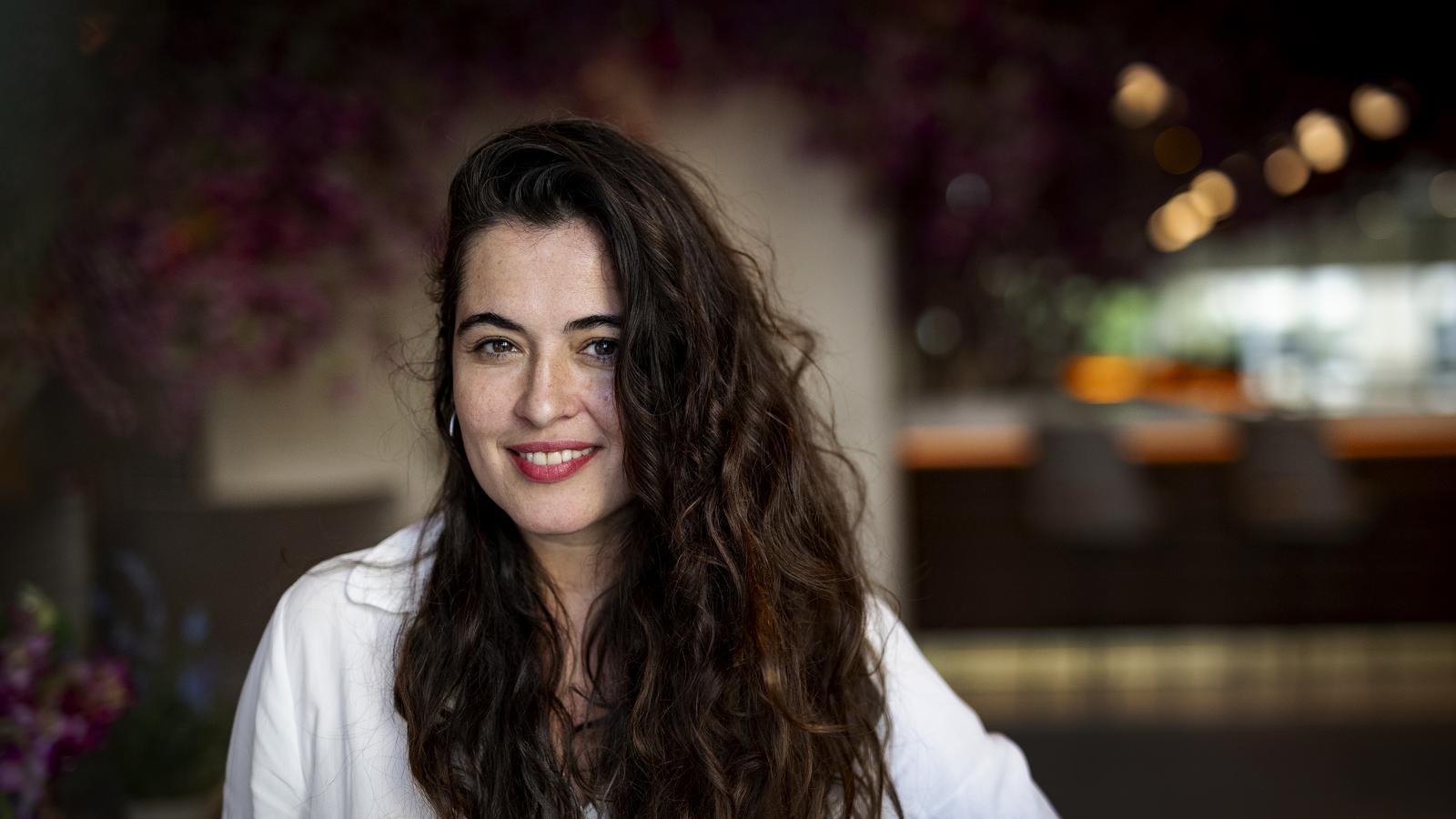
Barcelona"From the depths of the seas to the celestial heavens". This is the conceptual journey that Sílvia Pérez Cruz (Palafrugell, 1983) takes on the album Oral_Abisal (Sony, 2026), which is released this Friday: a dual repertoire and a new display of musical resources. There is the very fine work of a string quartet and the magnificent opulence of horn and percussion arrangements. There is the solitary voice and the choral energy. And there is, above all, the realization of an artist who continues to explore musical and emotional limits.
Listening to the new songs, do you feel different?
— By voice or by attitude?
In summary.
— Yes, I guess so, but I always end up feeling. Why do you say that?
A few days ago at the album premiere at the Liceu, I had the feeling that the new songs reflected the need for a new beginning after how you emptied yourself on the tour for the album Toda la vida, un día.
— I don't know. When I closed the concerts of Toda la vida, one day at the Grec Festival, there I ended up with total fulfillment. Then I did Lentamente [2024] with Juan Falú, which was returning to intimacy and not thinking about anything; it was pure interpretation, going to the animal. Then we did the album with Salvador Sobral, with compositions by others. Meanwhile, I have been composing, because I always compose, as a necessity... Are you talking about the compositions, the production, or the live performance?
For everything. For example, All my life, one day was an almost autobiographical album. Now, on the other hand, you look more outwards.
— There are two perspectives. Oral_Abisal has this duality: looking very deep inside and looking very far outside. They are all autobiographical, with more fantasy or less. They are different pains and joys. I ended up at peace, and now I continue in a very quiet peace. I am very happy with what I have done. I don't need to do anything more than express myself as best I can with the tools I have. And I see it as a continuation within my way of understanding life. There is a very similar search: to go to the extremes and seek connections there.
It surprised me that at the concert at the Liceo you didn't do any song from Toda la vida, un día.
— It would be eternal...
You did make some other records.
— But not many. It also depends on the live performance and emotion, and on studying the energy curve. But songs from before, which ones did we do? Mechita, Gallo rojo and Mañana... Since I don't have hits, I don't feel this kind of obligation to play certain songs.
You also recovered the version ofHymne à l’amour, by Édith Piaf, perhaps because you had just played at the Olympia in Paris?
— Yes, just for that. I mixed it with the Little waltz of Vienna...
Did you find ghosts of the past there, at the Olympia?
— Well, perhaps I would say so, especially at the end, when I was singing Ne me quitte pas, by Jacques Brel. I was tremendously excited to go to a place where so many performers I admire have performed. And you do notice that the walls have a memory. Just as when you play in a new place you notice that the walls don't know how to vibrate yet, at the Olympia you notice that they have vibrated a lot. I wanted to do Ne me quitte pas because, when I had done the play "Ella y yo" with Julio Manrique, I sang this song with a staging that recalled the Olympia, with a red curtain. Just the day before the concert in Paris, we decided we would do it. And luckily we did, because the emotion was very great. There were a few seconds when tears came to my eyes and I allowed myself to think: "Silvia, how are you? And where are you?". I felt all the memory of the Olympia.
This concentrated emotion is achieved in different musical formats. For example, at the concert in the Liceu, it happened both when you played as a quartet and later in the choral suite Mar de na Catalina. How do you experience seeing the audience's emotion?
— Everything begins on stage. For example, in Mar de na CatalinaEverything begins on stage. For example, in
In concerts there are moments when you explicitly act as a conductor: you turn your back to the audience to direct the musicians.
— Yes, this is very precious. I like it a lot. There's something about connecting with myself and with everything else: "Yes, I'm a little further ahead, but without you I don't exist." Of course I can sing alone, but there's a beauty that comes out precisely because we are all together.
Regarding composition and arrangements, on the new album have you tried things you hadn't tried before?
— Compositively, Oral and Abisal are very different. Oral has many more harmonies, it's much more guitar-driven, song-like, with chords I didn't like before. I used to play a lot with open strings, and now I've found a liking for these more bossa nova or jazz chords. On the other hand, Abisal is much simpler, with very few chords, and much more directional and trance-like. And the way of arranging is much more different. For example, in the studio, I would give the horns a part and tell them: "This note, this note, this chord. Can you play this melody?". A melody I might have written with the piano. But suddenly you hear the instrument and you hear a timbre, like in Capitana, where while testing the sound, a high note came out that sounded beautiful. And then I went to the piano to create the melody. With the string quartet, we work a lot together, with great meticulousness. For example, the song Abisal has a dissonance that if one person plays it louder it doesn't sound right; and if you remove it, it lacks a certain rawness it needs. Or we work to find the volume at which a note should be played for it to work. It's a very delicate job.
Abyssal is the song where you reverberate your voice the most?
— It's not reverb, it's two voices, with that thing in the middle that you don't quite know where it is. I composed it over a song by Marina Herlop that I really like. It has something very directional, of not moving the voice.
Speaking of placing your voice... In El golpe bajo you place it in different spots, because you change the way you sing throughout the song.
— It's more recited at the beginning. It has this attitude of pulling back and hesitating. And then it goes to something a bit more familiar, I don't know if it's flamenco or singer-songwriter. I always pull back, I really like it. But here I force it. It's nice that he plays the guitar, because you understand that I'm holding this tempo, but that I'm hesitating backwards.
You hesitate quite a lot in this song. You explained that it's all fiction, but that you'd been keeping it for a long time. Did you want to make a song like this, with such raw and fun spite?
— One of the things that costs me the most is getting angry and setting limits. But at 43 years old I am learning that it is also nice to get angry. Yes, I could make an album of anger. I had never thought of it, but I love it. Like those of Paquita la del Barrio. Accumulated anger, right? Oh, look, excellent.
Don't the betrayals weigh on you so much anymore?
— Zero. I also suppose that when they can be sung, they no longer weigh and can be transformed into something symbolically interesting. In the concert repertoire it works very well because it is very fresh, and a bit of lightness fits well between so much intensity. Jorge Drexler almost sang it, this one. He wanted him to sing it and he liked it a lot, but he was immersed in promoting the album and couldn't do it.

Rosalía, at one of the April concerts at Palau Sant Jordi, greeted you.
— Yes, he said my name. "Sílvia, Sílvia Pérez Cruz". It makes me laugh a lot, when my surnames are so attached to me.
On Rosalía's album, in the song La rumba del perdón, you and Estrella Morente collaborate. I interpreted it as a recognition of a lineage to which you and Morente belong, and that you are a great influence on her. But, as Estrella Morente explained, who complained about the final result, it's true that your voices are heard very little.
— Yes, this is the question of the day...
Do you agree with what Estrella Morente said? How did you experience it?
— There are beautiful things to say. I agree with you, that there was a will to recognize the lineage, a chain of voices.
It is something that you also do at concerts when you recognize the mastery of Carme Canela.
— It's something you also do at concerts when you recognize Carme Canela's mastery.
For a dream.
— Yes, I understand that the will is what you say: to honor the voices that have inspired her. In fact, I recently saw a video where Rosalía says that her favorite singers are Estrella and me, and I didn't know it! What an honor, what a thrill! For the song, each one recorded separately. She only gave me one day's notice, and I did a lot of work. I studied it, because it's very long, this song, to learn all the turns and all the complexity. But, well, I did it with all my love.
Very little remains, in the definitive song.
— There is very little left, in the definitive song.
I would like you to explain to me what Marta Roma, Carlos Montfort and Bori Albero, the trusted trio, represent to you.
— I would like you to explain to me what Marta Roma, Carlos Montfort, and Bori Albero, the trusted trio, represent to you.
And it has a super expressive color playing the cello.
— And it has a super expressive color playing the cello.
In these first concerts, your daughter, Lola, was also singing. Will she do the whole tour?
— I don't know. I want to take her to Latin America. She is finishing her second year of high school and will have exams and the selectivity. If not, she would indeed come.
Does she want to make music?
— She is an artist. She can do whatever she wants. She has brutal potential, but I want her to be whatever she wants. I love that she enjoys singing so much, because I understand it's complex. The pride we feel for each other... Mine is evident, as a mother. She has accompanied me my whole life, and she knows a lot. She is super pure, creative, and free. We have a very exciting bond, more exciting than any song. I have the career I have because I have been a mother, and I have been Lola's mother.
