The Palace of the Marquis of Alfarràs reveals the layers of the rehabilitation with the 'Atlas' by Adrià Goula
Photographs of different architectural renovations dialogue with pieces by eight artists at the 'Re-Edificatory Atlas' exhibition, in the Horta Labyrinth building

-
CAT -
CAST
- Palau del Marquès d'Alfarràs. Barcelona.From Thursday to Sunday from 10 a.m. to 2 p.m. and from 3 p.m. to 7 p.m. Until September 19th.
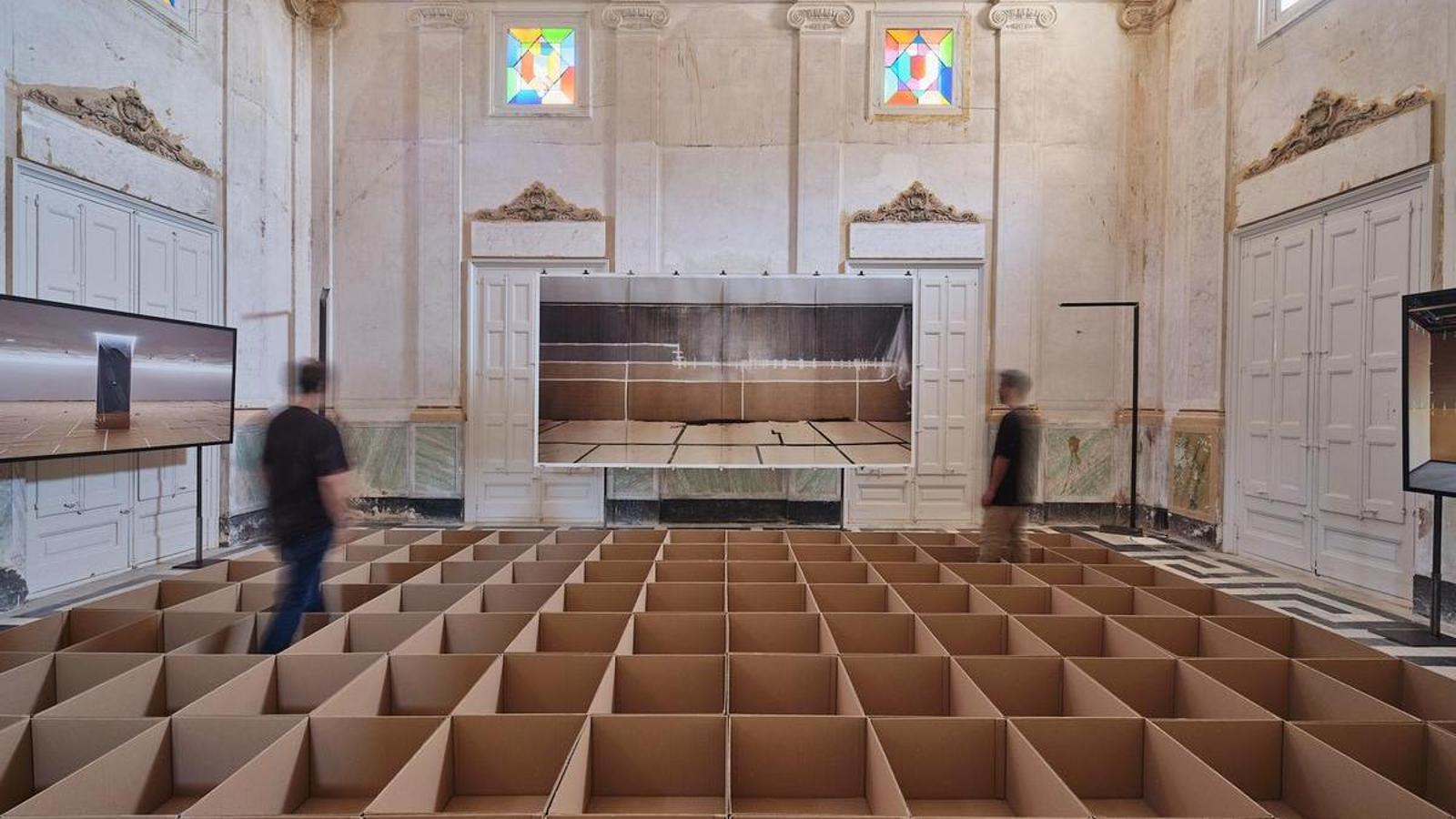
After two years of construction, the Palace of the Marquis of Alfarràs, at the Laberint d’Horta Park in Barcelona, reopened its doors to the public in 2025, for a few days a week. From the outside, the palace looks like an orientalist fantasy. But inside it is very different. At the heart of the building, there is still the 11th-century watchtower that gave it its origin, and some traces of the splendor it once had coexist with the renovation that saved it, the work of the studio ONL Arquitectura. In fact, throughout the tour, the different layers of the building's history are visible. Now the palace hosts an exhibition, Re-Edificatory Atlas, by architectural photographer Adrià Goula (Barcelona, 1973), which fits like a glove. It includes a series of his photographs of renovations carried out over the last fifteen years, of buildings including the Sala Beckett, the El Nacional restaurant, the Teatre Arnau, and the Mercat del Ninot. These are images that dialogue with works by eight artists, among whom are David Bestué, Carlos Bunga, Mario Santamaría, and Luz Broto.
What unites the photographs and the artworks is that they share processes; that is, both architects and artists carry out the actions of tearing down, protecting, camouflaging, rearranging, accumulating, and restructuring, among others. "In renovation works, a very magical moment occurs when the old work begins to disappear while the new work is still in progress. There is a series of temporary situations that have great architectural and poetic beauty, and show this epic character of construction," states Adrià Goula, who co-curates the exhibition with Alexandra Laudo. "These are unplanned situations that become real when taking the photo, because otherwise they disappear," adds the artist.

Goula is an architect by training and has been professionally dedicated to architectural photography since 2004. He is considered one of the best in the country. "I always approach my work from the point of view of not being the protagonist; the work itself must be, so I organize the photography according to the elements that organize the work, which is very different from someone who looks and feels at the center of what they see," says Goula. Re-Edificatory Atlas has its origin in a book of the same name that he plans to publish soon. The book has seventeen chapters, one for each action represented, and there are seven in the exhibition. The exhibition, which is part of the World Capital of Architecture 2026, will be open until September 19th and, after Barcelona, Goula would like to continue the project with exhibitions where other actions can be seen.
The exciting cycle of creation and destruction
At the beginning of the tour, an installation by Carlos Bunga made with cardboard boxes evokes protection, represented in the field of architecture with an image of one of the dwellings in the Winterthur building (Studio MK27) protected with cardboard during construction work. In the case of Camouflage, the intervention that Luz Broto made inside the Dilalica gallery, by the Maio studio, is related to images of spaces at the Sala Beckett (Flores i Prats) covered with plasterboard panels; a fragment of the building's history remains hidden under the new cladding. "Sometimes, the paint on the plasterboard reminds me of the ritual paintings of primitive tribes," explains Goula. And regarding Reorder, the transformation of the Casal Balaguer (Flores i Prats) dialogues with a miniature city that the artist Antoni R. Montesinos has made with wood and metal pieces from his workshop and materials found in the vicinity of the Parc del Laberint d’Horta.
One of the highlights of the tour is the action of Restructure: on one hand, some buildings under construction can be seen, among which are the Mercat del Ninot (Josep Lluís Mateo) and the Cap Roig castle (Nitidus Arquitectes), while the prop in the middle of the room, by David Bestué, is made with resin and polyester and a shredded cypress tree. And in Accumulate, the work that the artist Lara Almarcegui does with construction materials serves as a backdrop to two very powerful images of the rehabilitation of the Teatre Arnau (Harquitectes) and the future Raval music school (Carles Enrich and Taller 9s Arq) presided over by two enormous piles of rubble, the metaphor of a whole time that leaves to make room for the future.
