London temporarily recovers the Bayeux Tapestry, foundational tale of modern England
From September 10th, the British Museum exhibits a millennia-old piece of art that links and explains the common history of France and the United Kingdom above disagreements

-
CAT -
CAST
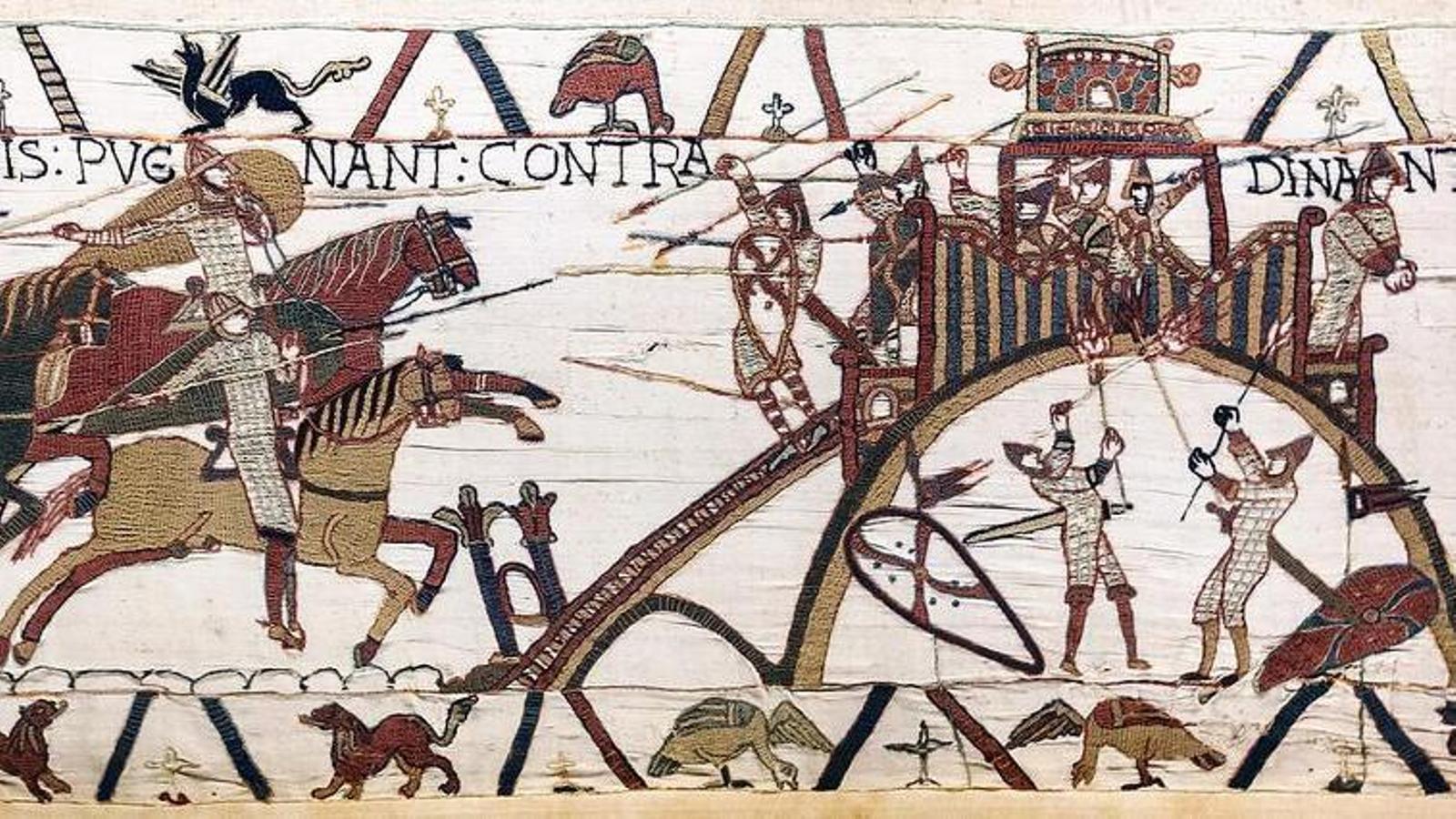
LondonThere are objects that explain an era and there are those that explain a country, or at least the vision that the victors of history have of the country. The Bayeux Tapestry belongs to the second category. With almost seventy meters in length and nearly a millennium of history, it is both an exceptional work of art, a tool of political propaganda, and the visual account of the moment that forever changed the destiny of England. From September 10, for the first time in almost 950 years, it will be possible to see it in London, after France authorized its loan within the framework of an unprecedented diplomatic agreement between French President Emmanuel Macron and the government of the then British Prime Minister, Keir Starmer.
The exhibition is, probably, the most or one of the most important that the British Museum has ever organized. The anticipation generated has been extraordinary months before the inauguration. Tickets that went on sale on July 1 to visit the exhibition between September and December 2026 sold out in a few hours. The museum has already announced two new batches of reservations that will be sold, for the general public, from October 21 and then from January.
But with money, even Saint Peter sings. Customers of the exclusive One Aldwych Hotel, where rooms cost more than 1,000 pounds a night, can still get their ticket for the exhibition, thanks to a business collaboration agreement with the British Museum. On the official website, tickets cost 33 pounds, if you managed to buy one. Hotel guests, on the other hand, are informed that they can choose any date and time during their stay to have priority when obtaining tickets, and that "many" are available. However, there is a limit of one ticket per guest and stay. This merchandising has caused quite a bit of criticism.
The Bloomsbury neighborhood institution's forecast is to receive 7.5 million visitors until the exhibition closes, in July 2027, a figure unprecedented in the museum's history. "This will undoubtedly be the most important year in our history," assured former Economy Minister George Osborne, currently chairman of the board, when receiving the tapestry on July 10 after an epic transfer. Visitors to the British Museum will have a limited time to see the work: 40 minutes.
The loan of the tapestry coincides with the temporary closure of the Bayeux Museum for a major renovation and has necessitated a logistical operation of extraordinary complexity. For months, conservation specialists have worked with exact replicas of the embroidery to design a transfer capable of minimizing any stress on such a fragile piece that many experts consider will hardly ever leave France again.

Historians believe that, most likely, the Bayeux Tapestry was embroidered by women in a workshop in England —possibly in Canterbury— shortly after the conquest of 1066, commissioned by a Norman patron. However, female authorship was overshadowed by the names of the men who commissioned it or who are its protagonists.
In fact, of the 626 characters that appear, women are an exceptional presence, with only between three and six identified female figures. More than 700 animals are also represented, including 202 horses and mules, 55 dogs, and 506 birds. This exceptional visual account of the Norman conquest of England is completed with 37 buildings or fortresses, 41 ships and boats, 49 trees and plant elements, and 57 inscriptions in Latin that explain the scenes and guide the narration.
An old claim
The return of the tapestry to the United Kingdom also marks the end of a long claim. For decades, attempts were made to get France to agree to lend it. It was even proposed to bring it to London for the coronation of Elizabeth II in 1953. However, all attempts failed. This also applies to the one that took place in 2018, when the French president, Emmanuel Macron, announced a temporary loan for 2022.
On the occasion of the piece's arrival in London, Macron published an article in The Times in which he stated that "the loan demonstrates all that the two countries can achieve when they join forces", in what constitutes a "tangible expression of a long-lasting friendship". The British government has taken out insurance that has valued the tapestry at 935 million euros.
In July 2025, during the French president's state visit to the United Kingdom, Macron made the announcement, a gesture of goodwill to the Starmer government after the tensions that Brexit caused between London and Paris. Indeed, in the aforementioned article, the French president also assured: "This [the loan] is what our partnership must continue to represent. The United Kingdom is a strategic partner, an ally and a friend of France. Faced with the great challenges of our time —the security of our continent, technological sovereignty, innovation, energy and decarbonisation, and the resilience of our democracies— we have decided to act together".

The interest in the Bayeux Tapestry goes far beyond its heritage exceptionality. Its almost seventy meters of embroidered linen –68.3, in fact– narrate the foundational moment of modern England. The scenes show the succession of events that culminated in the Battle of Hastings, on October 14, 1066, when William, Duke of Normandy, defeated Harold II, the Anglo-Saxon king of England, and became William the Conqueror.
The narrative, obviously, is not neutral. Most historians consider that the tapestry was commissioned by Bishop Odo of Bayeux, William's half-brother, probably to decorate the cathedral of the Norman city and celebrate the conquest of the island and the victory over King Harold II. Odo appears repeatedly, even fighting with a mace alongside the Norman troops. The embroidery constructs a story intended to justify the invasion. It presents Harold as a monarch who had betrayed the oath made before the relics of Bayeux Cathedral, where he would have promised to support William's rights to the English crown. By being crowned after the death of Edward the Confessor, Harold appears as a perjurer who morally legitimizes the Norman conquest.
In this sense, the Bayeux Tapestry is much more a piece of propaganda than a simple chronicle of events. The British Museum has decided to make this idea one of the guiding principles of the exhibition. Digital resources, enlargements of details, and immersive recreations of the Battle of Hastings allow us to understand how images functioned in the 11th century as an instrument of power in a society where the vast majority of the population could not read. In parallel, the museum confronts the Norman narrative with Anglo-Saxon sources, which offer very different interpretations of the same events.
Catherine Clarke, Professor of Popular History at the University of London, states that "the Battle of Hastings had profound consequences for England and, later, for a large part of Great Britain." "The country passed into Norman hands. By 1086, only 8% of England's territorial wealth remained in English hands; the remaining 92% belonged to the Normans. The language, culture, and traditions were subjected to the new occupying power. And more than a century later, the conquest continued to be an open wound," says Clarke.
A detail from the sources of the time allows us to grasp how the Anglo-Saxons experienced the occupation of 1066, the last successful one in the islands' history. Around 1196, the English monk William of Newburgh wrote that, whenever it rained, the battlefield of Hastings "sweated real and apparently fresh blood".
Paradoxes of history
The great paradox is that the invasion the tapestry celebrates ended up defining the United Kingdom we know today. William's victory did not just change the king. It transformed England from head to toe. A new Anglo-Norman kingdom was born which, for centuries, shared monarchs, aristocracy, and political interests with the other side of the English Channel. England, which until then had looked mainly towards Scandinavia, began to orient itself decidedly towards the European continent.

The consequences are still visible today. The great stone castles and immense medieval cathedrals that form part of the English landscape are direct heirs of the Norman conquest. So are many political and administrative institutions. The new rulers reorganized the system of government, incorporating continental models, and created bodies, such as the Exchequer, a precursor to the current British Treasury. Even English law underwent profound reforms that would mark the country's political evolution for centuries.
The conquest was also recorded in the language. The Anglo-Saxon peasants continued to raise the sheep (sheep), the cows (cows) and the pigs (pigs). But when those animals arrived roasted at the table of the new Norman lords, they became mutton (mutton or ram meat), beef (beef or ox meat) and pork (pork), words all derived from French. A thousand years later, the vocabulary continues to remember who worked the fields and who sat at the table.
For the next two centuries, England and France maintained a much closer relationship than British national history often suggests. Many English kings were born in France and ruled territories on both sides of the channel. Richard the Lionheart, one of the great myths of English history, spent less than six months of his life in England and preferred to reside in his French dominions. Even today, he is buried in the Abbey of Fontevraud, in the Loire Valley.
When Normandy was lost in 1204, the ties were not broken. English claims to the French crown would eventually lead to the Hundred Years' War. That conflict caused enormous fiscal pressure in England which fueled the Peasants' Revolt of 1381 and, after the definitive defeat in 1453, contributed to the instability that would lead to the Wars of the Roses. The last English possession in France, Calais, was lost in 1558. According to tradition, Queen Mary I said before she died that, if they opened her heart, they would find the city's name written there.

Political reinterpretation
This is why the Bayeux Tapestry has been politically reinterpreted time and again. Napoleon Bonaparte wanted to exhibit it in 1803 to show that France had already conquered England once and could do it again. More than two centuries later, Nigel Farage sported a tie decorated with scenes from the tapestry during the Brexit campaign to recall, in his words, "the last time we were invaded".
The British Museum, on the other hand, proposes a radically different reading. The tapestry does not just speak of an invasion. It also tells of the birth of a shared political space between England and Normandy, of a common aristocracy, of a transformed language, and of a country that for centuries looked towards France as much as, if not more than, towards its neighbouring islands.
It is difficult not to see a historical irony. In full post-Brexit stage, as the United Kingdom continues to redefining its relationship with Europe, the most anticipated cultural object of the year recalls how inseparable English identity is from the continent. That it is precisely Emmanuel Macron who has authorized this exceptional loan adds even more symbolism to the operation. Almost a thousand years ago, the embroidery justified the Norman conquest of England. Today, that same object arrives in London as a gesture of cultural diplomacy between two countries that have alternated centuries of wars and alliances, but which share a history much deeper than contemporary political debate often admits.
This is the great lesson of the exhibition. Beyond its artistic value, the Bayeux Tapestry reminds us that political borders can change, but shared stories continue to define nations. Few works explain this with such force as this long medieval embroidery which, almost a thousand years later, continues to force the British and French to look at their past together.
