Juan Mayorga makes Cervantes' dogs speak
The playwright premieres at the Teatre Romea 'Palabra de perro', a new dramaturgy of 'El coloquio de los perros'

-
CAT -
CAST
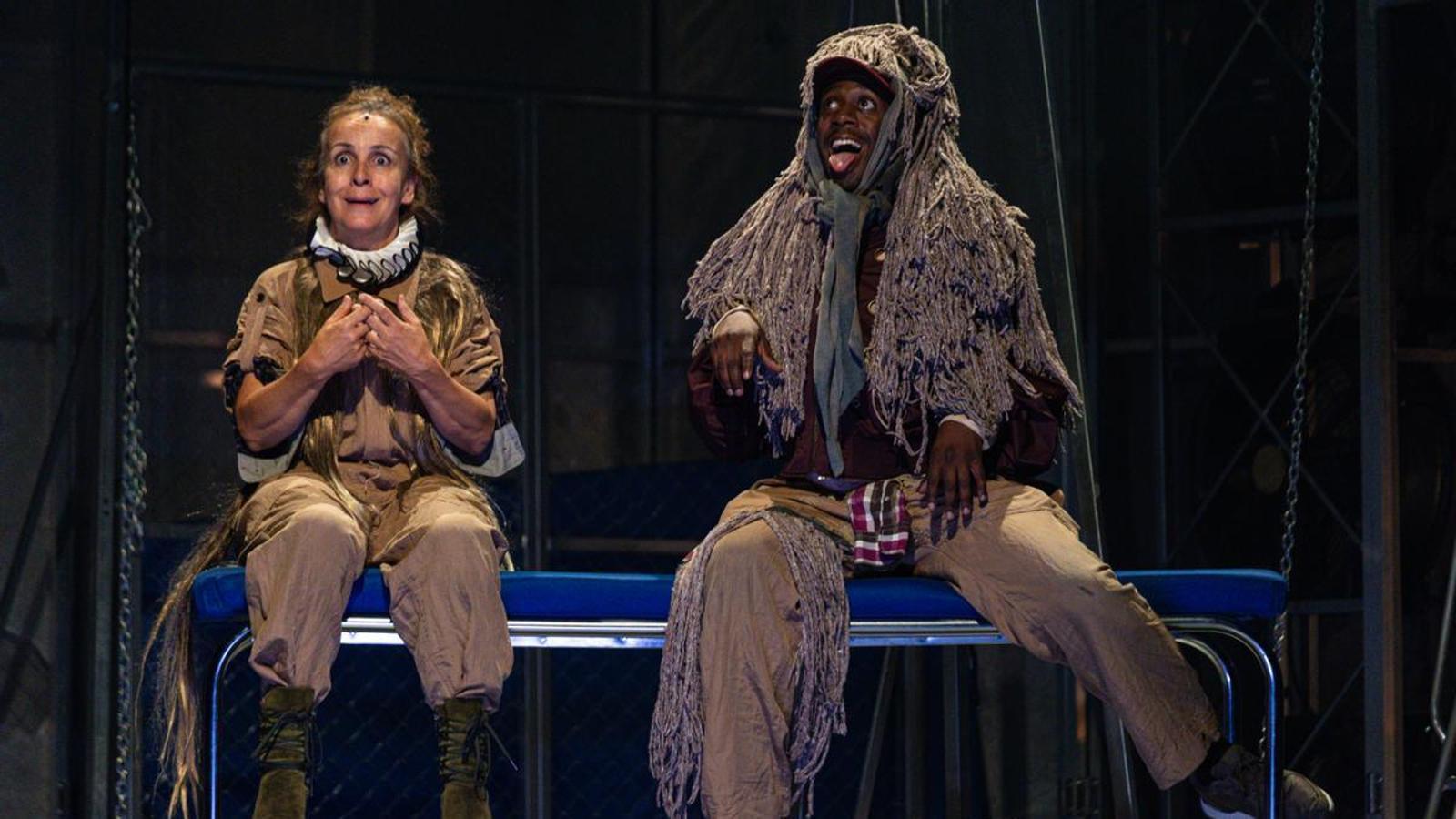
Barcelona"Millions of people are treated as if they were animals, while others of us have been educated to see other human beings as if they were," says the Madrid-born playwright Juan Mayorga. This is the starting point that fuels his latest show, Palabra de perro, created based on El coloquio de los perros, by Miguel de Cervantes, and starring Cecilia Solaguren, Jimmy Castro, and Jorge Kent. The play, which is being performed until November 8th at the Teatre Romea and is directed by Rakel Camacho, links the original text with contemporary society to question some of its certainties through the gaze of two dogs.
On stage, Mayorga brings back the characters of Cipión and Berganza, two dogs that acquire the gift of speech. From a position that is privileged with respect to their fellow creatures but also marginal in relation to people, the dogs observe and analyze human behavior. "The animal breaks the frame of representation and offers enormous freedom to the actors, the director, and the spectators. It unleashes the imagination and opens up possibilities that, otherwise, might not exist," states the playwright.
Cervantes's compassionate gaze
Mayorga's work in relation to the text has been to maintain its essence and, at the same time, connect it with the miseries and contradictions of the present, as well as current forms of exercising power. "All the masters in the play have their origin in Cervantes, but we have placed them in a tense dialogue between the author's time and our own. I did not want to lose sight of Cervantes' compassionate gaze. I have tried to safeguard his word and, at the same time, approach it from the present. Because it is not only about recovering a work from the past, but about asking ourselves what it tells us today," he highlights.
This approach is not devoid of humor and projects a contemporary world in which truth is constantly questioned and concepts like freedom, justice, and morality are no longer perceived as they once were. Likewise, it brings to the stage themes such as immigration, oppression, and corruption in the form of a fable. "It is a story of identity, sensitivity, and self-knowledge, but also of the vices and customs of a Spain full of chiaroscuro. There is a reflection on power and subjugation, on the relationships we establish with others, and on the mechanisms that condition us," points out the director.
The play also aspires to claim the word as a scenic element and grant it the importance that, according to the playwright, it deserves. "I owe the characters and an extraordinary demand regarding the word to Cervantes. The word is not a simple vehicle for transmitting an idea: it is a way of life. I would like the spectator, upon leaving the theater, to feel nostalgia for the word. Because more word is more life," says Mayorga.
Palabra de perro premiered this summer at the Almagro International Classical Theatre Festival. Mayorga, who won the Princess of Asturias Award for Literature in 2022, has already made animals speak in previous shows such as Últimas palabras de Copito de Nieve and La tortuga de Darwin, but working with a text by Cervantes has given a new dimension to this theatrical resource. "It was while working on this piece that I discovered the double value, poetic and political, of the presence of the animal on stage," underscores the playwright.
