Jorge Drexler: candombe, sympathy and 'Words of love' at the Palau Sant Jordi
The Uruguayan musician unfolds the rhythmic potential of the album 'Taracá' in front of 7,200 people

-
CAT -
CAST
- Palau Sant Jordi. October 31st, 2026
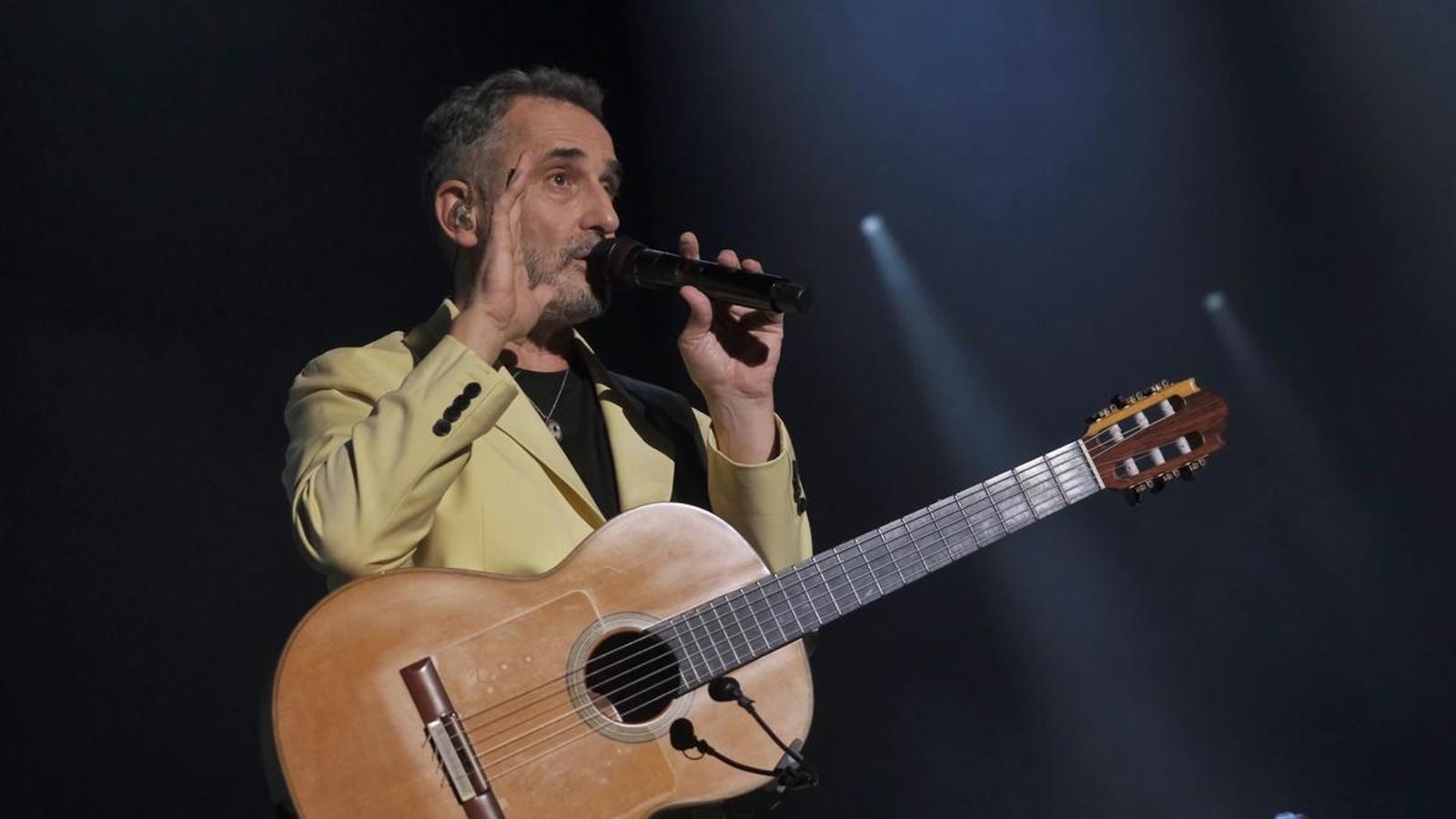
"To live and not be ashamed of being happy" could be Jorge Drexler's motto. It is a verse from ¿Qué será que es?, the Spanish version of the track by Brazilian artist Gonzaguinha that the Uruguayan musician played in the final stretch of Saturday's concert at the Palau Sant Jordi. A generous concert, lasting two and a half hours, with a remarkable rhythmic and scenic display, presided over by the charisma of an artist who was capable of conveying proximity – intimacy, in fact – in the vastness of the venue. He has the gift of the anecdote and the favor of an audience that celebrates his stand-up comedy skills, as he demonstrated all alone at the Palau de la Música in 2025. And despite the astonishment at the hostility that characterizes the present, he pursues happiness with the determination of a Quixote and a delicate irony hanging from his smile. Also attached to the melancholy of the milonga, he sometimes verges on an overdose of consonant rhyme, as happens in Cuando cantaba Morente with "candente", "inclemente" and "latente" (almost all poets have a bad day), but the consistency of his songbook and the communicative capacity of a voice that takes on harmonic challenges without virtuosity is undeniable.
Utopian and sentimental by nature, and with enough artistic and humanistic resources to "not get full of oneself", as he explained a few months ago in ARA, Drexler gathered 7,200 people, all seated, in the Barcelona presentation of the album Taracá (2026), the songs of which occupied a good part of the repertoire. It is not a minor detail, because the drums of the candombe, the Afro-Uruguayan rhythm that articulates the album, are the engine of this tour. And he has, of course, the help of a band of seven musicians and, in Barcelona, the special collaboration of percussionist Fernando Ramírez. To the rhythm of the candombe came the best moments of the night: in the first part, pieces like Tamborero, and in the final block, the spectacular El tambor chico, ¿Qué será que es?—which he took the opportunity to celebrate, in Portuguese, the victory of Lula da Silva in the presidential elections in Brazil— and Ante la duda, baila, a song that recalls the infamy of power that throughout history has wanted to ban sensual dance, whether it was the sarabande in the 16th century or reggaeton at the end of the 20th. "In Uruguay, the drum was also a symbol of rebellion during the dictatorship," he recalled before tackling Tamborero.
Drexler began the concert with Toco madera and ¿Cómo se ama?, two songs from Taracá that exude the undeniable influence of C. Tangana, explicit in Tocarte (the track they shared on the album Tinta y tiempo, from 2021) and also present in the visual setup: two vertical screens and one horizontal screen that offered black and white images, most of them in line with what is expected at a concert but some quite surprising, such as those provided by a camera installed inside a drum. The first songs already showed the good rapport between the musicians, the depth of the triple percussion and the desire to share the spotlight, a constant in a concert in which the singer Miryam Latrece, the guitarist and singer Flor Gamba, the double bassist Alejandra López and the drummer from the Ebre region Marc Pinyol had a special prominence.
Tribute to Serrat in Catalan
On this tour, Drexler incorporates a small stage that, in the central segment of the show, he uses for his most intimate repertoire, though not exactly alone because sometimes the band also participated by playing on the other stage. In this more cozy space, there was one of the most emotional moments of the night, when Drexler sang Milonga del moro judío, the ecumenical utopia of the Moorish Jew who lives with Christians and who does not know which God is his, nor which are his brothers. "Long live a free Palestine!", shouted a spectator in the silence of the Sant Jordi.
He opened the part on the small stage with Las palabras and immediately followed it with a version of Paraules d'amor, by Joan Manuel Serrat. Drexler is a friend of the most candid lexical associations... It was the first time he had sung it live, and he managed it with the help of the audience, to whom he explained that it was the first song in Catalan he heard forty years ago. In addition to singing Paraules d'amor, he also used Catalan to greet and to repeat thanks ("gràcies" and "merci"). All of this contributed to reinforcing the idea that the one at Sant Jordi was not a conventional concert. "It is the biggest concert I have ever played in Europe! Barcelona always giving me joy", he had said a while before. His son Pablo lives in Barcelona, and he has a group of admirers there, musicians who were also in the audience on Saturday such as Meritxell Neddermann (who collaborates on the album Taracá), Pau Vallvé, Macaco and Salvador Sobral, among others. Oh, and he did not forget that in the eighties, working as a street musician, he had played in front of the cathedral of Barcelona.
Furthermore, taking advantage of the fact that the singer Julieta Rada is in Barcelona these days (she is performing on November 5th at Jamboree), he invited her to sing La edad del cielo and to pay tribute to her father, Rubén Rada, the legendary Uruguayan musician who passed away on August 23rd. Together they performed Baile del candombe, with the essential assistance of the band. It was the transition for the return to the main stage and to kick off the final stretch of a concert that ended at a quarter to twelve with Todo se transforma. A particularly happy night of souls, with a first part in which the performance moved in fits and starts, too subjected to the dynamic of monologue-stories and dedications (for example, to Open Arms in Polvo de estrellas), and with an unstoppable second part, without shame in being happy.

