The secret of Josep Pla to continue writing after suffering a heart attack
Destino recovers the narration of the heart attack that the author of 'The Gray Notebook' suffered in 1972 and that for years has been studied in medical schools
-
CAT -
CAST
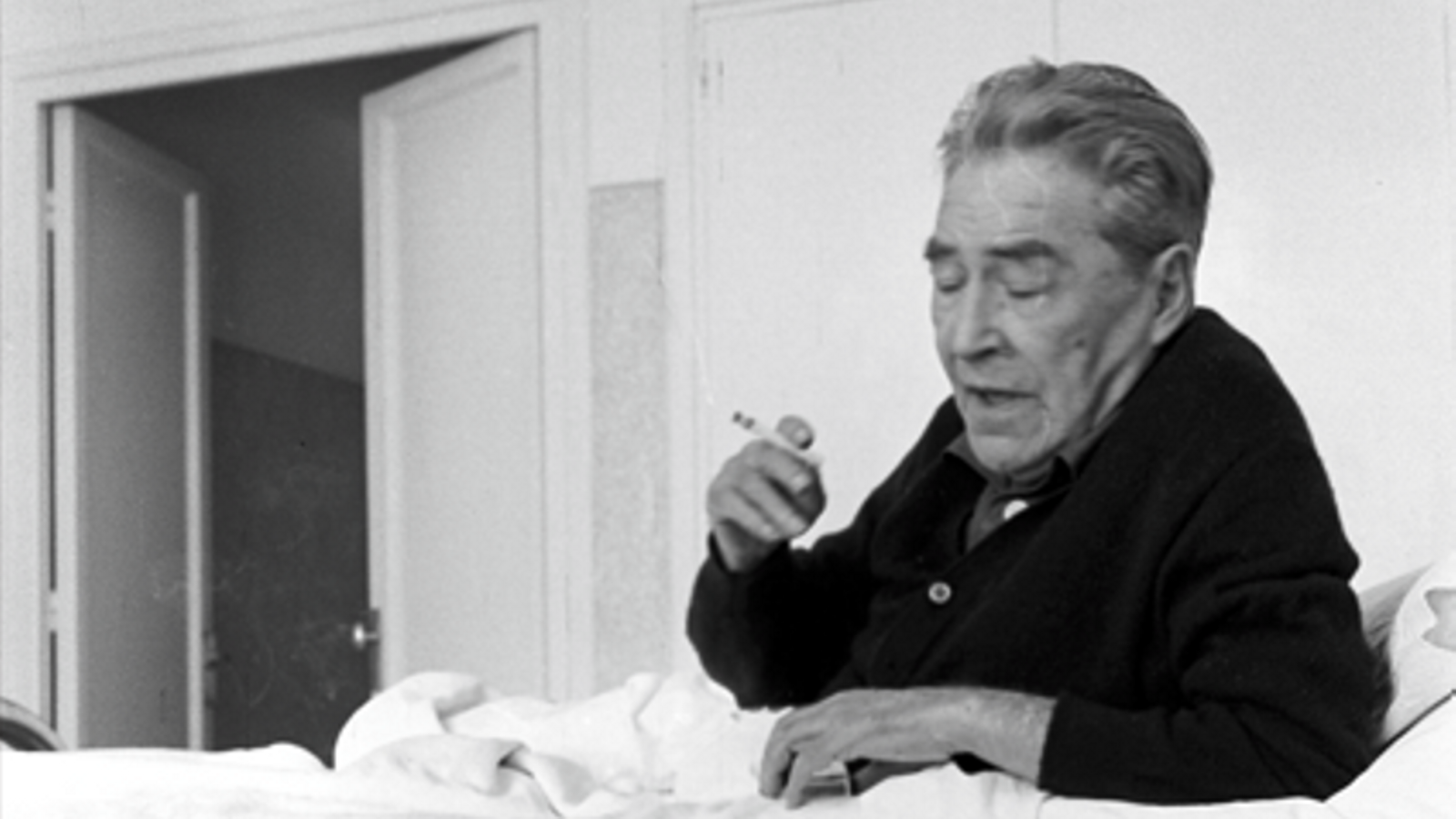
BarcelonaOn August 17, 1972, Josep Pla went to bed after dinner with some friends in L'Escala, but that night was not like any other. While reading the book he was halfway through, by “an 18th-century writer, terribly hypocritical, a great liar” who interested him greatly, Restif de la Bretonne, Pla began to feel unwell. “I felt that in the upper part of my chest a very painful bar was forming, above the space of my heart, and that, in the back of my torso, another parallel bar was forming, just as painful as the previous one,” he wrote two years later at the beginning of A myocardial infarction, which Destino has just put back into circulation accompanied by a prologue by Sergi Pàmies and two texts on typhus, an infection he contracted in 1942 due to the ingestion of a portion of spoiled oysters.
“These are the two major health problems that Pla suffered, and that is why we wanted to relate them,” recalls Jordi Cornudella, who, from Grup 62, continues to publish, in collaboration with the Càtedra Josep Pla, a minimum of two volumes related to the writer born in Palafrugell in 1897 and who died in Llofriu in 1981, after a long life dedicated to writing articles, chronicles, short stories, novels, and autobiographical texts. “In the case of A myocardial infarction, the writer Pla recycled the journalist Pla, as on so many other occasions,” continues Cornudella. “In the autumn of 1972, he dedicated three articles to it in the magazine Destino, and in September of the following year, he returned to it with a final text. These are the materials that he translated into Catalan and expanded for the narration of those events included in Notes per a Sílvia, volume 26 of the Obra Completa, published in 1974.” Pla, who at that time was already approaching 80, continued working day and night on the project inaugurated in 1966 with El quadern gris at the publishing house of Josep Vergés, of which there were still 18 volumes left to publish.
Returning to Pla in pieces
“We live in a world without time or space for the 30,000 pages that Pla left behind in writing, which is why it is worth it that for years the publishing industry has been serving them to us in little pieces –claims Sergi Pàmies–. I have been and am a great reader of his work, although the relationship with him has had its ups and downs. At the end of the 80s and the beginning of the 90s, his irrefutability was suffocating. I remember that I went so far as to write two articles: in one of them I mocked his enthusiasts, whom Pla himself would have spat on, and in the other, I ironized about the cliché that he himself had contributed to building”.
Pàmies acknowledges that, of the whole of the Planian oeuvre, he has a “very great preference” for the articles, included in volumes such as Notes disperses (volume 12, 1969), Notes del capvespre (volume 35, 1979) and Notes per a Sílvia, which includes A myocardial infarction. Also for the Homenots series, for stories like Contraban and for the books he dedicated to cities like Girona and Barcelona and to towns like Cadaqués. “The more banal and frivolous he is, the more I like it –he acknowledges–. When he wants to turn himself into a diligent author, he bores me more. In the case of A myocardial infarction, the subject is not frivolous, but he describes the heart attack with great verisimilitude, talent and style. It shows, once again, that he is a unique and extraordinary writer”. For years, Pla's text has been used in medical schools for the thoroughness and accuracy with which he describes all the symptoms suffered in the early hours of August 17th, followed by the doctor's visit the next day and the stay at the Clínica Corachan in Barcelona. “It doesn't surprise me that it has been used –continues Pàmies–. The documentary value of the story is remarkable. Pla was a great observer, the best chronicler of the era”.
A year after that setback that could have cost him his life, Josep Pla dared to give a series of tips “to avoid the repetition of the catastrophe”. Among them were doing everything possible to have no debts, not eating much, never entering “a pharmacy for pleasure”, not getting depressed and getting some rest. Towards the end of the text, he acknowledged that he had not listened to the doctors on two aspects, and that they were his secret to continue writing: tobacco and whiskey. “They are indispensable elements of my work –he admitted–. It is very possible that without having them I would not have had either the spirit or the patience to write what I have written –which, on the other hand, is of no importance”.
