Fire and frenzy: three centuries of revolts in Barcelona
Historians analyze how struggles for bread, strikes, and street pressure have conquered rights and transformed the city since the 18th century
-
CAT -
CAST
BarcelonaFrom the present, it may seem that we have never lived in such a dark era, with such an uncertain future and such accumulated hopelessness. If one looks back, however, insurrection has often taken hold of the streets of Barcelona. Sometimes, the response has been fierce repression—including executions—and without any victory for the insurgents. Other times, citizen mobilization has brought down governments and caused irreversible changes. In fact, many current rights would not exist without great mobilizations.
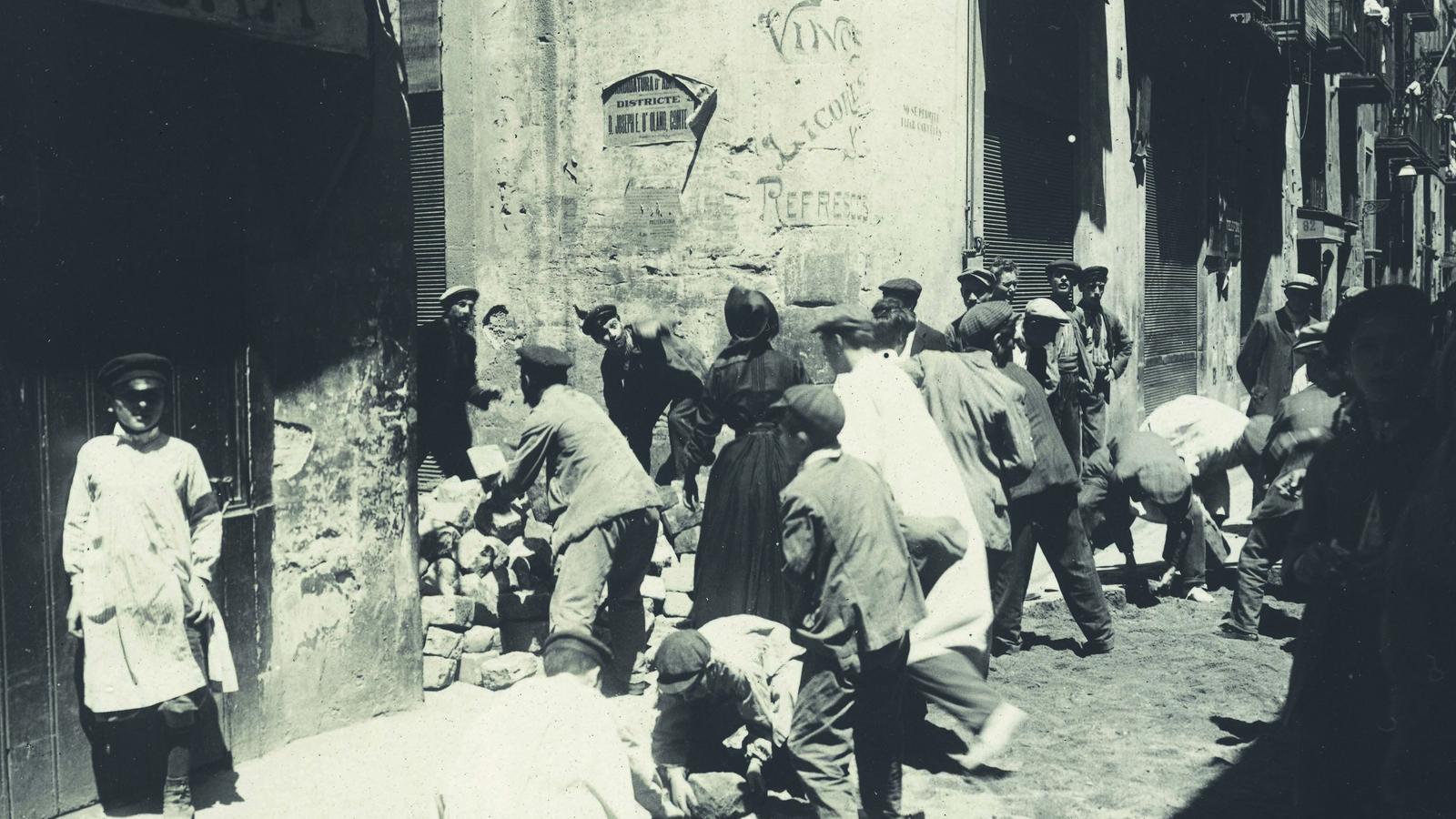
Barcelona carried the reputation of being revolutionary for a long time. Friedrich Engels, in the mid-19th century, wrote: "The history of Barcelona, the largest industrial city in Spain, is the one that records the most barricades in the world". "This image was consolidated between 1820 and the First Republic, was reborn with the 'Rosa de Foc' (Fire Rose) at the beginning of the 20th century and the Civil War, but it already had clear precedents in the Bread Riots (1789) and the Conscription riots (1773)", details the historian Jordi Roca Vernet.
In protests such as the Bread Riots of 1789 or the Women's Revolt of 1918, it was precisely they who were the first to take to the streets. In the Barcelona of 1789, a municipal decree announcing the rise in the price of bread unleashed a revolt that, for three days, turned the life of the city upside down. In 1918, it was once again the rising cost of bread that put women on a war footing. Amàlia Alegre, a resident of the Raval, hung a sign calling them to march to the Civil Government and demand a reduction in prices. Despite the appearance of a spontaneous gesture, there was political coordination behind it: Alegre was linked to the Radical Party.
Lampoons and chimes
"There are historical photographs of the Civil Government stairs where you can see how they gave way due to the massive presence of women who climbed them at the same time to speak with the governor; they shattered the staircase with their weight," explains historian and archaeologist Laia Gallego. "It is a little-known revolt, but very interesting, just like the women's rallies of the late 19th and early 20th centuries, which show how they went about conquering spaces. The defense of basic needs continues today, and in these struggles, there is once again a majority of women," adds Gallego.
These protests went beyond simple protest against hunger. "When the population revolted in 1789, they were not only demanding food, but defending a certain conception of social justice, according to which the authorities had the responsibility to guarantee supplies and prevent speculation," points out historian Raquel Castellà. "The 1773 'Revolt of the Quotas' also had a dimension that went beyond recruitment," she adds. In 1773, the discontent spread to the streets through lampoons that pointed out causes and culprits; the revolt spread inside and outside the city walls, and the bells were rung in 'sometent', the traditional form of mobilization at that time.
"More than half of the population was mobilized, but if they went down in history it was not only because of the motives, but also because of the capacity to organize themselves into boards or deputations. Guild structures and professional colleges facilitated these boards, which negotiated both with the local Bourbon power and with the revolting groups," details Jordi Roca Vernet.

The unions and the ambition to storm power
The great leap, according to Roca Vernet, occurred between 1820 and 1874: "In this period it was no longer just a matter of negotiating, but the capacity to propose an alternative and disruptive political project in the face of multiple crises was articulated." An example of this transition was the 1835 Bullanga (riot). Barcelona suffered from overpopulation within its walls, deadly epidemics (such as yellow fever in 1821 or cholera in 1834), and a worsening of living conditions aggravated by labor mechanization and the fiscal pressure of the Carlist wars. The outbreak of the riot initiated the Revolutionary Biennium and the Progressive Triennium. The population burned convents because they held grievances against the Church for the oppression it had exerted against the popular sectors during the Restoration, and its alignment with Carlism unleashed their wrath. That revolt accelerated the confiscation of property and transformed the city urbanistically: ecclesiastical spaces gave way to civic facilities such as theaters, libraries, and archives.
"With the riots there was deep unrest and very recognized leaders emerged. The way to capitalize on the unrest was more organized and a real social change occurred there," details the historian Manel Risques. This leap was consolidated with the strike movements of the late 19th and early 20th centuries and the appearance of the unions. Strikes such as that of the self-acting machines (1854; against the mechanization of spinning) or the general strike of 1855, under the slogan "Association or death", paralyzed production to demand the right to association, the 10-hour workday, and a minimum wage. Years later, the La Canadenca strike (1919), called by the CNT's Single Union of Water, Gas and Electricity, brought Barcelona to a standstill for 44 days, leaving the city without electricity or transport, and forced the government to yield, establishing for the first time by law the 8-hour workday.
"La Canadenca is an extraordinary example of how a labor grievance ends up causing a far-reaching legislative transformation –says Raquel Castellà–. But this does not mean that material needs disappear from subsequent mobilizations. The 1951 tram strike once again places the cost of living at the center, and the struggles for housing or for self-managed spaces at the end of the 20th century and the beginning of the 21st maintain a very clear material dimension. Therefore, we do not go from fighting to survive to fighting to have rights: what changes is the way these needs are formulated politically, how they are organized collectively, and what capacity they have to challenge power". Protests such as those of the Cinema Princesa (1996), that of Can Vies (2014), or the battle of Urquinaona (2019), according to Roca Vernet, responded to "very concrete problems and groups": the housing crisis, which the squatter movement was already denouncing in the first two cases, and the protest against the Procés sentences, which the police forces did perceive as a threat. "Despite having a rupturist rhetoric, they did not have an alternative government proposal nor the capacity to carry along social majorities, so they were impactful but without continuity or structural changes".
Tolerance for violence
Throughout the 19th and early 20th centuries, the perception of violence was very different from today's. The Tragic Week (1909) erupted due to the unrest accumulated after Spain's defeat in the overseas colonies and the need to recruit men from the working class—who could not pay to be exempted from military service. The popular uprising ended with a terrible toll: two thousand arrests, two hundred deportations, and five executions, including that of the pedagogue Francesc Ferrer i Guàrdia, who was shot as a scapegoat.
"In the 19th century, violence was understood as a form of negotiation, and there was a much higher resilience to police and military violence," points out Roca Vernet. "People were aware that challenging the power did not mean spending a few days at the police station, but risking one's life or suffering harsh penalties. In the uprising of 1843, for example, there were 140 executed and 400 banished." Risques agrees: "Now there is a great rejection of violence, but when the State was exclusionary, as in the 19th century, direct confrontation and barricades were seen as the logical way to stand up to power."
During the Franco regime, however, the model changed and the weight of repression on the streets was no longer in the hands of the army but fell to militarized police forces, which acted with impunity under the protection of the civil governor. Even so, actions such as the tram strike of 1951 managed to stop the increase in fares. "In this country, things have been changed through protests: we would not have reached the 1978 Constitution without the prior mobilizations," emphasizes Risques.
In fact, as historian Dolors Marín details, throughout the Transition, from 1975 to 1978 there were many strikes, practically every day. In 1970 there were 1,547 strikes throughout Spain; in 1974 they increased to over 2,000; they reached 2,807 in 1975, and in 1976, which significantly marked the beginning of the democratic transition, they rose to 3,662. That year, more than 2.5 million workers went on strike. Even though Franco died in his bed in 1975, they finished off the regime in the streets. Many legislative changes were the result of major mobilizations, including those for LGBTI and women's rights. "They were very violent demonstrations and the police fired real bullets at the protesters; there were many arrests and many beatings. They greatly marked the entire generation of the Transition and, above all, people's behavior in the street. It went, first, from coming out timidly to overturning buses, burning things when necessary, or smashing the windows of establishments like El Corte Inglés," says Marín.

The discourse of power
Can we say that there is a linear evolution towards increasingly less violent societies? Castellà believes not. "Violence has always been judged based on who exerts it, against whom it is directed, and who has the capacity to publicly explain the facts," he states.
From the perspective of power, the treatment of protest has maintained some historical constants. "Since the 19th century, authorities and the media have used terms like subsistence riot or bullanga to degrade mobilizations –explains Roca Vernet–. The concept of bullanga was constructed to deny political organization and present the protest as a spontaneous and violent movement. Qualifying the participants as delinquents, lumpen or mere women has been a systematic strategy to minimize the real challenge".
Roca Vernet compares this with recent episodes: "In France, we have seen broad mobilizations from diverse sectors in defense of education and equality. However, it is often preferred to focus attention on the disturbances to degrade the protest and ignore the demands. Regarding the recent episodes in Barcelona, the response of a very small collective has been over-dimensioned due to the destruction of property and the fear that the French model will be repeated".
On the other hand, explains Roca Vernet, popular mobilizations within a democratic framework, regardless of the many limitations that this framework may have, do not have the same scope as in a period where there was no democracy. "When the citizenry did not have formal channels to express their discomfort, the street was the final resource," says Roca Vernet. Another difference, as Risques details, is that in a democracy, the police do have to answer for disproportionate actions.
From the street to the networks
Technology has also transformed coordination dynamics. As Castellà recalls, the mobilizations of the 18th and 19th centuries were not spontaneous: markets, taverns, workshops, spaces of popular sociability, associations, and neighborhood networks were fundamental for transmitting information, sharing grievances, and generating complicity. Rumors, proclamations, printed leaflets, and an increasingly influential political press also played an important role. Trade unions provided permanent structures, coordination mechanisms, strike funds, and negotiation capacity. This allowed for sustaining mobilizations over prolonged periods and articulating demands that went beyond a single neighborhood.
Digital social networks have transformed the speed of calls to action. "A mobilization can spread in a matter of hours and fill a street, but speed does not necessarily equate to greater capacity for transformation if the struggle cannot be sustained over time," states Castellà.
Ultimately, the history of the Barcelona revolts does not show a linear evolution or an innate inclination of the city to build barricades or burn dumpsters, but rather the persistence of a historical struggle that still continues: who has the power to decide and how can citizens intervene in things that affect their lives in many aspects.
The 'La Canadenca' strike, which at the time generated a very intense social confrontation, is today remembered as a milestone in the history of labor rights. "Many mobilizations that we remember today as social achievements were perceived, at the time, as a threat by a part of society. History also teaches us that the legitimacy of a protest is disputed in the present and reinterpreted from the future," says Castellà.

