Drawing with time: the keys to Flores i Prats' "emotional heritage"
The architects responsible for the Beckett Theatre disembark in France with a large exhibition at the Arc en Rêve center

-
CAT -
CAST
BordeauxThe architect couple formed by Ricardo Flores and Eva Prats, known for being the authors of Sala Beckett in Barcelona, continues to receive international recognition. After the 2023 Venice Architecture Biennale, the Arc en Rêve architecture center in Bordeaux has welcomed them with open arms, and until January 17th, it dedicates a major exhibition to them based on their vision of how to intervene in historic buildings. Emotional heritage is three times larger than the space they had at the Venetian Arsenal. On the opening night, the auditorium was packed, and the audience began to applaud before Flores and Prats started speaking. Afterwards, a dinner of honor with paella (à la française).
The exhibition marks the arrival of Flores and Prats in France, that is, in the country of Lacaton & Vassal, winners of the Pritzker Prize and benchmarks for the improvement of the built environment. There are commonalities between the two studios, but the Catalans have a more experimental and affective vision. "Lacaton & Vassal and other firms have been working in this field for a long time, but we distinguish ourselves by the perspective of emotion and the intangible," states Ricardo Flores. "In France there are many very good firms, but from our point of view there is still work to be done. Our perspective can be a contribution, because this aspect of the memory of buildings that we incorporate is not developed," says Flores.

The direction of Arc en Rêve programmed the exhibition a couple of years ago, and in the end it has coincided with the tenth anniversary of Sala Beckett. "Perhaps it's a sign," says Flores. "Sala Beckett was a turning point in our work: we were able to synthesize many of the things we had worked on before. And from Beckett we were able to establish several lines of research. In fact, Eva has done her doctorate based on the themes that Sala Beckett brought us". "The strength of all the buildings we have worked on is not only in their physicality – states Eva Prats –, but also in the memories embedded in them, the cultural construction they contain, the traces of occupation and how they explain the activities that took place there or those that were carried out there in their origin, but which have disappeared. We are much more interested in the intangible".
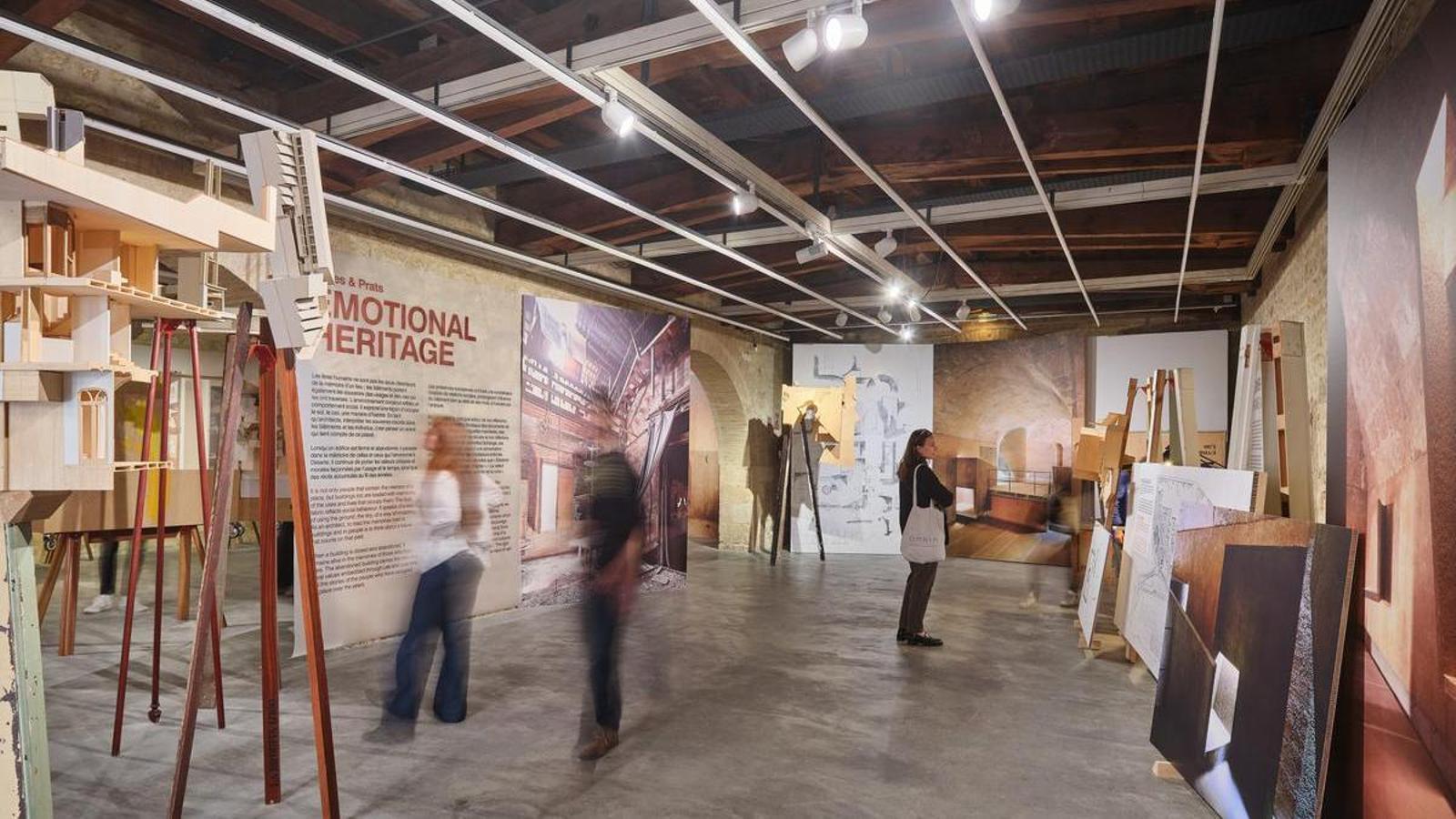
As they did at the Venice Biennale, Flores and Prats have recreated the fabulous working atmosphere of their studio in the exhibition halls of Arc en Rêve, with tables full of drawings and plans. Everything is like a great immersive installation: one doesn't know where to start among this avalanche of materials. Many of the models on display are mounted on wooden legs, designed by Curro Claret, to be able to keep them close while drawing. Unlike Venice, however, the route is now organized around four themes represented by one or more works.

The first theme is Drawing with time, and they explain it with the Museum of Mills of the Balearic Islands, in Palma, where they incorporated the previous lives of the building into the project. Before being a museum, the miller and his family lived in this mill, and later the building was illegally occupied. "When we arrived, we found many marks of different occupations, and it was very attractive," says Flores. "Even if the actions were illegal or poorly controlled, when they reach you they are already a document. We worked with everything: it is very beautiful to think that everything is valid, that none of the lives has priority over the others." "Working with this superposition gives you freedom because you can choose what inspires you the most," he adds.
In this area is one of the projects that Flores and Prats have underway: La Favorita, transformation of the old industrial complex into a center for coworking and production. They themselves use part of the building as a warehouse and workspace. There is also the Hotel Nuevo Triunfo in Barcelona and the Casa Providència, in Badalona, where they built a new staircase in the center of the house that also functions as a skylight.

On the other hand, Flores and Prats are aware that their interventions, rather than being definitive, represent another layer in the life of a building. "This is what is beautiful, and it is the contact with ruin that has given us this, the fact that ruin has this open condition – says Flores –. When you transform it, you don't quite know whether time is going forward or backward. The most interesting thing about our work is that, rather than imposing a specific solution, it opens up themes and raises discussions. In fact, the exhibition shows that we are more interested in the process than in the result.
Flores and Prats worked in the studio alongside Enric Miralles, another architect who carried out some daring refurbishments, including the Utrecht City Hall and the Santa Caterina Market. "In Enric's works, the boundary between the new and the old is more visible, and his action was very strong, geometrically and materially," explains Flores. "In Santa Caterina, you see the roof, and the old part is underneath. We are fascinated by it, but at the same time, one could criticize how far he went. For us, having more unity between one stage and another represents an evolution. We prefer this ambiguity of not knowing who has done what".

The challenge of incorporating new uses
In the second area, the rehabilitation of the Casal Balaguer, in Palma, carried out in collaboration with the Duch-Pizà studio, represents The right to inherit. "It is not about freezing a building in a certain state, but about being able to incorporate new uses and new programs into it," says Flores. "They transformed it many times over nearly a hundred years, and that gave us the confidence to transform it again. We turned a private house into a public building without losing the mystery of an old house, which is a marvel," says Flores. In their work, Flores and Prats act "with radicality and, at the same time, with great respect." At Casal Balaguer, they used an existing courtyard to house a sculptural communication core made of concrete.
The route continues with Use value, represented by the transformation of the old Pau i Justícia cooperative into the Sala Beckett in Poblenou, and also by a previous building, the Nau Yutes. The latter is less known to the general public, but it is one of the first projects in which Flores and Prats delved into the dialogue between the new and the old. The children of the owners of this textile company in Sant Just Desvern commissioned them to expand a warehouse while maintaining the existing building as much as possible. Flores and Prats even gave a new life to the office furniture and created new ensembles with the existing furniture, combined with new pieces. For this reason, as they would do again later at Sala Beckett, they cataloged and hierarchized all existing elements. The most striking aspect of the intervention is the red corrugated sheet metal that envelops the existing and new volume, evocative of the fabric rolls that were stored there.
Reviving an old theatre in the heart of Brussels
The exhibition, supported by the Institut Ramon Llull, culminates with the most emblematic project that Flores i Prats has underway: the rehabilitation of the old Théâtre des Variétés, currently under construction, representative of The open value of ruin. Created in collaboration with Ouest Architecture, this project involves the rehabilitation of a listed rationalist building in the center of Brussels and its transformation into a new cultural center with a large hall and a smaller one for performing arts and music.
Regulations allowed them to preserve only the facade of this building by Victor Bourgeois, but one of Flores i Prats's major decisions was to preserve the old ruined hall as a public space, as a forum. "We are not interested in recovering a specific element or piece, but the whole atmosphere. If we had only preserved the facade by Bourgeois, who was a follower of Le Corbusier, it would have been decontextualized. We have preserved much more and, although it is not valuable in itself, it has the value of the whole," points out Flores.
